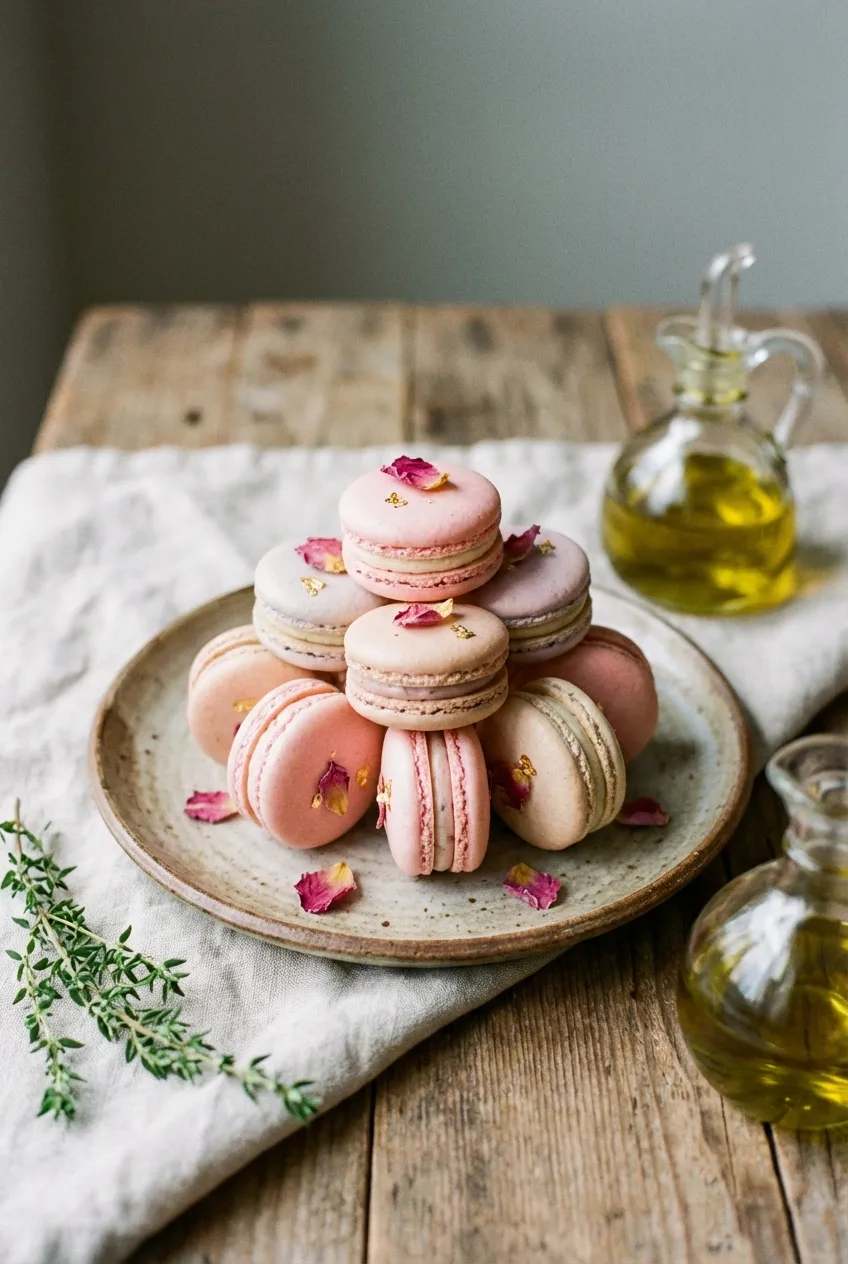
There’s something uniquely special about making macarons from scratch. I recently baked a batch of these rose petal macarons for a spring garden party, and their delicate floral flavor was the perfect fit for the occasion. They are as beautiful as they are delicious, with a crisp shell and a soft, chewy interior that melts in your mouth. Julia’s note: I prefer a very subtle floral taste, so I stick to exactly one teaspoon of rose water, but you can adjust slightly to your preference.
While macarons have a reputation for being tricky, this recipe breaks down the process into clear, manageable steps. We’ll focus on the key techniques, from whipping a stable meringue to mastering the macaronnage, to ensure you get great results. This is a wonderfully rewarding project for a weekend, and the finished macarons make an elegant gift or dessert for any celebration.
Perfect Macaron Shells Every Time
The foundation of a great macaron is a perfect meringue. This requires clean, grease-free equipment, as any fat can prevent your egg whites from whipping to their full volume. Start with room-temperature egg whites, which whip up more easily than cold ones. As you whisk, add the granulated sugar gradually. This helps dissolve the sugar completely and stabilizes the egg white foam, leading to the stiff, glossy peaks needed for a strong macaron structure. When you lift the whisk, the peak should hold its shape without drooping.
Mastering the Macaronnage Technique
Macaronnage is the French term for folding the dry ingredients into the meringue, and it’s the most crucial step for achieving that signature smooth top and ruffled “feet.” The goal is to deflate the meringue just enough so the batter flows slowly and smoothly, often described as a “lava-like” consistency. Use a spatula to scrape around the bowl and cut through the middle. To test it, lift your spatula; the batter should fall off in a continuous, thick ribbon that slowly melts back into the batter within about 20-30 seconds. Under-mixing leaves the shells lumpy and hollow, while over-mixing causes them to spread and crack.
Exploring Rose Flavor Variations
The delicate flavor of rose water can transform these macarons, but it’s important to strike the right balance. Too little and the flavor is lost; too much and it becomes soapy. For a more complex floral note, you can pair the rose water with a tiny drop of pure vanilla or almond extract in the buttercream filling. This can round out the flavor and keep it from being one-dimensional. When selecting a rose water, look for one made from distilled rose petals for the purest, most authentic taste. Always add flavorings at the end of mixing to avoid disrupting the meringue’s structure.
Recipe Overview
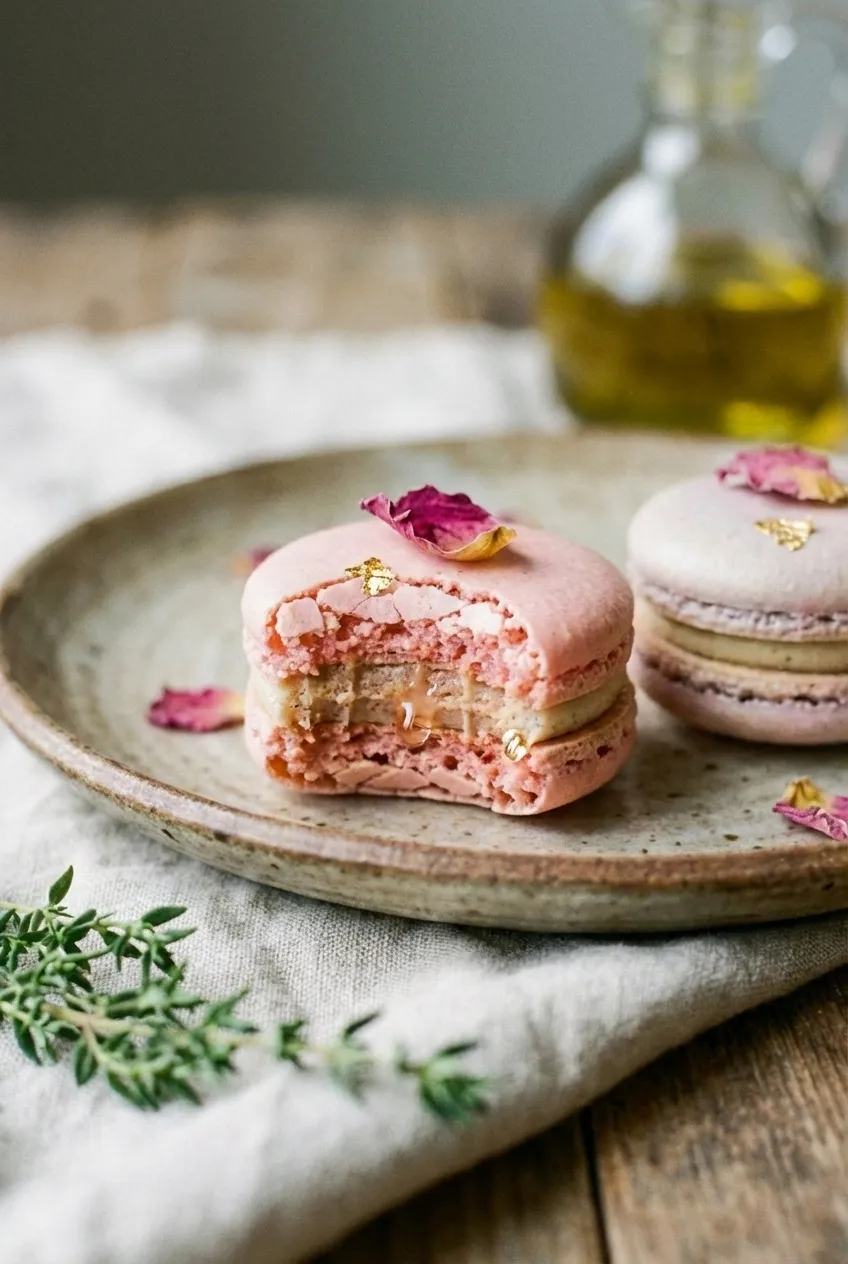
- Prep Time: 30 minutes
- Cook Time: 15 minutes
- Total Time: 1 hour
- Servings: 24 macarons
- Difficulty: Advanced
Ingredients
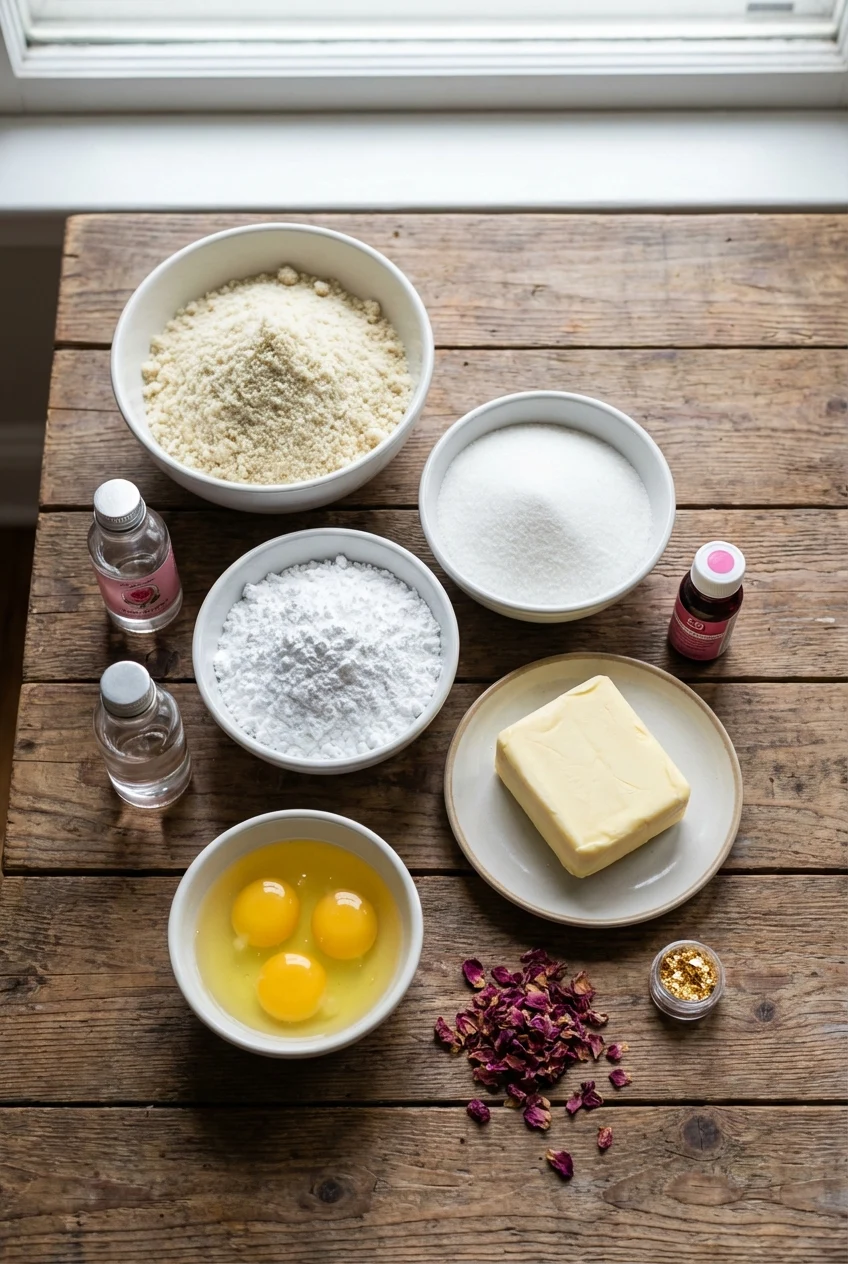
For the Macaron Shells
- 175g (1 3/4 cups) finely ground almond flour
- 125g (1 1/4 cups) powdered sugar
- 90g (3 large) egg whites, at room temperature
- 50g (1/4 cup) granulated sugar
- 5g (1 tsp) rose water
- A few drops pink gel food coloring (optional)
For the Rose Buttercream
- 113g (1/2 cup) unsalted butter, softened
- 100g (1 cup) confectioners’ sugar
- A few drops of rose water, to taste
For Garnish
- 5g (1/4 cup) edible rose petals
- Gold flakes (optional)
Step-By-Step Instructions
- Prepare Dry Ingredients
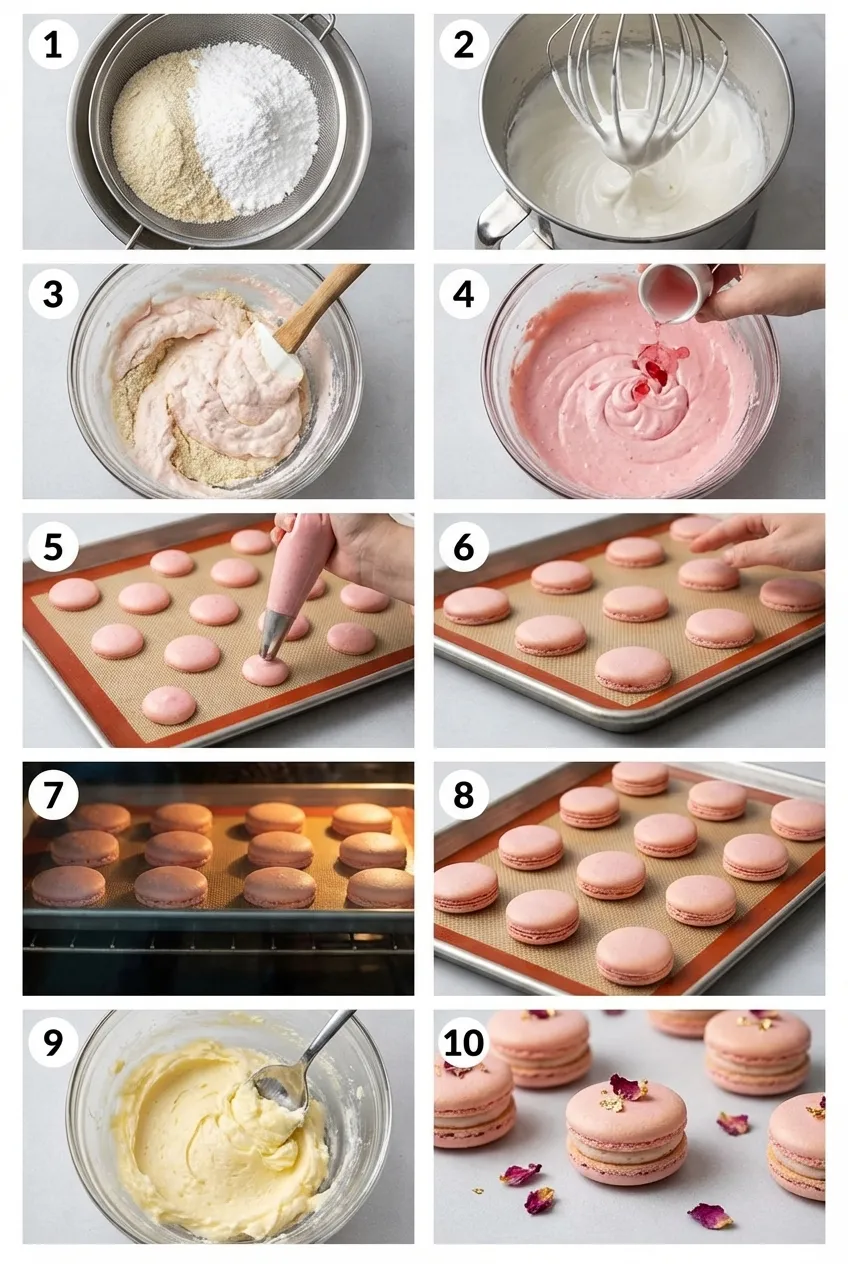
Sift the almond flour and powdered sugar together into a large bowl. Sifting is essential for removing any lumps, which ensures a smooth, light macaron shell. Set the mixture aside.
- Make Meringue
In the clean bowl of a stand mixer fitted with the whisk attachment, whisk the egg whites on medium speed until frothy. Gradually add the granulated sugar while mixing, then increase the speed to high. Continue to whisk for about 5 minutes, or until the meringue is glossy and forms stiff peaks.
- Incorporate Dry Ingredients
Add one-third of the almond flour mixture to the meringue and gently fold it in with a spatula. Add the remaining dry ingredients in two more stages, folding until just combined. The goal is to incorporate the flour without deflating too much air.
- Add Flavor and Color
Fold in the rose water and a few drops of pink gel food coloring, if using. Continue the macaronnage process, folding the batter until it flows from the spatula like a thick ribbon or lava. Be careful not to overmix.
- Pipe Macarons
Transfer the batter to a piping bag fitted with a small round tip (about 1/2-inch). Line a baking sheet with a silicone mat or parchment paper. Pipe 1.5-inch circles about 1 inch apart. Tap the baking sheet firmly on the counter a few times to release any air bubbles.
- Rest and Preheat
Let the piped macarons rest at room temperature for 30-60 minutes, until they form a dry skin on top. They should not feel sticky to the touch. While they rest, preheat your oven to 300°F (150°C).
- Bake
Bake for 15-18 minutes, rotating the pan halfway through. The macarons are done when the tops are firm and the “feet” are well-developed and don’t jiggle when you gently nudge a shell. Let them cool completely on the baking sheet before removing.
- Prepare Rose Filling
In a medium bowl, use an electric mixer to cream the softened butter until smooth. Gradually beat in the confectioners’ sugar until light and fluffy. Add a few drops of rose water to taste. If the filling is too thick, add a drop of milk; if too thin, add more sugar.
- Fill Macarons
Pair up cooled macaron shells by size. Pipe a small amount of the rose buttercream onto the flat side of one shell and gently sandwich it with its partner, pressing just enough to spread the filling to the edge.
- Decorate
Garnish the filled macarons with edible rose petals and a few gold flakes for an elegant finish. For the best flavor and texture, let the filled macarons mature in the refrigerator for 24 hours before serving.
If you enjoy this dish, try our Spring Berry Chocolate Tart for a perfect pairing or next-weeknight option.
Substitutions & Variations
- Floral Waters: Replace the rose water with lavender water or orange blossom water for a different floral profile.
- Natural Color: A tiny amount of beet powder can be used in place of gel coloring for a natural pink hue, but add it with the dry ingredients.
- Chocolate Drizzle: For extra flair, melt white chocolate and drizzle it over the finished macarons before the garnish sets.
Make-Ahead, Storage & Reheat
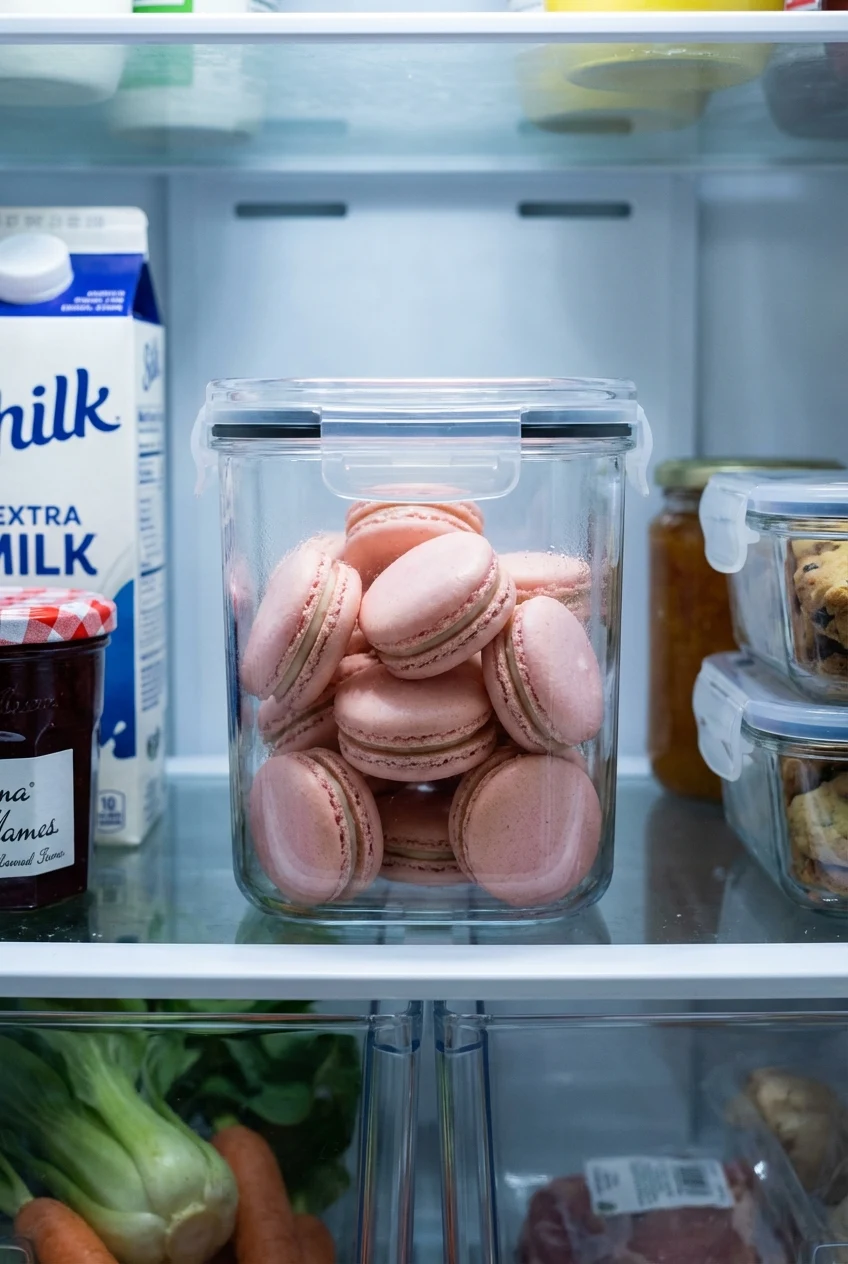
Store filled macarons in an airtight container in the refrigerator for up to four days. Their flavor and texture actually improve after maturing for a day. Bring them to room temperature for about 20-30 minutes before serving for the best texture.
Nutrition
- Serving Size: 1 macaron (one sandwich cookie)
- Per Serving: 90 calories, 4g fat, 2g protein, 11g carbs
- Per 100g: 390 calories, 17g fat, 8g protein, 44g carbs
Estimates only.
FAQ
Why do my macaron shells crack on top during the baking process?
Cracks often happen if the batter isn't rested long enough to form a dry skin, which protects the tops from expanding too fast in the oven's heat.
What is the primary cause of hollow macaron shells with a large gap?
Hollows usually point to an over-whipped meringue that's too airy or an oven that's too hot, causing the shells to rise and set before the inside bakes.
How do I know if the batter is mixed enough for perfectly smooth shells?
The batter is ready when it flows from the spatula in a slow, continuous ribbon that can form a figure-eight, which shows it has the right consistency.
What is the best way to tell when the macaron shells are fully baked?
They're done when the tops are firm and the 'feet' don't wiggle when you gently nudge a shell, indicating the interior structure is set and won't collapse.
Why are my macarons lopsided or have feet that spread out unevenly?
This is often caused by uneven piping or not tapping the tray firmly enough to release trapped air bubbles, which can push the batter sideways as it bakes.
Does the type of almond flour I use really make that much of a difference?
Yes, a super-fine, blanched almond flour is best. Coarser or oily flours can create bumpy shells and may disrupt the delicate meringue structure during mixing.
Is it possible to make successful macarons on a very humid or rainy day?
It's challenging because high humidity prevents the shells from forming a protective skin. Using a dehumidifier or air conditioner can help create a drier environment.
Is it better to freeze empty macaron shells or the finished, filled macarons?
You can do either. Freezing empty shells in an airtight container preserves their texture best. Filled macarons also freeze well and will be ready to thaw and serve.
Can I make the meringue properly with a hand mixer instead of a stand mixer?
A hand mixer works well, but it will take more time and patience to whip the egg whites to stiff, glossy peaks. Just be sure not to stop whipping too early.
Equipment
- Large mixing bowl
- Stand mixer with whisk attachment
- Silicone baking mat or parchment paper
- Piping bag with 1/2-inch round tip
- Medium mixing bowl
- Electric mixer
Ingredients
- For the Macaron Shells
- 175 g Finely ground almond flour
- 125 g Powdered sugar
- 90 g Egg whites room temperature (about 3 large eggs)
- 50 g Granulated sugar
- 5 g (1 tsp) Rose water
- a few drops Pink gel food coloring (optional)
- For the Rose Buttercream
- 113 g (1/2 cup) Unsalted butter softened
- 100 g (1 cup) Confectioners’ sugar
- a few drops Rose water to taste
- For Garnish
- 5 g (1/4 cup) Edible rose petals
- a few flakes Gold flakes (optional)
Instructions
- Sift almond flour and powdered sugar together into a large bowl and set aside.
- Whisk egg whites in a clean stand mixer bowl at medium speed until frothy; gradually add granulated sugar and whisk on high until stiff, glossy peaks form about 5 minutes.
- Fold one-third of almond flour mixture gently into meringue using a spatula; repeat with remaining dry ingredients in two additions, folding until just combined to avoid air deflation.
- Fold in rose water and optional pink gel food coloring; continue folding to a thick ribbon or lava-like batter flow consistency without overmixing.
- Transfer batter to a piping bag fitted with a 1/2-inch round tip; pipe 1.5-inch circles about 1 inch apart on a baking sheet lined with silicone mat or parchment.
- Tap the baking sheet firmly on the counter to release air bubbles and let macarons rest at room temperature for 30-60 minutes until a dry skin forms and surface is not sticky.
- Preheat oven to 300°F (150°C); bake macarons for 15-18 minutes, rotating pan halfway, until tops are firm and feet are well developed without jiggle.
- Cool macarons completely on the baking sheet before removing.
- To prepare filling, cream softened butter with electric mixer until smooth; gradually beat in confectioners’ sugar until light and fluffy, then add rose water to taste; adjust thickness with milk or sugar as needed.
- Pair cooled macaron shells by size; pipe rose buttercream onto one shell and sandwich with the other, pressing gently to spread filling to edges.
- Decorate filled macarons with edible rose petals and optional gold flakes; refrigerate for 24 hours to mature flavor and texture before serving.
