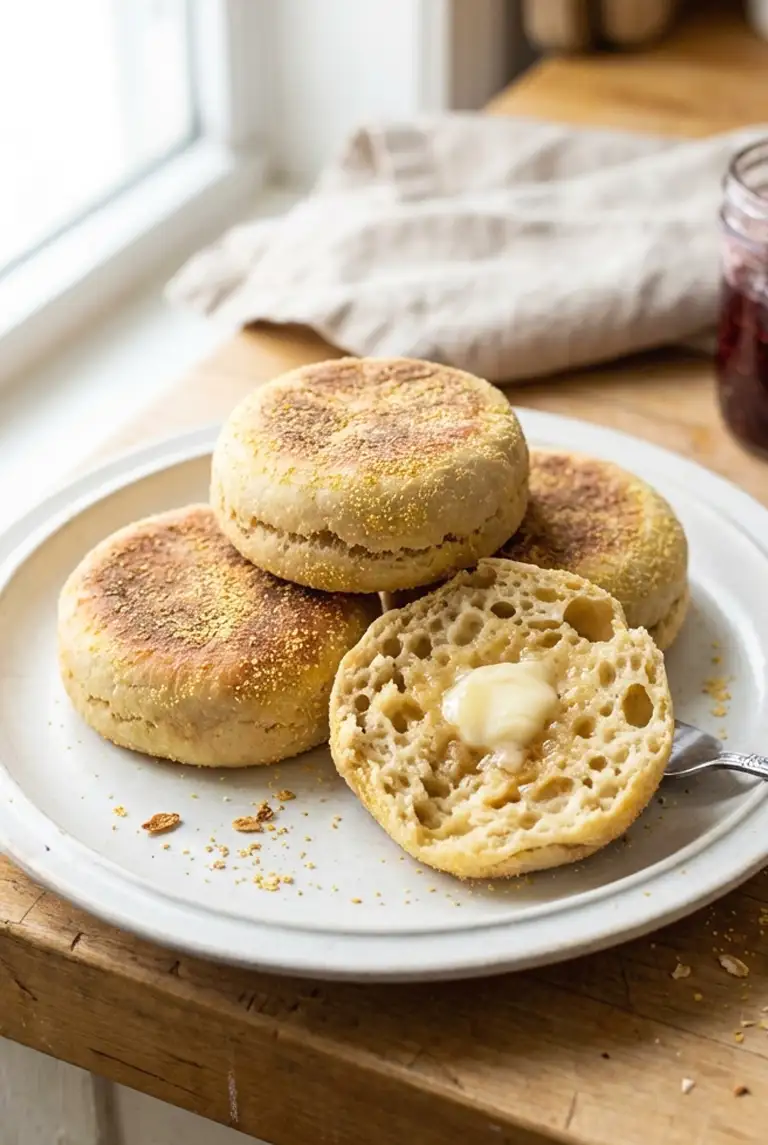
The first time I tested these, I cooked them the way I’d cook pancakes: hotter pan, quicker finish, done when the outside looked right. That gave me English muffins with browned tops and centers that still felt damp and slightly gummy. The fix was less dramatic than I expected—lower heat, a softer dough, and more patience once they hit the skillet.
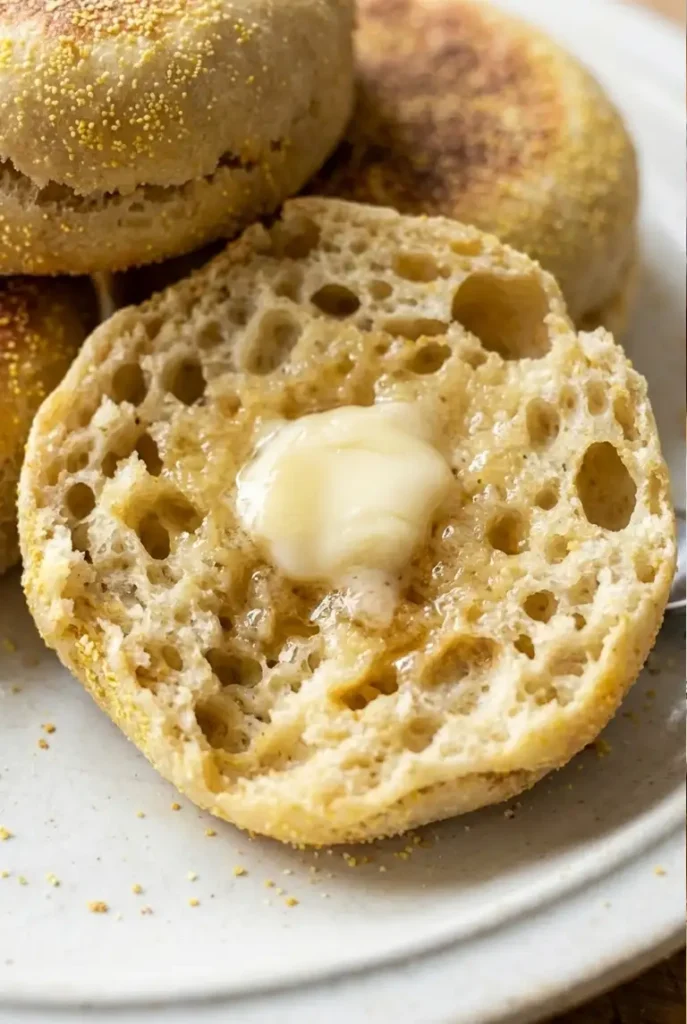
That slower cook is what gives them the texture people actually want from an English muffin. When you split one open with a fork, the inside should tear into rough ridges and little pockets instead of slicing cleanly like sandwich bread. The crumb stays chewy without turning heavy, the outside gets that light cornmeal grit, and once toasted, the edges crisp properly while the middle stays tender.
Why These Stay Light Inside Instead of Flat and Bready
- The dough stays slightly tacky, which helps create a lighter interior instead of a tight, dry crumb.
- A full second rest gives the cut rounds time to puff before they ever hit the skillet, so the centers cook more evenly.
- Moderate heat matters more than people expect. It lets the crust form gradually while the inside has time to set.
- Fork-splitting at the end preserves the rough interior ridges that make English muffins toast the way they should.
How to Make Sourdough Discard English Muffins
- 3/4 cup warm milk (180g), heated to 100 to 110°F
- 1 tablespoon sugar
- 2 1/4 teaspoons active dry yeast
- 1/2 cup sourdough discard (120g)
- 3 tablespoons unsalted butter (40g), melted
- 1 large egg (50g)
- 3 cups all-purpose flour (360g)
- 1 teaspoon salt
- Cornmeal, for dusting
- Oil or butter, for the skillet
How to make sourdough discard English muffins on a skillet
What the dough should look like after mixing
- In a large bowl, combine the warm milk, sugar, and yeast. Let it sit for 5 to 10 minutes, until it looks foamy on top.
- Add the sourdough discard, melted butter, and egg. Whisk until mostly smooth.
- Add the flour and salt. Stir until a shaggy dough forms. It should look sticky and a little rough at this stage, not dry or stiff. Hold off on extra flour unless the dough is truly unworkable.
Knead and let the dough rise
- Turn the dough out onto a lightly floured surface and knead for 6 to 8 minutes. It should become more cohesive and elastic, though still slightly tacky. It does not need to be perfectly smooth like sandwich bread dough.
- Place the dough in a lightly greased bowl, cover, and let it rise for 1 to 1 1/2 hours, or until puffed and roughly doubled. A lightly pressed fingertip should leave a slow-filling indent.
How to shape English muffins without overworking the dough
- Dust a baking sheet or tray with cornmeal.
- Turn the risen dough onto a lightly floured surface. Gently pat it out to about 3/4 inch thick.
- Cut rounds with a biscuit cutter or glass about 3 inches wide. Gather the scraps gently and cut more as needed.
- Place the rounds on the cornmeal-dusted tray, then dust the tops lightly with more cornmeal. Cover loosely and let rest for 30 to 40 minutes, until they look slightly swollen and lighter, not flat and tight.
How to cook English muffins without burning the outside
- Heat a cast-iron skillet or heavy pan over low to low-medium heat. Grease lightly with oil or butter. The pan is ready when a drop of water softly sizzles instead of snapping hard.
- Cook the muffins in batches for 5 to 7 minutes per side. The first side should become deep golden, not dark brown. If they color in under 5 minutes, the heat is too high.
- Flip and cook the second side for another 5 to 7 minutes. If your muffins are thick or your skillet heats unevenly, cover loosely for part of the cooking time to help the centers cook through.
How to tell when skillet English muffins are fully cooked
- The muffins should feel springy, not squishy, when pressed lightly in the center. If you want to check with a thermometer, the middle should be around 200°F.
- Transfer to a rack and cool completely. Don’t split them while hot; trapped steam will compress the crumb and make the inside look damp.
How to split English muffins for the best texture
- Use the tines of a fork to go around the middle edge of each muffin, then pry it open gently. That rough split keeps the pockets and ridges intact much better than a knife.
If you’re looking for another easy breakfast idea, my Sourdough Discard Waffles are a practical way to use up the rest of your starter.
Tips for English muffins with better nooks and crannies
- Keep the dough a little soft. A drier dough gives you a tighter, more bread-like interior.
- Don’t skip the second rise. The shaped rounds need that bench rest to relax and puff.
- Cook them more slowly than instinct tells you. The center needs time to set before the crust gets too dark.
- Always fork-split after cooling. That’s what gives you the rough interior that toasts so well.
Variations Worth Trying
Sourdough discard English muffins with honey
Replace the sugar with 1 tablespoon honey. If the dough feels looser than usual, reduce the milk by 1 tablespoon. This version browns faster, so keep a close eye on the skillet heat. The flavor comes out a little rounder and softer, especially if you’re eating these with butter or peanut butter.
Sourdough discard English muffins with fresh milled flour
Replace 25 to 50% of the all-purpose flour with fresh milled wheat flour. Let the mixed dough rest for 15 minutes before kneading so the bran can hydrate. Expect the dough to absorb a little more liquid and the final crumb to be slightly denser. I would not start with 100% fresh milled flour here unless you already bake with it often and know how thirsty your flour runs.
How to store, freeze, and reheat English muffins
Store cooled English muffins in an airtight container at room temperature for up to 2 days, or refrigerate for up to 5 days.
For longer storage, freeze them split or whole in a freezer bag for up to 2 months. If you freeze them whole, thaw before splitting. If already split, they can go straight into the toaster.
To reheat, toast until the cut sides are crisp and the center is warmed through. That brief drying in the toaster brings back the contrast between the crisp edges and tender interior.
If you want another fast savory breakfast option, this Quick and Cheesy Breakfast Quesadilla is a good one to keep in rotation.
Troubleshooting sourdough discard English muffins
Why are my sourdough discard English muffins dense instead of airy?
Usually because the dough was too dry, under-risen, or handled too firmly during shaping. The dough should stay a little tacky, and the cut rounds should look slightly puffy before cooking.
Why are my English muffins browned outside but still gummy in the middle?
The skillet was too hot. The outside colored before the center had time to cook through. Lower the heat and, if needed, loosely cover the pan for part of the cooking time.
Can I make sourdough discard English muffins without rings?
Yes. This dough is sturdy enough to cut and cook without English muffin rings. Just keep the dough thickness even so they cook at the same rate.
Can I use frozen or older sourdough discard in this recipe?
Yes, as long as it smells normal and not rotten. Thaw frozen discard fully and stir it before using. Older discard usually tastes sharper, which makes the tang more noticeable in the finished muffins.
Sourdough Discard English Muffin FAQs
Do I have to use cornmeal?
No, but it helps. Cornmeal keeps the dough from sticking to the tray and gives the outside that familiar dry, lightly crisp finish. Semolina also works.
Can I make the dough ahead?
Yes. After kneading, cover the bowl and refrigerate the dough overnight. Let it sit out the next day long enough to lose some chill, then shape, rest, and cook.
Why should I fork-split instead of using a knife?
A knife cuts the crumb cleanly. A fork tears it open into uneven ridges, which gives you more surface area for toasting and better pockets for butter.
Can I toast these straight from frozen?
Yes, if they’re already split. Toast them a little longer than usual so the center heats through before the edges get too dark.
Nutrition
- Serving size: 1 English muffin
- Calories: 221 kcal
- Protein: 7g
- Fat: 5g
- Carbohydrates: 36g
- Per 100g: Calories 267 kcal, Protein 8g, Fat 6g, Carbohydrates 44g.
These values are approximate and will vary based on ingredient brands and final yield.
Sourdough Discard English Muffins
Equipment
- Large bowl
- Whisk
- Biscuit cutter or glass
- Cast-iron skillet or heavy pan
- Baking sheet or tray
- Fork
- Cooling rack
Ingredients
- 3/4 cup warm milk (180g), heated to 100 to 110°F
- 1 tablespoon sugar
- 2 1/4 teaspoons active dry yeast
- 1/2 cup sourdough discard (120g)
- 3 tablespoons unsalted butter (40g), melted
- 1 large egg (50g)
- 3 cups all-purpose flour (360g)
- 1 teaspoon salt
- Cornmeal, for dusting
- Oil or butter, for the skillet
Instructions
- Combine warm milk, sugar, and yeast in a large bowl; let sit 5-10 minutes until foamy.
- Add sourdough discard, melted butter, and egg; whisk until mostly smooth.
- Add flour and salt; stir until a shaggy, slightly sticky dough forms.
- Turn dough onto floured surface and knead 6-8 minutes until cohesive and elastic but still slightly tacky.
- Place dough in greased bowl, cover, and let rise 1 to 1 1/2 hours until puffed and roughly doubled.
- Dust baking sheet with cornmeal.
- Turn risen dough onto floured surface; pat to 3/4 inch thickness.
- Cut rounds about 3 inches wide with biscuit cutter or glass; gather scraps and cut more if needed.
- Place rounds on cornmeal-dusted tray; dust tops lightly with cornmeal, cover loosely, and rest 30-40 minutes until slightly swollen and lighter.
- Heat cast-iron skillet over low to low-medium heat; grease lightly with oil or butter. Pan is ready when a drop of water softly sizzles.
- Cook muffins in batches 5-7 minutes per side; first side should be deep golden, not dark brown.
- Flip and cook second side 5-7 minutes, covering loosely if needed for even cooking of centers.
- Muffins are done when springy but not squishy; internal temp about 200°F if checked.
- Transfer to cooling rack and cool completely before splitting.
- Split muffins with fork tines to preserve rough interior for best texture and toasting.
