

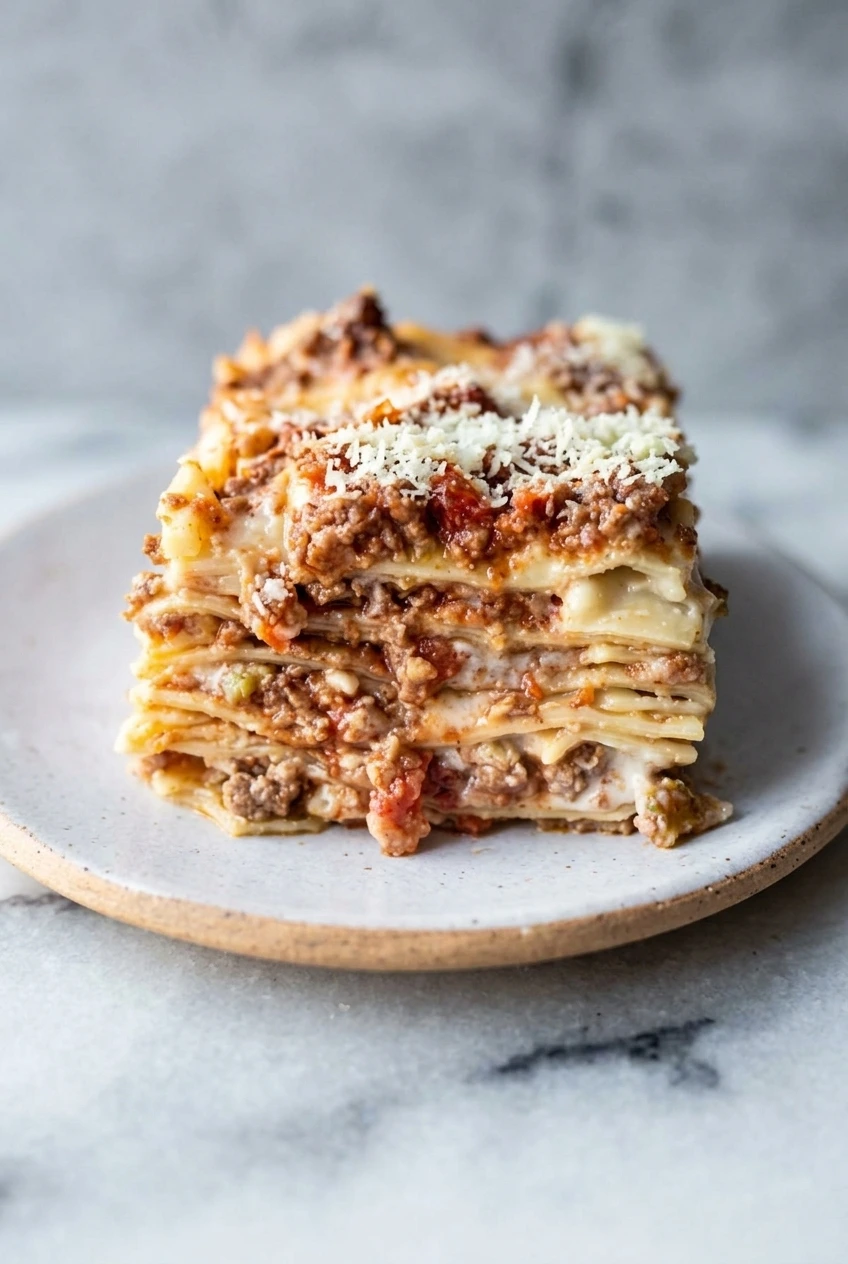
Lasagna Bolognese with Béchamel Sauce
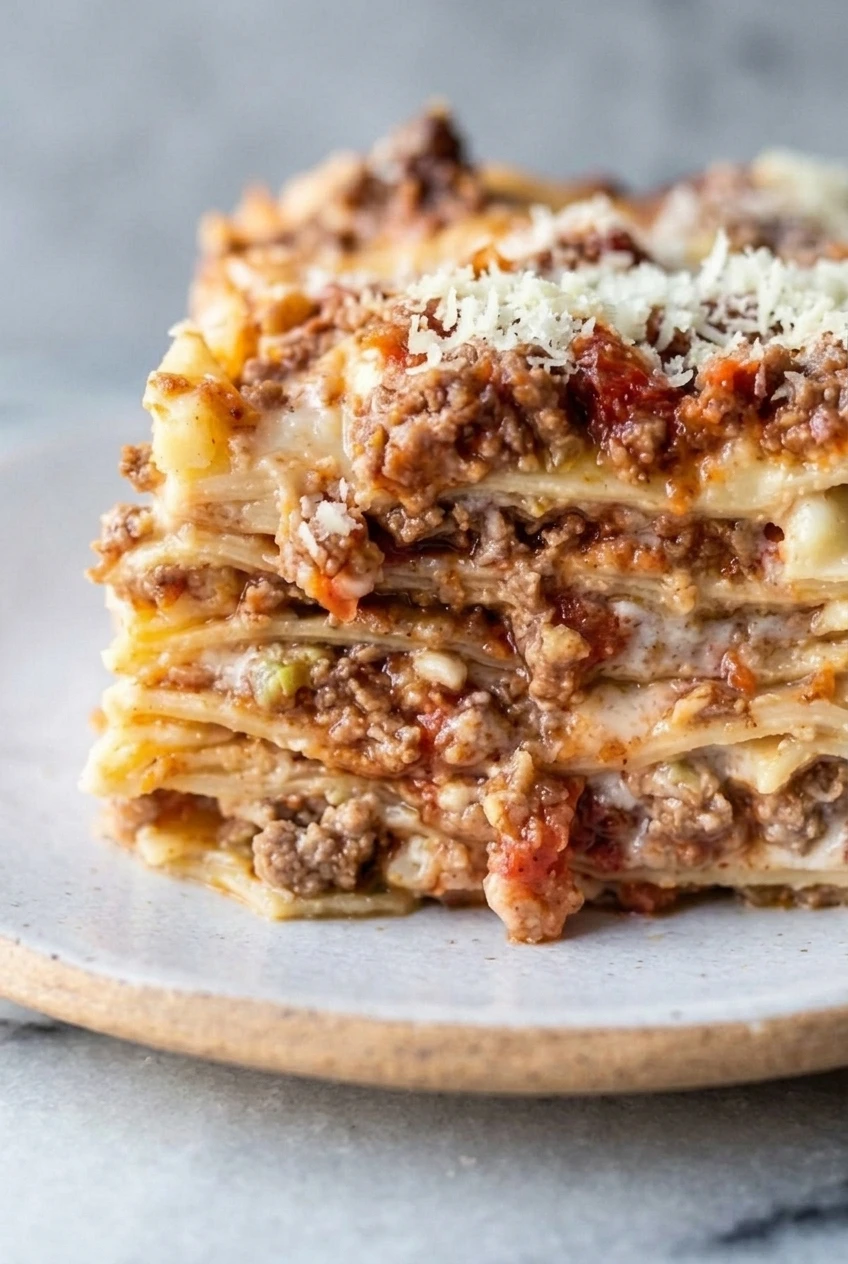
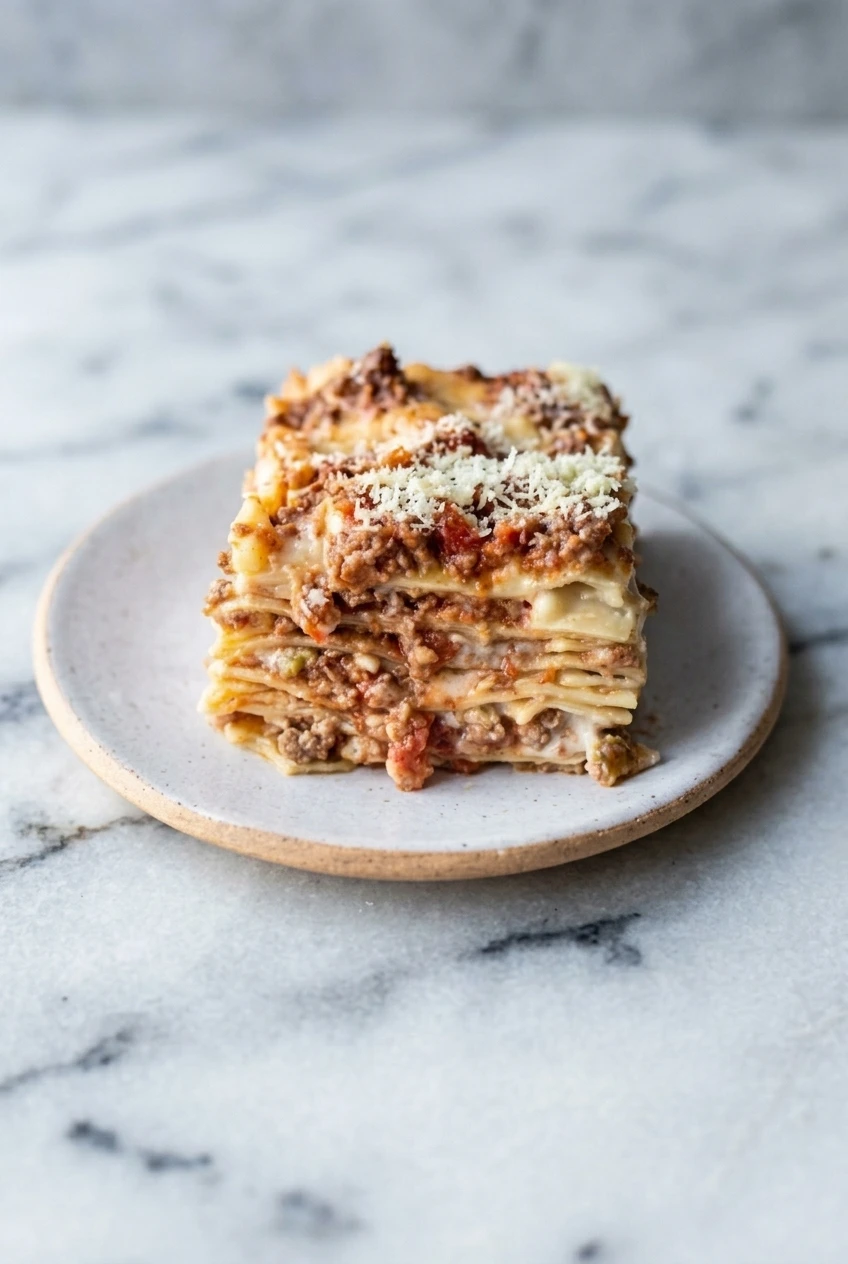
Thin sheets of fresh pasta separate beef-and-pork ragù from creamy béchamel in this Parmesan-topped lasagna. There’s no ricotta or mozzarella: the sauces stay in distinct layers, and the top browns in the oven. For slices that hold together, simmer the ragù until it’s thick but moist, spread the sauces thinly, and let the baked lasagna rest before cutting. The ragù and béchamel can be made ahead to make assembly easier.
Ingredients
Makes 8 to 10 servings.
- 4 ounces pancetta, finely diced (115g)
- 1 tablespoon olive oil
- 1 medium yellow onion, finely diced (150g)
- 1 medium carrot, finely diced (75g)
- 1 rib celery, finely diced (50g)
- 1 pound ground beef (450g)
- 8 ounces ground pork (225g)
- 2 tablespoons tomato paste (30g)
- 1 cup dry white wine
- 1 can (28 ounces) crushed tomatoes (about 800g)
- 1 cup whole milk, for the ragù
- 6 tablespoons unsalted butter (85g)
- ½ cup all-purpose flour (60g)
- 5 cups whole milk, warmed, for the béchamel
- ⅛ teaspoon freshly grated nutmeg
- 2 cups finely grated Parmesan or Parmigiano-Reggiano, divided (200g)
- About 1 pound fresh egg lasagna sheets (450g)
- Fine salt, for the ragù, béchamel, and pasta water
- Black pepper, to taste
Red wine can replace the white wine in the ragù. An extra light sprinkle of Parmesan is optional at serving.
How to Make Lasagna Bolognese
- Brown the meat and vegetables: In a heavy Dutch oven or large saucepan, cook the pancetta and olive oil over medium heat until the pancetta releases some fat and begins to brown. Add the onion, carrot, and celery; cook until softened. Add the beef and pork and cook, breaking them into small pieces, until no pink remains and some meat has browned, about 15 to 20 minutes total.
- Simmer the ragù: Stir in the tomato paste, then add the wine and let it reduce before adding the crushed tomatoes and 1 cup milk. Season with salt and pepper. Simmer gently over low heat, stirring occasionally, for about 1½ to 2 hours. The sauce should mound softly on a spoon rather than run like soup, but remain moist enough to spread.
- Make the béchamel: Melt the butter in a medium saucepan over medium-low to medium heat. Whisk in the flour and cook briefly, then gradually whisk in the warm milk. Whisk as the sauce thickens, about 12 to 15 minutes, until smooth and pourable. It should lightly coat a spoon and flow from a ladle. Season with salt, pepper, and nutmeg.
- Prepare the pasta: Bring a large pot of salted water to a boil. Cook the fresh sheets in batches for about 30 to 60 seconds, or according to the package directions, just until flexible. Transfer to cool water, then drain, blot, and lay them separately on clean towels or parchment. Do not stack wet sheets.
- Assemble: Preheat the oven to 350°F (175°C). Lightly grease a deep 9-by-13-inch baking dish if needed. Spread a thin layer of béchamel on the bottom. Add pasta, then thin, separate layers of ragù and béchamel, followed by Parmesan. Repeat to make about four filling layers. Finish with pasta, béchamel, and the remaining Parmesan.
- Bake: Cover loosely with foil, keeping it off the topping, and bake for 20 to 25 minutes. Uncover and bake for about 15 to 20 minutes more. Start checking at 35 minutes: the edges should bubble, the center should be hot, a knife should pass through the pasta with little resistance, and the top should be golden with deeper browned spots. If the top browns before the center is hot, keep it covered longer.
- Rest and serve: Let the lasagna rest in the dish for at least 25 minutes so the layers settle. Cut square portions with a sharp knife and lift them with a spatula. Serve each slice upright to show the pasta, ragù, and béchamel layers.
Choosing and Preparing the Pasta Sheets
This method uses fresh egg lasagna sheets, briefly cooked until flexible rather than fully soft. Thickness varies by product, so follow the package directions if they differ. Cooling, blotting, and separating the sheets keeps them from sticking or tearing during assembly.
Dried and no-boil noodles need different preparation and may need a different bake schedule. Do not use the fresh-pasta timing unchanged.
Getting the Sauce Consistency Right
Ragù that runs across the dish will make the layers slippery. If yours is loose, simmer it longer so excess moisture evaporates, but stop while it is still moist and easy to spread. The béchamel should flow from a ladle while lightly coating a spoon; a stiff sauce is hard to spread in thin layers.
Make-Ahead, Storage, and Reheating
The ragù and béchamel can be made ahead and refrigerated separately for about 2 to 3 days. Press parchment or plastic wrap directly against the béchamel as it cools to limit skin formation. You can also assemble the lasagna ahead and refrigerate it; a chilled dish may need extra baking time. Check the center and pasta for doneness rather than relying only on the clock.
Cool leftover lasagna promptly and refrigerate it covered in an airtight container for up to 3 days. Reheat portions in a 325°F (165°C) to 350°F oven until hot through, covering them if the surface starts to dry. Individual portions can also be reheated in the microwave.
Assembled, unbaked lasagna and well-wrapped baked portions can be frozen, though recommended freezer storage times vary. Thaw an unbaked lasagna overnight in the refrigerator when practical, then bake until its center is hot and the edges are bubbling, allowing extra time for a cold dish.
Serving and More Pasta Dinners
Serve a square slice with a simple green salad or roasted asparagus. For a quicker skillet-style take on similar flavors, try Bowtie Pasta Lasagna. For other pasta dinners, see Creamy Sausage and Spinach Pasta or the meatless Caramelized Onion Pasta.
Nutrition
Approximate nutrition per serving, based on 1 of 9 servings: 750 calories, 39g protein, 49g fat, and 43g carbohydrates. Approximate values per 100g: 160 calories, 8g protein, 10g fat, and 9g carbohydrates. Values vary with the pasta, meat, and cheese used.
Equipment
- Dutch oven or large saucepan
- Medium saucepan
- Whisk
- Large pot
- Deep 9-by-13-inch baking dish
- Aluminum foil
Ingredients
For the Ragù
- 4 ounces pancetta, finely diced (115g)
- 1 tablespoon olive oil
- 1 medium yellow onion, finely diced (150g)
- 1 medium carrot, finely diced (75g)
- 1 rib celery, finely diced (50g)
- 1 pound ground beef (450g)
- 8 ounces ground pork (225g)
- 2 tablespoons tomato paste (30g)
- 1 cup dry white wine
- 1 can (28 ounces) crushed tomatoes (about 800g)
- 1 cup whole milk
- Fine salt, to taste
- Black pepper, to taste
For the Béchamel
- 6 tablespoons unsalted butter (85g)
- ½ cup all-purpose flour (60g)
- 5 cups whole milk, warmed
- ⅛ teaspoon freshly grated nutmeg
- Fine salt, to taste
- Black pepper, to taste
For Assembly
- About 1 pound fresh egg lasagna sheets (450g)
- 2 cups finely grated Parmesan or Parmigiano-Reggiano, divided (200g)
- Fine salt, for the pasta water
Instructions
- Cook the pancetta and olive oil in a heavy Dutch oven or large saucepan over medium heat until the pancetta releases fat and begins to brown.
- Add the onion, carrot, and celery and cook until softened. Add the beef and pork; break the meat into small pieces and cook until no pink remains and some pieces are browned, about 15 to 20 minutes total.
- Stir in the tomato paste. Add the wine and let it reduce, then stir in the crushed tomatoes and 1 cup milk. Season with salt and pepper.
- Simmer the ragù gently over low heat, stirring occasionally, for 1½ to 2 hours, until thick but still moist and spreadable.
- Melt the butter in a medium saucepan over medium-low to medium heat. Whisk in the flour and cook briefly.
- Gradually whisk in the warm milk. Cook, whisking, for 12 to 15 minutes, until smooth, pourable, and lightly coating a spoon. Season with salt, pepper, and nutmeg.
- Bring a large pot of salted water to a boil. Cook the fresh pasta sheets in batches for 30 to 60 seconds, or according to package directions, just until flexible.
- Transfer the pasta sheets to cool water, then drain and blot them. Lay them separately on clean towels or parchment.
- Preheat the oven to 350°F (175°C). Lightly grease a deep 9-by-13-inch baking dish if needed.
- Spread a thin layer of béchamel in the dish. Add pasta, then thin, separate layers of ragù and béchamel, followed by Parmesan. Repeat to make about four filling layers, then finish with pasta, béchamel, and the remaining Parmesan.
- Cover loosely with foil, keeping it off the topping. Bake for 20 to 25 minutes, then uncover and bake for about 15 to 20 minutes more, until the edges bubble, the center is hot, and the top is golden with browned spots.
- Let the lasagna rest in the dish for at least 25 minutes. Cut into portions with a sharp knife and lift with a spatula.
Tips
- Simmer the ragù until it mounds softly on a spoon but remains moist enough to spread.
- Keep the ragù and béchamel in thin, separate layers so the lasagna slices hold together.
- Cool, blot, and separate the pasta sheets to help prevent sticking and tearing.
- If the top browns before the center is hot, keep the lasagna covered longer.
- Let the lasagna rest for at least 25 minutes before cutting.
Variations
- Red Wine Ragù: Replace the dry white wine with red wine in the ragù.