

Christmas Stollen Bread
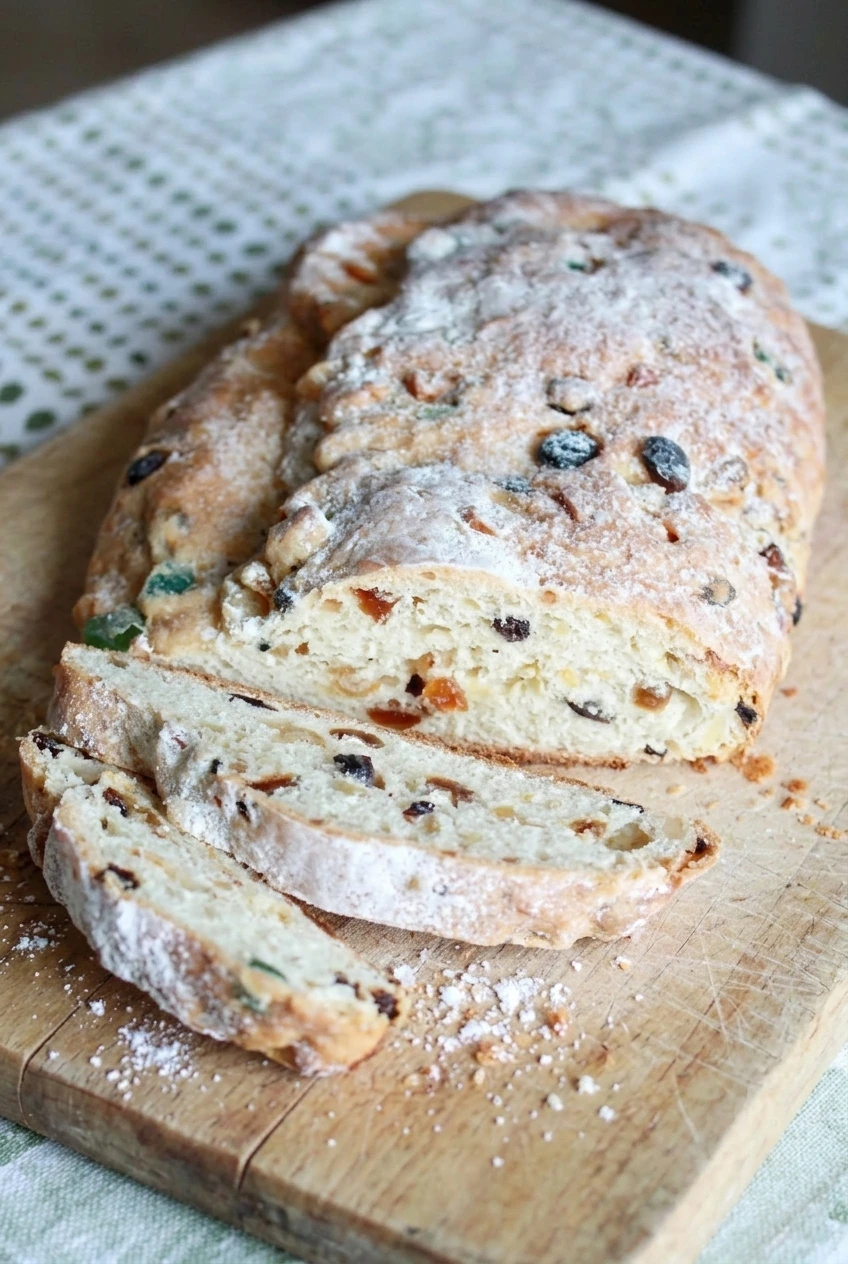
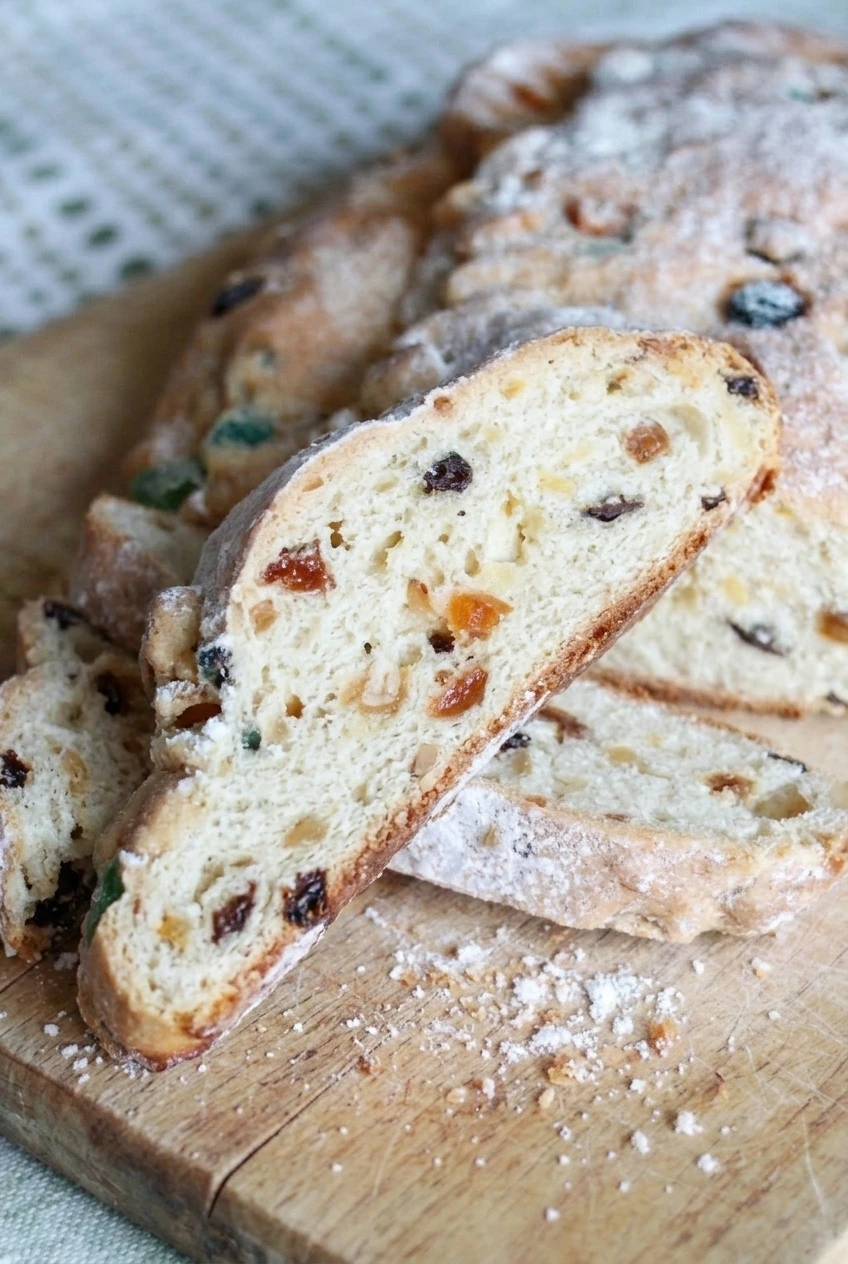
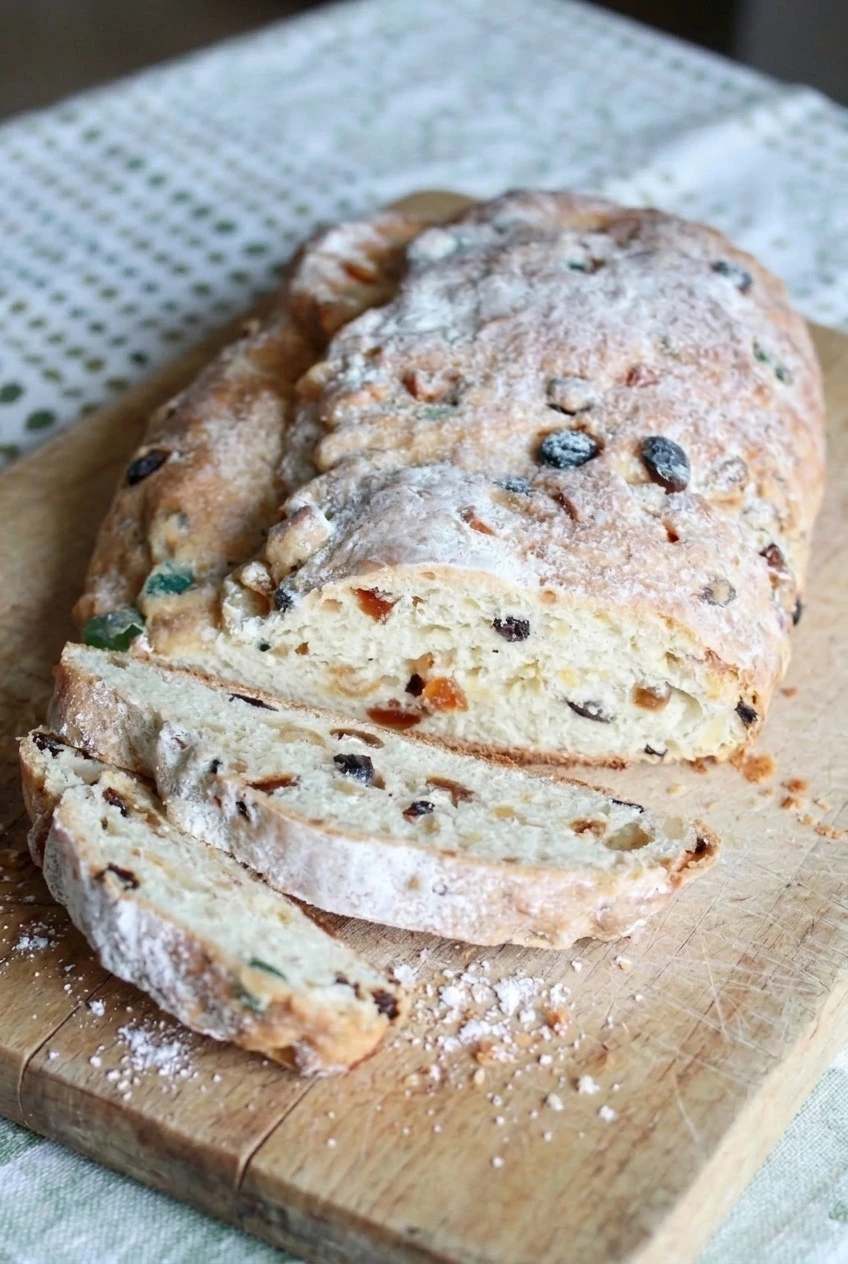
Christmas stollen is an enriched yeast bread with a tender, fruit-and-almond-studded crumb. This version makes two low, folded oval loaves with a light golden crust and a generous coating of confectioners’ sugar.
Allow time for two rises. Soak the fruit to soften it, then drain it well before folding it into the dough. Once shaped, use the loaves’ puffiness to judge the final rise and check both color and center temperature during baking—the clock alone will not tell you when they are done.
Ingredients for Christmas Stollen Bread
- 1 cup raisins (150g)
- 1/2 cup mixed candied fruit or candied citrus peel (80g)
- 1/3 cup orange juice
- 4 cups all-purpose flour, plus a little more if needed (500g)
- 2 1/4 teaspoons active dry yeast (7g)
- 3/4 cup whole milk, warm
- 1/3 cup granulated sugar (65g)
- 1/2 cup unsalted butter, softened (115g)
- 2 large eggs
- 1 teaspoon fine salt
- 1 teaspoon lemon zest
- 1/2 teaspoon ground cardamom
- 1/2 cup chopped almonds (60g)
- 4 tablespoons unsalted butter, melted, for finishing (55g)
- 1 cup confectioners’ sugar, or more as needed for coating (120g)
Optional: Replace the orange juice with 1/3 cup dark rum for soaking the fruit. For a light vanilla note, add 1 teaspoon vanilla extract with the eggs.
How to Make Christmas Stollen Bread
- Soak the fruit: Combine the raisins and candied fruit with the orange juice. Let stand for about 30 minutes, stirring once or twice. Drain thoroughly and blot dry. The fruit should be plump but not dripping; excess liquid can make the dough wet and leave damp patches in the bread.
- Mix and knead: Stir the yeast and a spoonful of the measured sugar into the warm milk; let stand until foamy. Add the remaining sugar, softened butter, eggs, salt, lemon zest, cardamom, and flour. Knead by hand or with a dough hook for 10 to 15 minutes, until smooth and elastic. The dough should be soft and slightly tacky. If it is too wet to gather and knead, add flour a tablespoon at a time.
- Let the dough rise: Cover the bowl and leave it in a warm, draft-free place until the dough has roughly doubled, about 1 to 1 1/2 hours. Enriched dough may take longer in a cool kitchen; judge it by its volume.
- Add the fruit and almonds: Gently press the dough into a broad shape. Fold in the drained fruit and almonds a little at a time, distributing them without tearing the dough. Divide into two equal portions.
- Shape the loaves: Form each portion into a broad, low oval. Make a shallow lengthwise groove slightly off center with the side of your hand or a rolling pin. Fold the smaller side over the larger side, leaving the lower edge visible, and gently press the fold to form a ridge. Avoid pressing out all the air or forcing fruit through the surface.
- Proof: Set the loaves well apart on a parchment-lined rimmed baking sheet and cover loosely. Let rise until fuller and puffy, about 30 to 45 minutes. A gentle fingertip indentation should partly spring back; if the dough deflates, it has likely proofed too long. Preheat the oven to 350°F (175°C) before baking.
- Bake: Bake uncovered for about 35 to 45 minutes, beginning to check at 35 minutes. The loaves should be light golden rather than deeply browned, with centers that reach about 190°F (90°C). Place the thermometer tip in the bread, not a piece of fruit. Rotate the sheet if browning is uneven, or tent the loaves loosely with foil if the tops color before the centers are done.
- Finish and cool: Brush the warm loaves generously with melted butter. Let it absorb briefly, then dust with confectioners’ sugar. Once the coating settles, add another light dusting if needed. Cool completely before wrapping or cutting into thick slices.
For another festive yeast bread, try Christmas Chocolate Babka.
Christmas Stollen Variations
Almond-Paste Stollen
For a filled loaf, divide about 4 ounces of almond paste or marzipan into two narrow logs. Place one along each oval before folding the dough. The main recipe has no separate filling.
Rum-Soaked Fruit
Replace the orange juice with 1/3 cup dark rum. Drain and blot the soaked fruit before adding it to the dough.
How to Serve and Store Christmas Stollen
Serve thick slices with hot cider or another warm drink. Leftover slices can be toasted. If the sugar coating has absorbed, add a fresh dusting shortly before serving.
Cool the loaves completely, then keep them covered at room temperature for up to about one week. Store cut slices in an airtight container to limit drying. For longer storage, wrap a fully cooled loaf well and freeze for up to three months. Thaw before serving and refresh the sugar coating if needed.
A thawed whole loaf can be warmed briefly in a 375°F (190°C) oven. Watch it closely so it does not dry out.
Nutrition
Approximate nutrition per slice, based on 18 slices from two loaves: 290 calories, 5g protein, 11g fat, and 44g carbohydrates. Approximate nutrition per 100g: 390 calories, 7g protein, 15g fat, and 61g carbohydrates. Values vary with slice size and the amount of confectioners’ sugar used.
Christmas Stollen Bread
Equipment
- Mixing bowl
- Stand mixer with dough hook (optional)
- Rimmed baking sheet
- Parchment paper
- Kitchen thermometer
Ingredients
For the fruit
- 1 cup raisins (150 g)
- 1/2 cup mixed candied fruit or candied citrus peel (80 g)
- 1/3 cup orange juice, or dark rum as an optional substitute
For the dough
- 4 cups all-purpose flour, plus a little more if needed (500 g)
- 2 1/4 teaspoons active dry yeast (7 g)
- 3/4 cup warm whole milk
- 1/3 cup granulated sugar (65 g)
- 1/2 cup softened unsalted butter (115 g)
- 2 large eggs
- 1 teaspoon fine salt
- 1 teaspoon lemon zest
- 1/2 teaspoon ground cardamom
- 1/2 cup chopped almonds (60 g)
- 1 teaspoon vanilla extract (optional)
For finishing
- 4 tablespoons melted unsalted butter (55 g)
- 1 cup confectioners’ sugar, or more as needed (120 g)
Instructions
- Combine the raisins, candied fruit, and orange juice. Let stand for about 30 minutes, stirring once or twice. Drain thoroughly and blot dry.
- Stir the yeast and a spoonful of the measured sugar into the warm milk. Let stand until foamy.
- Add the remaining sugar, softened butter, eggs, salt, lemon zest, cardamom, and flour. Add the optional vanilla, if using.
- Knead by hand or with a dough hook for 10 to 15 minutes, until smooth and elastic. If the dough is too wet to gather and knead, add flour a tablespoon at a time.
- Cover the bowl and let the dough rise in a warm, draft-free place until roughly doubled, about 1 to 1 1/2 hours.
- Gently press the dough into a broad shape. Fold in the drained fruit and almonds a little at a time, then divide the dough into two equal portions.
- Shape each portion into a broad, low oval. Make a shallow lengthwise groove slightly off center, fold the smaller side over the larger side, and gently press the fold to form a ridge.
- Place the loaves well apart on a parchment-lined rimmed baking sheet and cover loosely. Let rise until fuller and puffy, about 30 to 45 minutes. Preheat the oven to 350°F (175°C).
- Bake uncovered for about 35 to 45 minutes, checking from 35 minutes. The loaves should be light golden, with centers at about 190°F (90°C). Rotate the sheet if browning is uneven, or tent loosely with foil if the tops color too quickly.
- Brush the warm loaves generously with melted butter. Let the butter absorb briefly, then dust with confectioners’ sugar. Add another light dusting if needed after the coating settles.
- Cool completely before wrapping or slicing.
Tips
- Drain and blot the soaked fruit well so excess liquid does not make the dough wet.
- Judge the first rise by the dough’s volume; enriched dough may take longer in a cool kitchen.
- Fold in the fruit and almonds gently to avoid tearing the dough.
- Check the center temperature and color rather than relying on the baking time alone.
- Place the thermometer tip in the bread, not in a piece of fruit.
Variations
- Almond-Paste Stollen: Divide about 4 ounces of almond paste or marzipan into two narrow logs. Place one along each oval before folding the dough.
- Rum-Soaked Fruit: Replace the orange juice with 1/3 cup dark rum, then drain and blot the fruit before adding it to the dough.