

Vegetarian Charcuterie Board
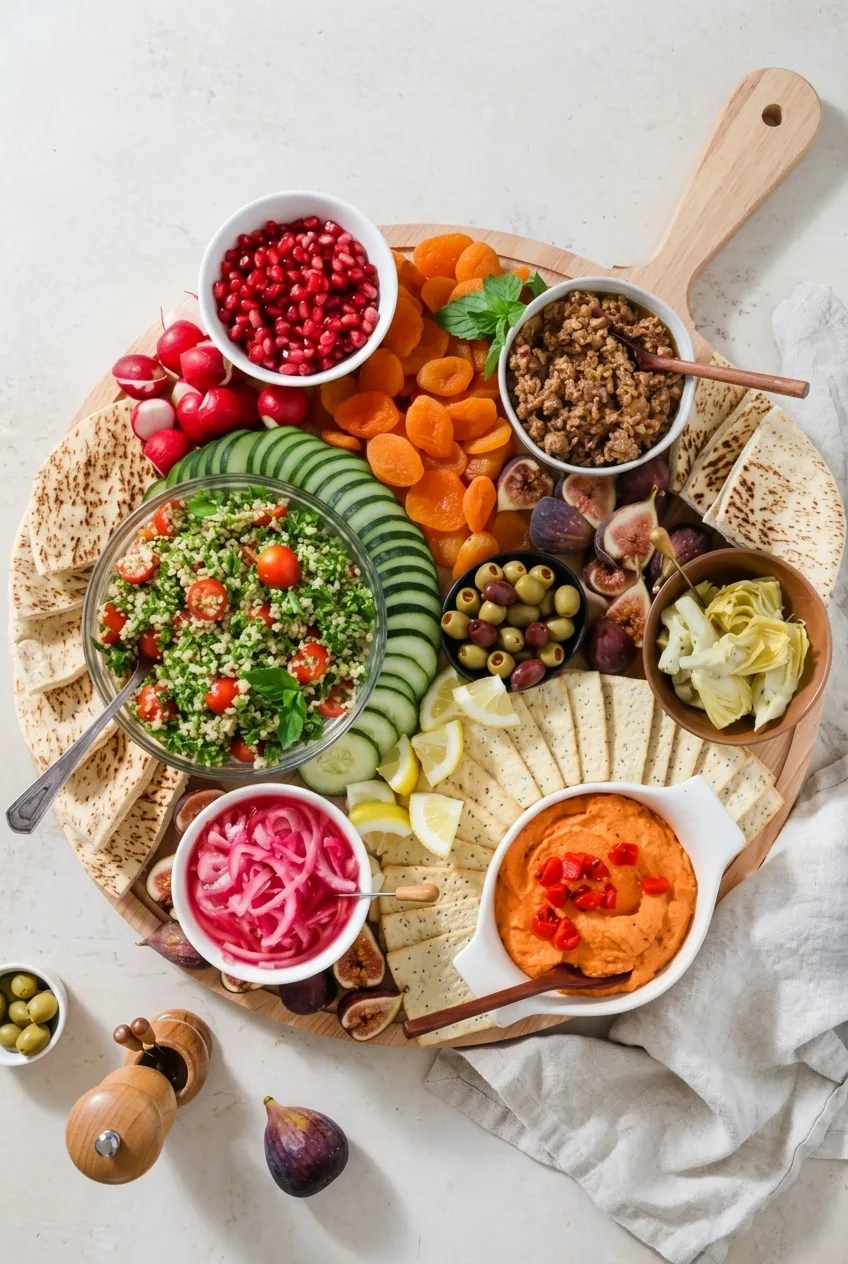
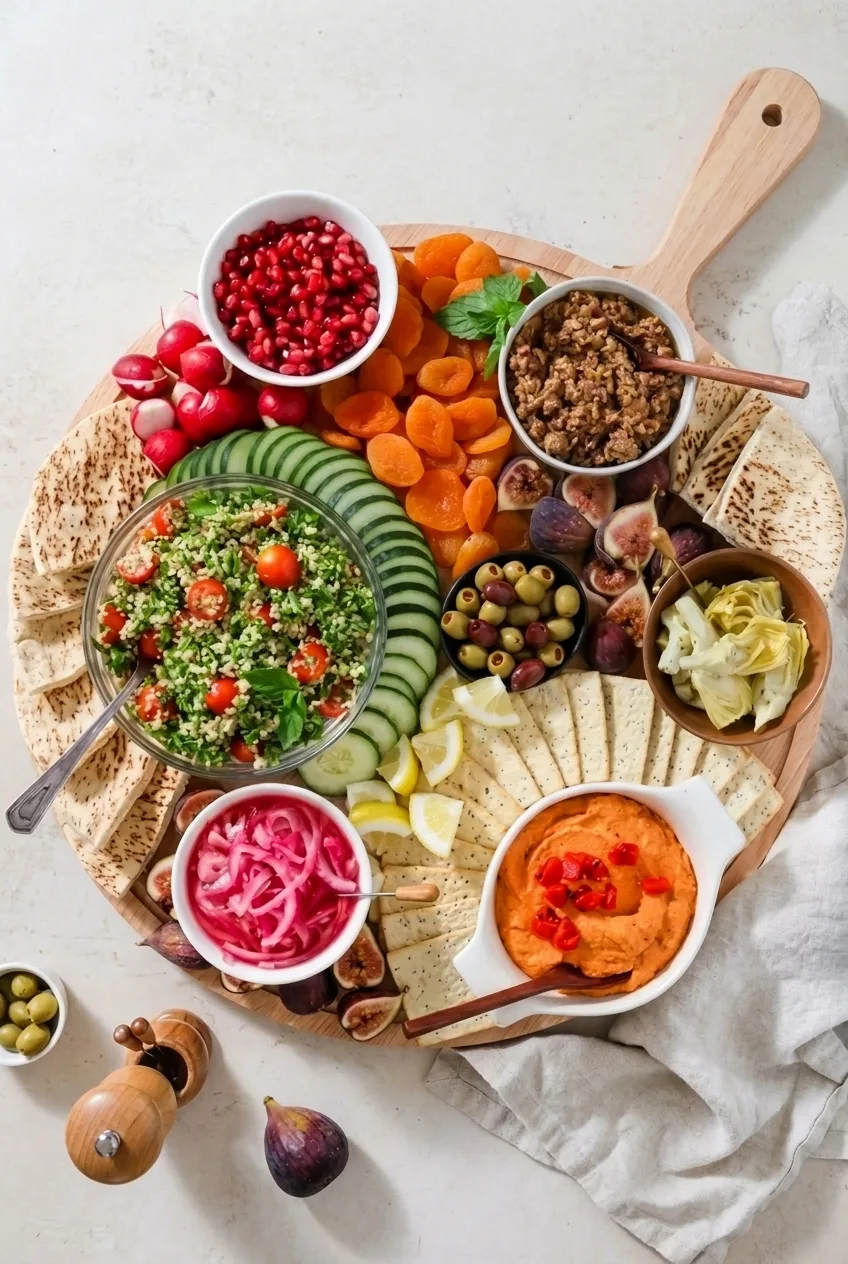
Tabbouleh and roasted red pepper hummus anchor this Mediterranean-inspired vegetarian charcuterie board. Cucumber, radishes, fruit, pita, crackers, olives, and artichokes fill out the round platter without cheese or meat substitutes.
The key is to set out seven bowls first, then arrange the dippers and produce around them. Bowls contain the moist ingredients, while separate pita and cracker clusters stay easy to reach. Assembly takes about 25 minutes and serves eight as an appetizer.
Ingredients for the Board
- 2 cups prepared tabbouleh (about 400g)
- 1 1/2 cups prepared roasted red pepper hummus (about 360g)
- 2 tablespoons diced roasted red pepper
- 3/4 cup prepared pickled red onions, drained (about 90g)
- 3/4 cup pomegranate arils (about 130g)
- 3/4 cup mixed olives, drained (about 115g)
- 1 cup marinated artichoke hearts, drained (about 170g)
- 1/2 cup coarsely chopped walnuts (about 60g)
- 1 large English cucumber, thinly sliced (about 300g)
- 4 pita rounds, cut into wedges (about 240g)
- 4 ounces rectangular crackers or crispbreads (about 115g)
- 1 small bunch radishes, about 8, trimmed (about 150g)
- 1 cup dried apricots (about 130g)
- 5 or 6 fresh figs, halved (about 250g)
- 1 lemon, cut into small wedges
- 2 or 3 small fresh mint sprigs, optional
These amounts are practical estimates for a 16- to 18-inch round board. You’ll also need seven small food-safe bowls, serving spoons, and, if helpful, small tongs or picks.
How to Assemble the Vegetarian Charcuterie Board
- Prepare the components: Wash and dry the cucumber, radishes, figs, and lemon. Slice the cucumber, halve the figs, trim the radishes, and cut the lemon and pita into wedges. Drain the onions, olives, and artichokes until moist but not dripping.
- Place the seven bowls: Put the tabbouleh and hummus in two larger bowls. Fill five smaller bowls with the onions, pomegranate arils, olives, artichokes, and walnuts. Top the hummus with diced roasted red pepper. Set the bowls securely across the board, leaving room beside the tabbouleh for cucumber and along the edges for pita and crackers.
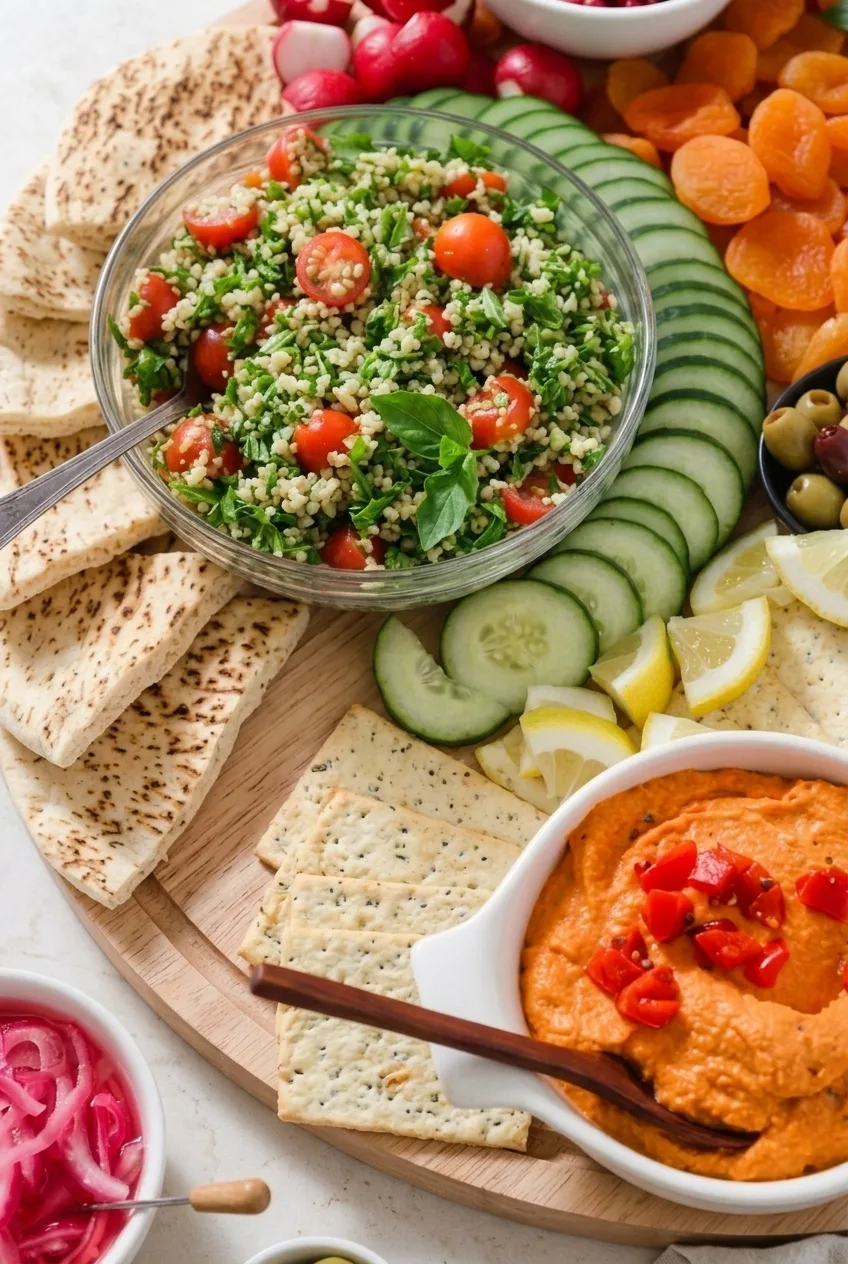
- Arrange the cucumber and dippers: Overlap the cucumber slices in a broad curve between the tabbouleh and the center of the board. Fan the pita wedges along the left side and the rectangular crackers along the lower right. Keep the crackers away from damp produce and brined foods so they stay crisp.
- Fill the open spaces: Add the radishes, dried apricots, fig halves, and lemon wedges in separate clusters. Tuck in mint, if using. Leave enough space to reach each bowl and lift a cracker without disturbing nearby food. Serve with spoons and small tongs or picks.
If the bowls crowd your board, move some components to a second platter rather than covering the cucumber arc or packing the crackers too tightly.
What to Prepare Ahead
Buy or prepare the tabbouleh, hummus, and pickled onions ahead and refrigerate them separately. Cut the pita in advance if convenient, but keep the crackers sealed and dry. Slice the figs and cucumber and assemble the board close to serving so the produce looks fresh and the crackers stay crisp. Ready-to-eat pita needs no heating.
Figs, Nuts, and Dietary Checks
If fresh figs are unavailable, use a similar-sized cluster of fresh grapes. Let guests know the board contains walnuts.
The main board has no cheese, but it is not automatically vegan: check prepared tabbouleh, hummus, pickles, pita, and crackers for animal-derived ingredients. If adding cheese to a vegetarian version, choose an animal-rennet-free variety and place it on a larger board or separate platter. For a different fruit-and-cheese format, see this summer charcuterie board.
Storing Leftovers
Refrigerate perishable leftovers promptly in airtight containers. Keep moist components separate from pita and crackers, and store crackers dry. Some components may remain suitable for up to three days, but judge each separately; cut cucumber and figs may lose quality sooner. Freezing the assembled board is not recommended.
Nutrition
Approximate nutrition per serving, based on 8 appetizer servings: 475 calories, 11g protein, 19g fat, and 69g carbohydrates. Approximate values per 100g: 145 calories, 3g protein, 6g fat, and 21g carbohydrates. Values vary with the prepared ingredients and how much of each component guests take.
Equipment
- 16- to 18-inch round serving board
- Seven small food-safe bowls
- Serving spoons
- Small tongs or picks
- Knife
- Cutting board
Ingredients
Bowls
- 2 cups prepared tabbouleh (about 400 g)
- 1 1/2 cups prepared roasted red pepper hummus (about 360 g)
- 2 tablespoons diced roasted red pepper
- 3/4 cup prepared pickled red onions, drained (about 90 g)
- 3/4 cup pomegranate arils (about 130 g)
- 3/4 cup mixed olives, drained (about 115 g)
- 1 cup marinated artichoke hearts, drained (about 170 g)
- 1/2 cup coarsely chopped walnuts (about 60 g)
Produce and Dippers
- 1 large English cucumber, thinly sliced (about 300 g)
- 4 pita rounds, cut into wedges (about 240 g)
- 4 ounces rectangular crackers or crispbreads (about 115 g)
- 1 small bunch radishes, about 8, trimmed (about 150 g)
- 1 cup dried apricots (about 130 g)
- 5 or 6 fresh figs, halved (about 250 g)
- 1 lemon, cut into small wedges
- 2 or 3 small fresh mint sprigs, optional
Instructions
- Wash and dry the cucumber, radishes, figs, and lemon.
- Thinly slice the cucumber, trim the radishes, halve the figs, and cut the lemon and pita into wedges.
- Drain the pickled onions, olives, and artichokes until moist but not dripping.
- Spoon the tabbouleh and hummus into two larger bowls. Fill five smaller bowls with the onions, pomegranate arils, olives, artichokes, and walnuts.
- Top the hummus with the diced roasted red pepper, then arrange all seven bowls securely across the board.
- Overlap the cucumber slices in a broad curve between the tabbouleh and the center of the board.
- Fan the pita wedges along the left side and the crackers along the lower right, away from damp produce and brined foods.
- Arrange the radishes, dried apricots, fig halves, and lemon wedges in separate clusters. Add mint, if using.
- Leave room to reach each bowl and lift the crackers easily. Serve with spoons and small tongs or picks.
Tips
- Drain brined ingredients well so they do not make nearby foods soggy.
- Keep crackers away from moist produce and brined foods to help them stay crisp.
- Assemble close to serving time so the cucumber and figs look fresh.
- If the bowls crowd the board, move some components to a second platter.
- Keep crackers sealed and dry until serving.
Variations
- Grape and Fig Swap: Replace the fresh figs with a similar-sized cluster of fresh grapes.
- Vegetarian Cheese Addition: Add an animal-rennet-free cheese and serve it on a larger board or separate platter.