Author

Julia

Browsing

Sheet Pan French Toast

Sheet pan French toast cooks eight whole slices together instead of in skillet batches. A brief dip in cinnamon custard leaves the centers soft without making the bread too fragile to move. The slices bake on a lightly oiled metal pan until their undersides brown, then get a closely watched broil for patchy golden tops—no flipping needed. Serve them warm, loosely overlapping on plates, with maple syrup poured over just before eating.

Time: 15 minutes prep; 12–17 minutes cooking; about 30 minutes total. Yield: 4 servings, 2 slices each.

Ingredients for Sheet Pan French Toast
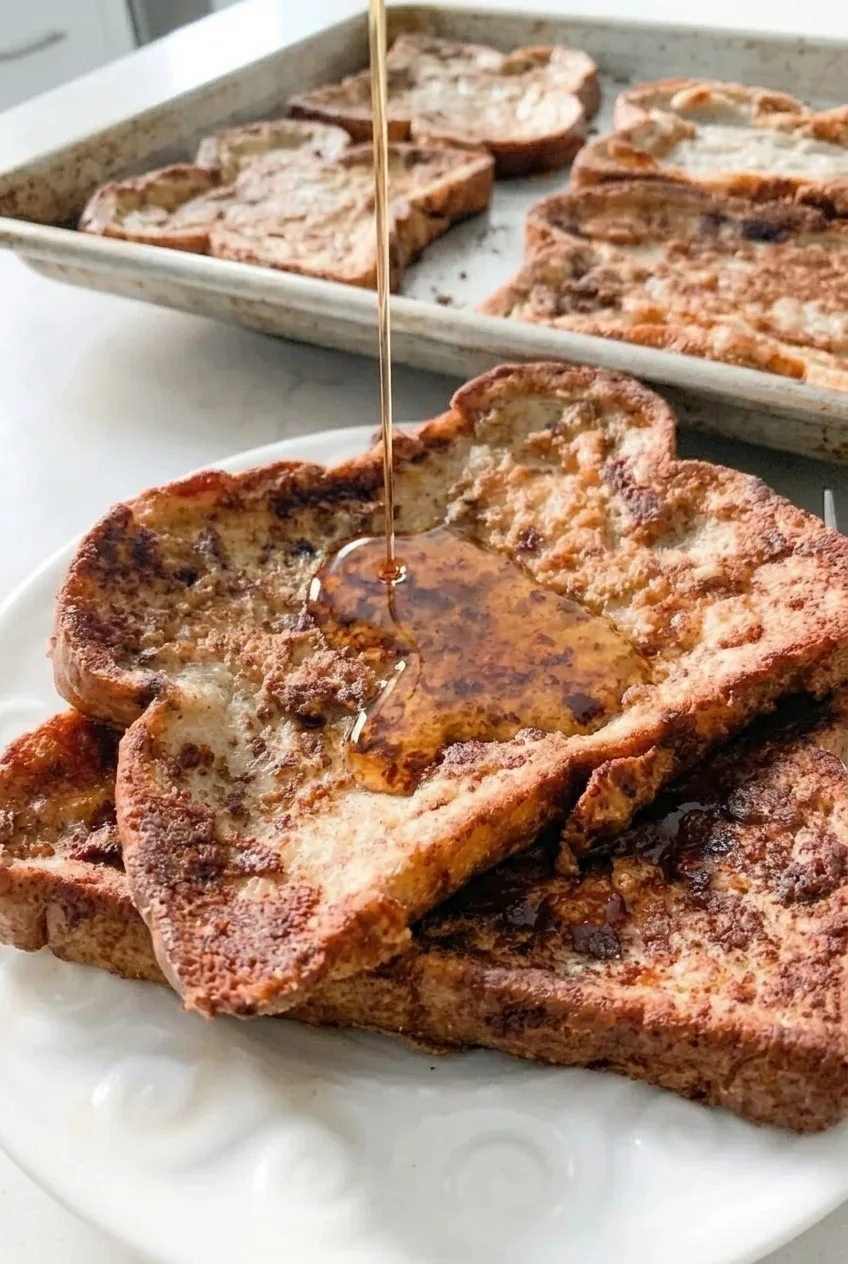
Close view of syrup-glazed French toast with mottled cinnamon browning and soft-looking centers.
  • 8 slices sturdy bread, about 3/4 inch thick (about 400g)
  • 4 large eggs
  • 1 cup whole milk (240g)
  • 2 tablespoons packed light brown sugar (25g)
  • 1 teaspoon ground cinnamon
  • 1 teaspoon vanilla extract
  • 1/4 teaspoon fine salt
  • 1 tablespoon neutral oil
  • About 1/3 cup maple syrup, for serving (105g)

How to Make Sheet Pan French Toast
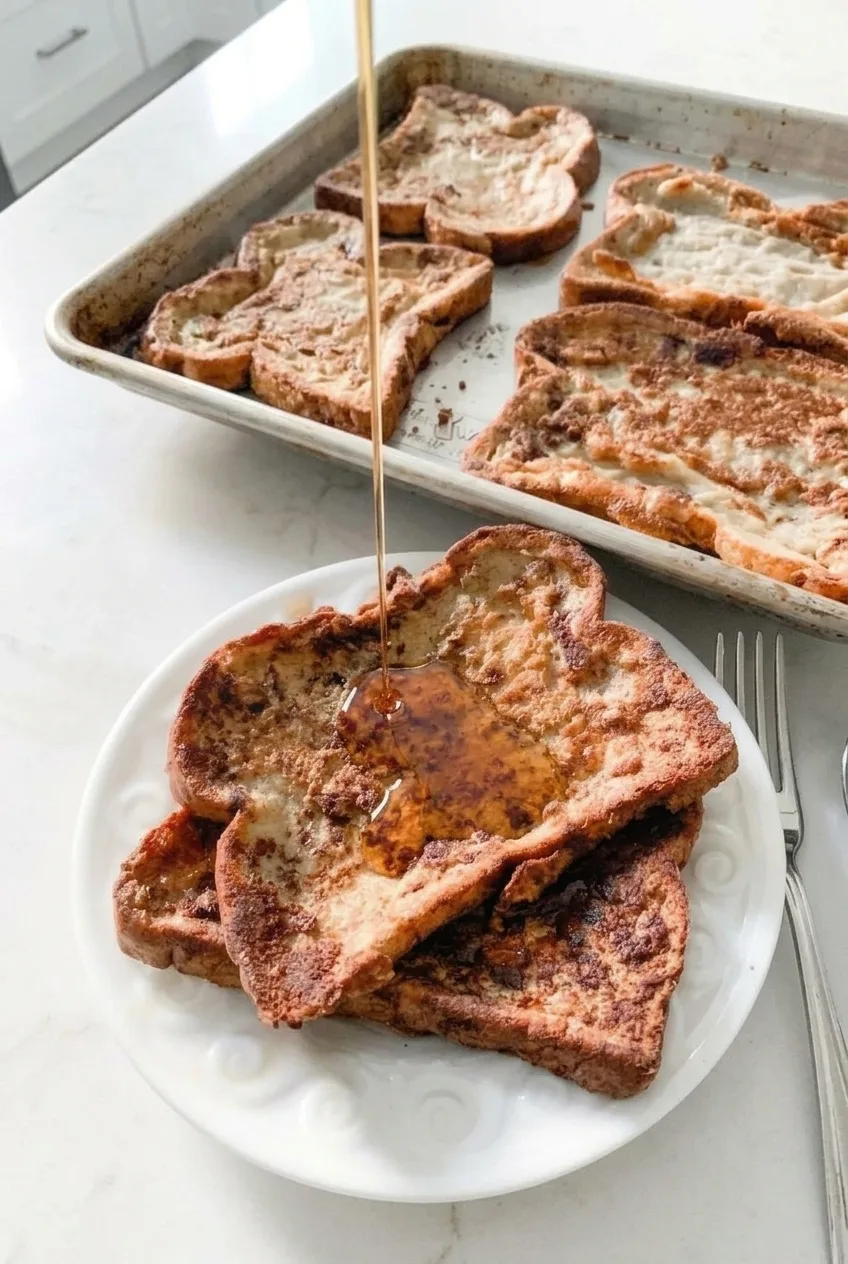
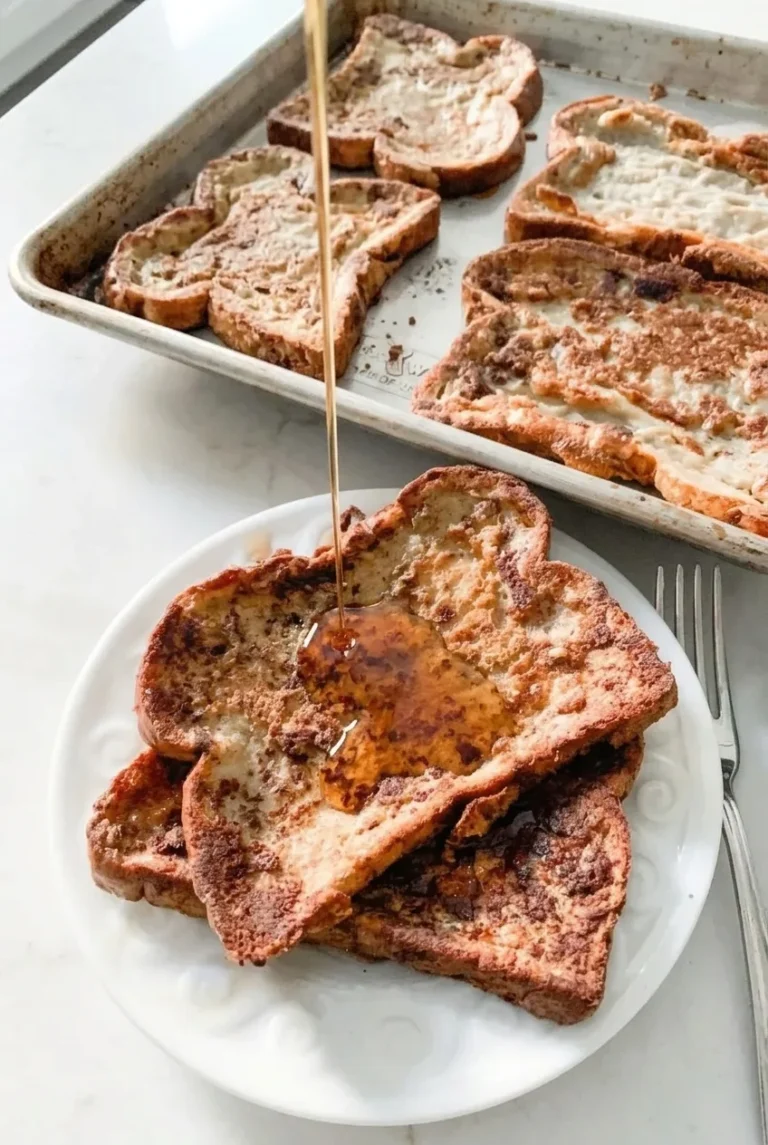
White plate of syrup-topped French toast beside a sheet pan of additional whole slices.
  1. Preheat and oil the pan: Set one oven rack in the lower third and another about 6 inches from the broiler. Heat the oven to 425°F (220°C). Spread the oil thinly and evenly over a bare, 18-by-13-inch rimmed metal sheet pan. Use a broiler-safe pan and do not line it with parchment.
  2. Whisk the custard: Whisk the eggs, brown sugar, cinnamon, and salt until no large streaks of egg remain. Whisk in the milk and vanilla, then pour into a wide, shallow dish.
  3. Dip the bread: Coat each slice on both sides, about 5–10 seconds per side for sturdy bread. It should be damp and slightly softened but still hold its shape. Let excess custard drip into the dish, then arrange the slices in one layer with small gaps. Do not pour leftover custard onto the pan. If the slices do not all fit, use a second pan rather than overlapping them.
  4. Bake the bottoms: Bake uncovered on the lower rack for about 10–14 minutes. Starting at 10 minutes, carefully lift an edge with a thin spatula. The bottoms should be golden-brown, and the centers should look set, with no visibly wet custard on top.
  5. Broil the tops: Move the pan to the upper rack and switch to broil. Watch continuously for about 1–3 minutes, until the tops have irregular golden and cinnamon-brown spots. Carefully reposition the pan if it browns unevenly. If the tops color before the centers look set, stop broiling and return the pan to the 425°F oven briefly.
  6. Serve: Let the toast stand for about 1 minute, then lift the whole slices with a spatula. Loosely overlap two slices on each plate and pour maple syrup over them just before serving.

Choose Bread That Holds a Brief Soak

Sturdy white or whole-grain slices about 3/4 inch thick are easier to move without tearing. Give especially soft bread a shorter dip; drier bread may need a little longer. Either way, let excess custard drain off so it does not pool beneath the slices.

Brioche works for a richer version, but its delicate slices may need a shorter dip and an earlier browning check. Oat or nut milk can replace the whole milk, though the richness and browning may change. Handle gluten-free sliced bread gently and adjust the dip to how well it holds together.

How to Prevent Sticking and Soggy Bottoms

Spread the oil across the bare metal pan rather than leaving puddles. For this bake-then-broil method, direct contact with the oiled pan helps the undersides brown. Check that they are golden before moving the pan under the broiler; trying to lift the slices too early can make them harder to release. The finished centers should be soft, not wet with uncooked custard.

Serving and Storing Leftovers

Add syrup after cooking, not before broiling, so it stays on the plated toast instead of browning under the intense heat. Serve fresh berries alongside if desired. For a savory brunch companion, add sausage egg and cheese breakfast casserole.

Cool leftovers and refrigerate them promptly in a covered container. Reheat until hot in an oven or toaster oven if you want a drier surface; reheated toast may be softer than freshly baked.

Nutrition

Approximate nutrition per serving of 2 slices, including one-quarter of the maple syrup: 500 calories, 17g protein, 14g fat, and 77g carbohydrates. Based on total ingredient weights before baking, that is approximately 200 calories, 7g protein, 6g fat, and 31g carbohydrates per 100g. Values vary with the bread and how much custard the slices absorb.

Sheet Pan French Toast

Eight slices of bread bake together in cinnamon custard until soft inside with golden, browned tops.
Course: Breakfast
Cuisine: American
Prep: 15 min
Cook: 15 min
Total: 30 min
Servings: 4 Calories: 500 kcal

Equipment

  • 18-by-13-inch rimmed metal sheet pan
  • Wide shallow dish
  • Whisk
  • Thin spatula

Ingredients

  • 8 slices sturdy bread, about 3/4 inch thick (about 400 g)
  • 4 large eggs
  • 1 cup whole milk (240 g)
  • 2 tablespoons packed light brown sugar (25 g)
  • 1 teaspoon ground cinnamon
  • 1 teaspoon vanilla extract
  • 1/4 teaspoon fine salt
  • 1 tablespoon neutral oil
  • About 1/3 cup maple syrup (105 g), for serving

Instructions

  1. Set one oven rack in the lower third and another about 6 inches from the broiler. Preheat the oven to 425°F (220°C).
  2. Spread the oil thinly and evenly over a bare, broiler-safe 18-by-13-inch rimmed metal sheet pan. Do not line the pan with parchment.
  3. Whisk the eggs, brown sugar, cinnamon, and salt until no large streaks of egg remain. Whisk in the milk and vanilla, then pour the mixture into a wide, shallow dish.
  4. Dip each bread slice on both sides for about 5–10 seconds per side. Let excess custard drip off, then arrange the slices in one layer on the pan with small gaps. Do not pour leftover custard onto the pan; use a second pan if needed.
  5. Bake uncovered on the lower rack for about 10–14 minutes. Starting at 10 minutes, carefully lift an edge with a thin spatula. The bottoms should be golden-brown and the centers set, with no visibly wet custard on top.
  6. Move the pan to the upper rack and switch the oven to broil. Watch continuously for about 1–3 minutes, until the tops have irregular golden and cinnamon-brown spots. Reposition the pan carefully if it browns unevenly. If the tops brown before the centers are set, stop broiling and return the pan to the 425°F (220°C) oven briefly.
  7. Let the toast stand for about 1 minute, then lift the slices with a spatula. Serve two slices per plate with maple syrup poured over just before eating.

Tips

  • Use sturdy bread about 3/4 inch thick so the slices are easier to dip and move.
  • Dip especially soft bread for less time; drier bread may need a little longer.
  • Let excess custard drip off and leave small gaps between slices to prevent pooling.
  • Wait until the bottoms are golden before lifting the slices.
  • Watch the toast continuously while broiling, as the tops brown quickly.

Variations

  • Brioche French Toast: Use brioche for a richer version, dip it briefly, and check for browning early.
  • Dairy-Free French Toast: Replace the whole milk with oat milk or nut milk; richness and browning may vary.
Notes

Refrigerate cooled leftovers promptly in a covered container. Reheat until hot in an oven or toaster oven; the toast may be softer than when freshly baked.

Nutrition

Calories: 500 kcal | Protein: 17 g | Fat: 14 g | Carbohydrates: 77 g

Fluffy Buttermilk Pancakes

These small buttermilk pancakes have thick, tender sides and golden-brown tops that make them easy to stack. Stir the batter only until the flour is moistened, then cook 1/4-cup portions over moderate heat. A few lumps help keep the pancakes tender, while bubbles and set edges tell you when to flip.

For the berry-topped finish, drizzle the warm stacks with a thick buttermilk glaze, add strawberries, raspberries, and blueberries, and dust with powdered sugar. Wait until serving to add the toppings so the pancakes do not soften while you cook the remaining batches.

Ingredients for Fluffy Buttermilk Pancakes

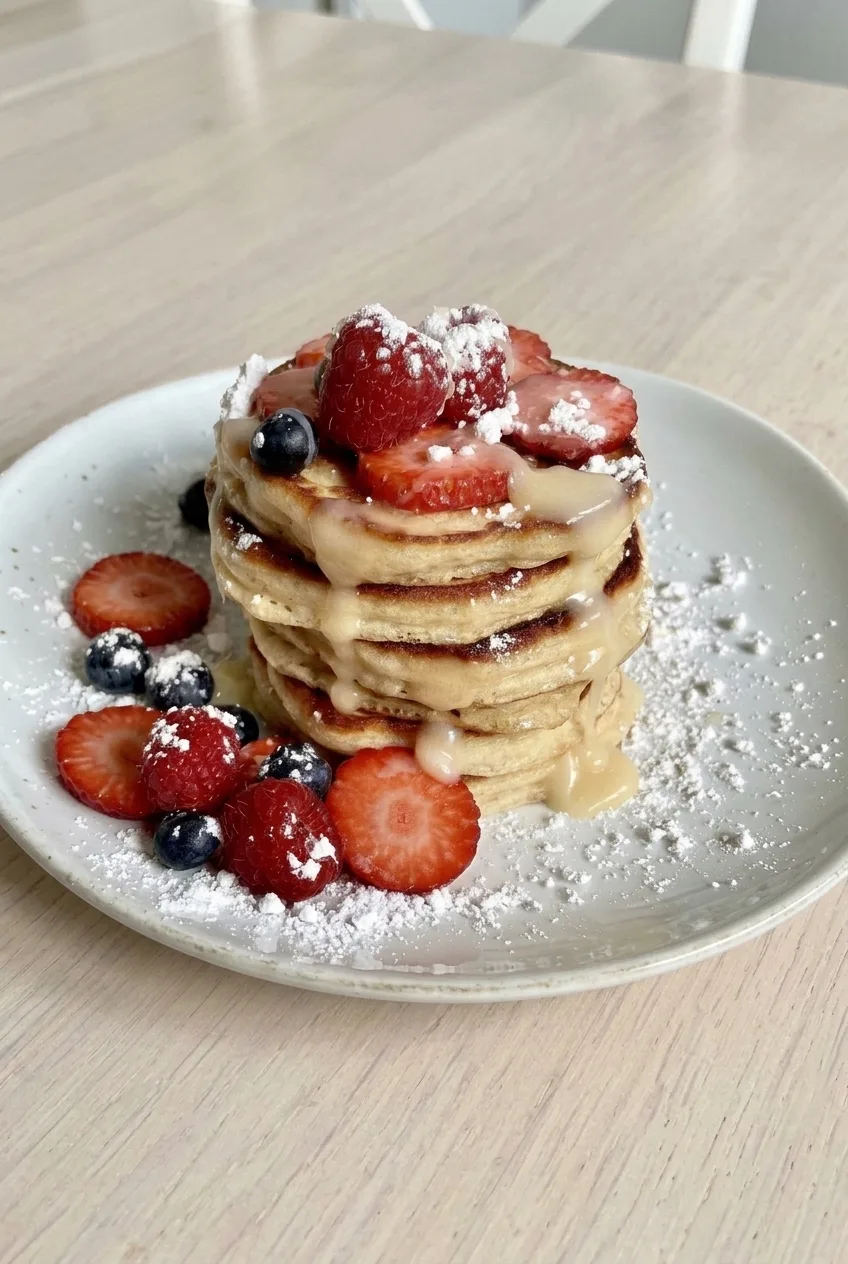
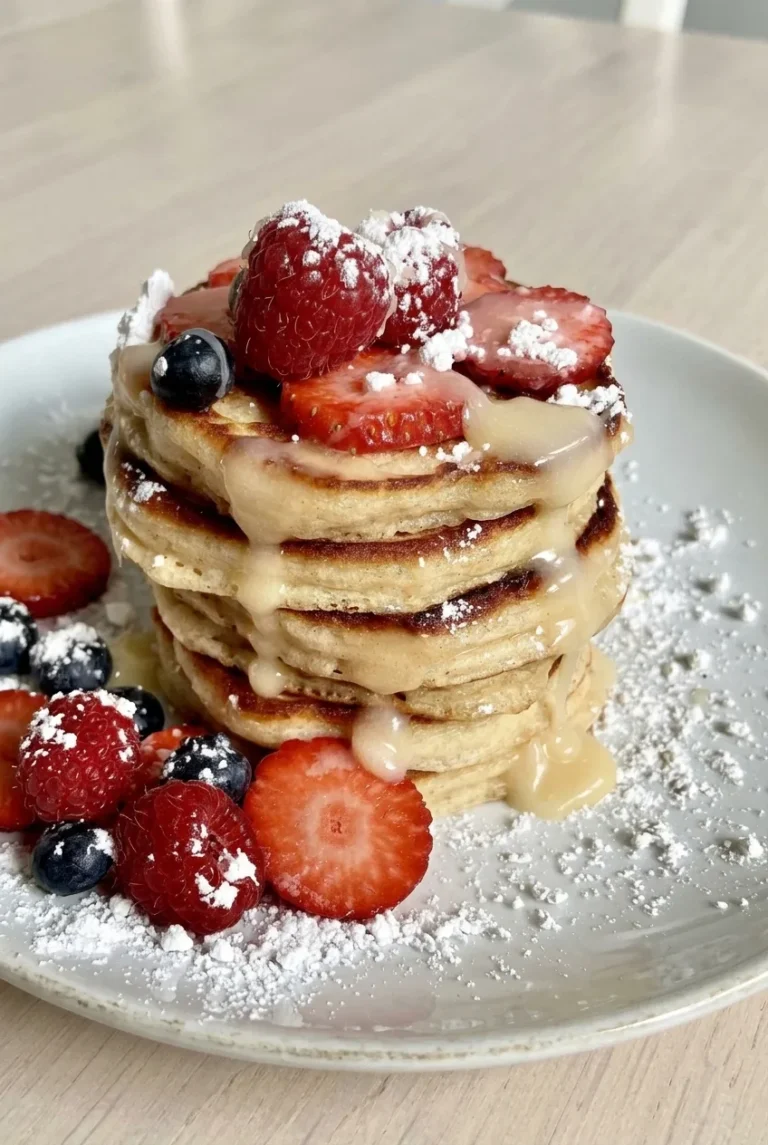
Close view of thick pancake layers, tender crumb, pale glaze, and fresh berries

Makes about 14–16 small pancakes, or 4 servings. Prep time: about 12 minutes. Cook time: about 20–30 minutes in batches. Total time: about 35–45 minutes.

For the pancakes

  • 2 cups all-purpose flour (240g)
  • 2 tablespoons granulated sugar (25g)
  • 2 teaspoons baking powder (8g)
  • 1/2 teaspoon baking soda
  • 1/2 teaspoon fine salt
  • 1 3/4 cups cultured buttermilk, plus more by the tablespoon if needed
  • 2 large eggs
  • 4 tablespoons unsalted butter, melted and slightly cooled (55g)
  • About 1–2 teaspoons neutral oil or additional butter, for the skillet

For the glaze and topping

  • 1 cup powdered sugar for the glaze, plus about 1 tablespoon for dusting
  • 2–3 tablespoons cultured buttermilk for the glaze
  • About 1 cup sliced strawberries (150g)
  • About 1/2 cup fresh raspberries (60g)
  • About 1/3 cup fresh blueberries (50g)

How to Make Buttermilk Pancakes

Full plate of berry-topped buttermilk pancakes with glaze and powdered sugar on a neutral table
  1. Preheat the pan: Warm a large nonstick skillet over medium-low to medium heat for about 5 minutes, or set an electric griddle to 325–350°F (165–175°C). The surface should be evenly hot but not smoking. Add a thin film of oil or butter just before cooking.
  2. Mix the dry ingredients: Whisk the flour, granulated sugar, baking powder, baking soda, and salt in a large bowl.
  3. Make the batter: Whisk 1 3/4 cups buttermilk and the eggs in a second bowl. Add them to the dry ingredients and stir just until moistened, then fold in the melted butter. Stop while small lumps remain, with no large patches of dry flour. The batter should be thick and scoopable but spread a little on its own; if it is too stiff to portion, add buttermilk 1 tablespoon at a time.
  4. Cook in batches: Pour about 1/4 cup batter per pancake onto the lightly greased skillet, leaving room to spread and flip. Check the first pancake after about 2 minutes to see how quickly it is browning. Flip when bubbles on top have opened, the edges look set, and the underside is golden, usually after about 3–4 minutes. Cook the second side for about 1–2 minutes, until golden with no wet batter in the center. Do not press the pancakes down. If they brown before the centers cook, lower the heat for the next batch.
  5. Finish the batches: Transfer cooked pancakes to a plate, or hold them unglazed in a 200–250°F (95–120°C) oven while the rest cook. Wipe dark residue from the skillet and lightly regrease as needed.
  6. Make the glaze: Stir 1 cup powdered sugar with 2 tablespoons buttermilk. Add up to 1 more tablespoon buttermilk, a little at a time, until the glaze is opaque and falls slowly from a spoon. If it becomes too thin, whisk in a little more powdered sugar.
  7. Stack and serve: Stack the warm pancakes on plates. Spoon the glaze over the tops so it drips down the sides. Add the strawberries, raspberries, and blueberries on and around the stacks, dust lightly with the remaining powdered sugar, and serve promptly.

How to Keep Buttermilk Pancakes Fluffy

Stirring until the batter is smooth can make the pancakes dense. Stop once the flour is moistened; small lumps are fine. The baking soda works with the buttermilk to help the pancakes rise, so there is no need for a long batter rest before cooking.

Buttermilk Substitutes

Milk soured with lemon juice or vinegar can replace the buttermilk, though it may make a thinner batter. Plain yogurt thinned with milk is another option. In either case, check that the batter is thick and scoopable before cooking.

Serving the Berry-and-Glaze Stack

Keep the berries and glaze separate until the pancakes are ready to eat. For a larger brunch, pair the stacks with sausage, egg, and cheese breakfast casserole.

Storing and Reheating Leftover Pancakes

Cool plain pancakes before refrigerating them in an airtight container, with parchment between layers, for about 2–3 days. Keep the berries and glaze separate. Reheat pancakes in a toaster, skillet, or briefly in a microwave until warm, then add the toppings.

For a larger batch, warm plain pancakes in a 350°F oven for roughly 10 minutes, checking that they do not dry out. To freeze, cool plain pancakes in a single layer, then transfer them to a freezer bag with parchment between layers. Use within about 4 weeks.

Nutrition

Approximate nutrition per serving, based on 4 servings with glaze and berries: 590 calories, 13g protein, 17g fat, and 97g carbohydrates. Approximate values per 100g of finished pancakes and toppings: 205 calories, 5g protein, 6g fat, and 34g carbohydrates. Values vary with portion size and the amount of glaze or pan fat used.

Fluffy Buttermilk Pancakes

Tender, golden buttermilk pancakes served with a simple glaze and fresh berries.
Course: Breakfast
Cuisine: American
Prep: 12 min
Cook: 25 min
Total: 40 min
Servings: 4 Calories: 590 kcal

Equipment

  • Large nonstick skillet or electric griddle
  • Mixing bowls
  • Whisk
  • Spatula

Ingredients

For the pancakes

  • 2 cups all-purpose flour (240g)
  • 2 tablespoons granulated sugar (25g)
  • 2 teaspoons baking powder (8g)
  • 1/2 teaspoon baking soda
  • 1/2 teaspoon fine salt
  • 1 3/4 cups cultured buttermilk, plus more by the tablespoon if needed
  • 2 large eggs
  • 4 tablespoons unsalted butter, melted and slightly cooled (55g)
  • 1–2 teaspoons neutral oil or additional butter, for the skillet

For the glaze and topping

  • 1 cup powdered sugar for the glaze, plus about 1 tablespoon for dusting
  • 2–3 tablespoons cultured buttermilk for the glaze
  • About 1 cup sliced strawberries (150g)
  • About 1/2 cup fresh raspberries (60g)
  • About 1/3 cup fresh blueberries (50g)

Instructions

  1. Warm a large nonstick skillet over medium-low to medium heat for about 5 minutes, or heat an electric griddle to 325–350°F (165–175°C).
  2. Whisk the flour, granulated sugar, baking powder, baking soda, and salt in a large bowl.
  3. In a second bowl, whisk the buttermilk and eggs. Add them to the dry ingredients and stir just until moistened.
  4. Fold in the melted butter, stopping while small lumps remain. If the batter is too stiff to portion, add buttermilk 1 tablespoon at a time.
  5. Lightly grease the hot skillet with oil or butter. Pour about 1/4 cup batter per pancake onto the skillet, leaving room to spread and flip.
  6. Cook until bubbles on top have opened, the edges look set, and the underside is golden, usually about 3–4 minutes. Flip and cook the second side for 1–2 minutes, until golden and cooked through.
  7. Transfer cooked pancakes to a plate or hold them unglazed in a 200–250°F (95–120°C) oven while cooking the remaining batches. Wipe dark residue from the skillet and regrease as needed.
  8. Stir 1 cup powdered sugar with 2 tablespoons buttermilk. Add up to 1 more tablespoon buttermilk gradually until the glaze is opaque and falls slowly from a spoon. Whisk in more powdered sugar if it becomes too thin.
  9. Stack the warm pancakes and spoon the glaze over them. Add the strawberries, raspberries, and blueberries, dust with the remaining powdered sugar, and serve promptly.

Tips

  • Do not overmix the batter; small lumps help keep the pancakes tender.
  • Check the first pancake to gauge how quickly the skillet is browning the batter.
  • Lower the heat if the pancakes brown before their centers cook.
  • Do not press the pancakes down while they cook.
  • Add the glaze and berries just before serving so the pancakes do not soften.

Variations

  • Soured-Milk Pancakes: Replace the buttermilk with milk soured with lemon juice or vinegar; check that the batter remains thick and scoopable.
  • Yogurt Pancakes: Replace the buttermilk with plain yogurt thinned with milk, adjusting until the batter is thick and scoopable.

Notes

Refrigerate cooled plain pancakes in an airtight container for 2–3 days, or freeze with parchment between layers for up to about 4 weeks. Reheat until warm and add the berries and glaze just before serving.

Nutrition

Calories: 590 kcal | Protein: 13 g | Fat: 17 g | Carbohydrates: 97 g

Sausage Egg and Cheese Breakfast Casserole

Thick portions of this bread-based breakfast casserole have soft, egg-soaked centers, browned sausage crumbles, and melted cheddar. The exposed bread corners turn golden in the oven while the cubes underneath stay tender.

Cook and drain the sausage before assembly so its fat doesn’t make the custard greasy. A 20-minute soak moistens the bread, so there’s no need to prepare the casserole the night before. Bake until the center—not just the top—is set.

Ingredients for Sausage Egg and Cheese Breakfast Casserole

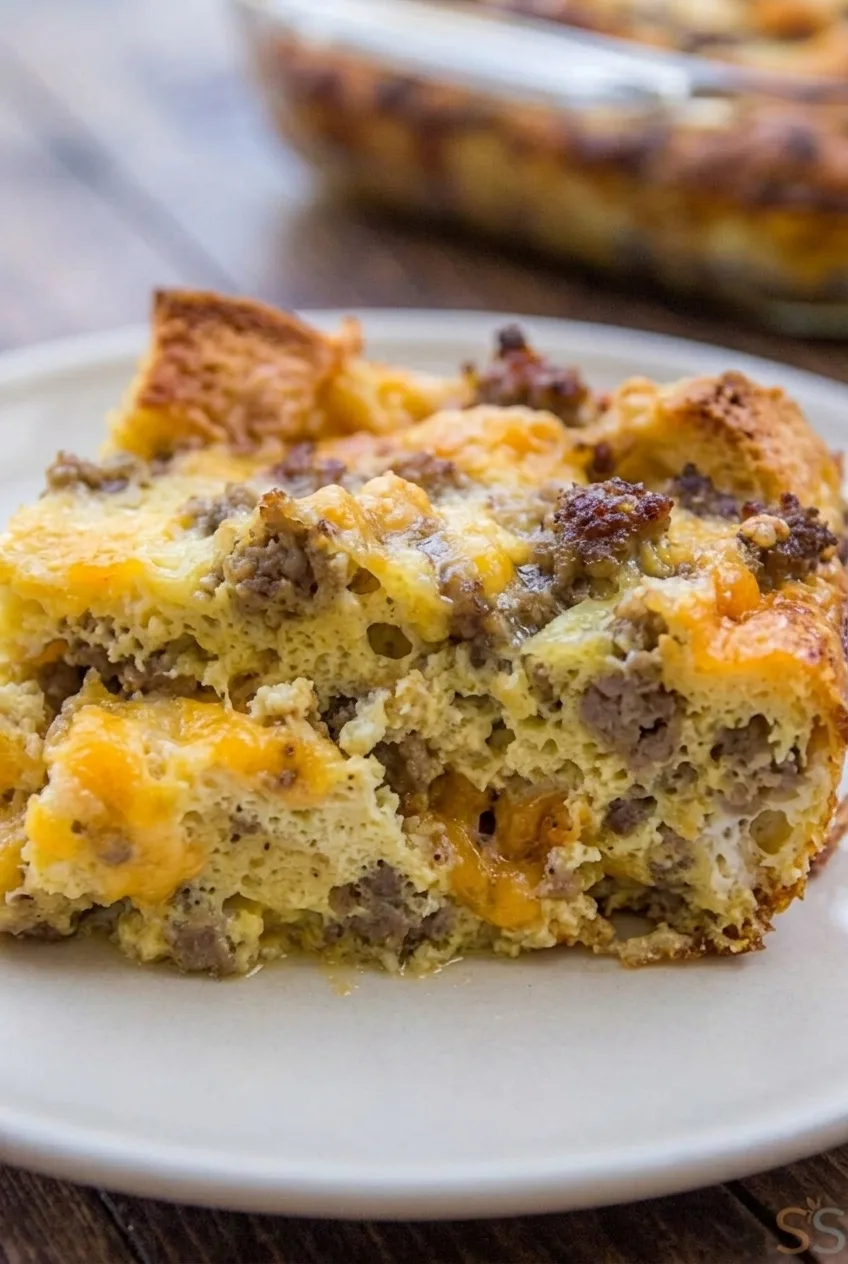
Close view of a cut casserole portion showing soft bread, sausage crumbles, and melted cheddar
  • Cooking spray or butter, for greasing the dish
  • 6 cups sturdy day-old bread, cut into roughly 1-inch cubes (about 225g)
  • 1 lb pork breakfast sausage (about 450g)
  • 2 cups shredded sharp cheddar cheese, divided (about 225g)
  • 10 large eggs
  • 1 1/2 cups whole milk
  • 1/2 teaspoon kosher salt
  • 1/4 teaspoon freshly ground black pepper

Optional: Add 1 teaspoon Dijon mustard to the egg mixture for a little tang.

Yield: 8 generous portions. Time: About 20 minutes to prepare, 20 minutes to soak, 40–50 minutes to bake, and 10 minutes to rest; about 1 hour 30 minutes to 1 hour 40 minutes total.

How to Make Sausage Egg and Cheese Breakfast Casserole

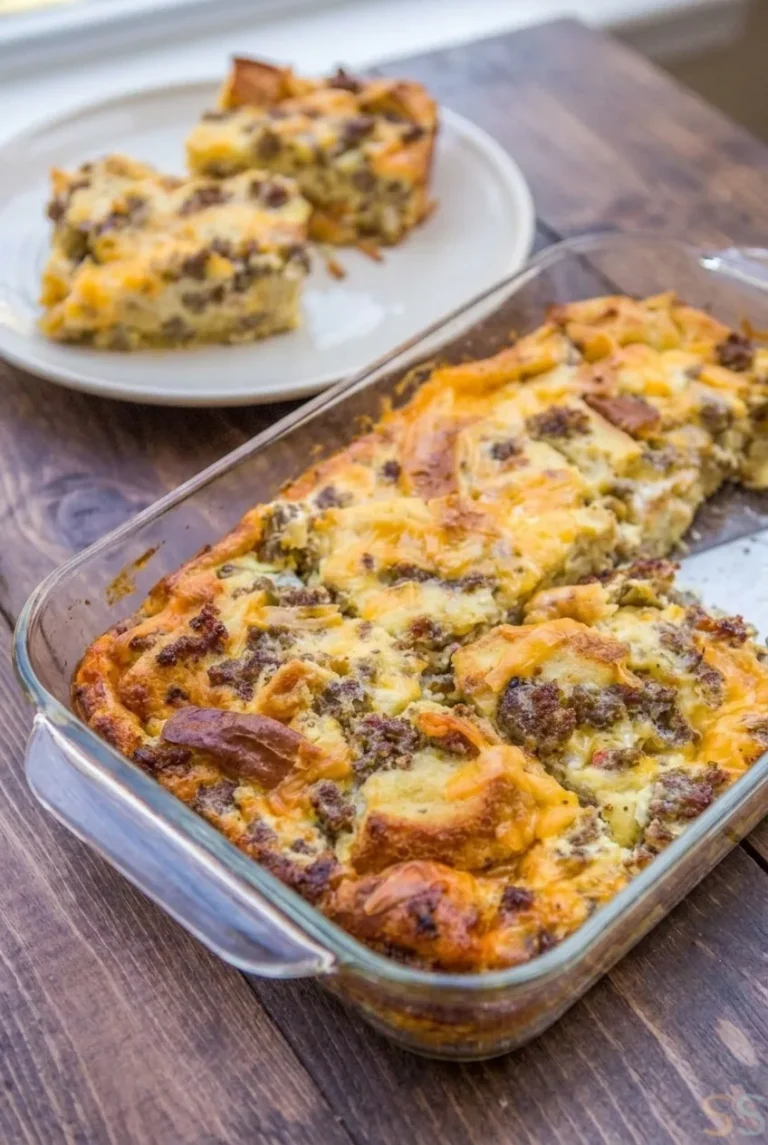
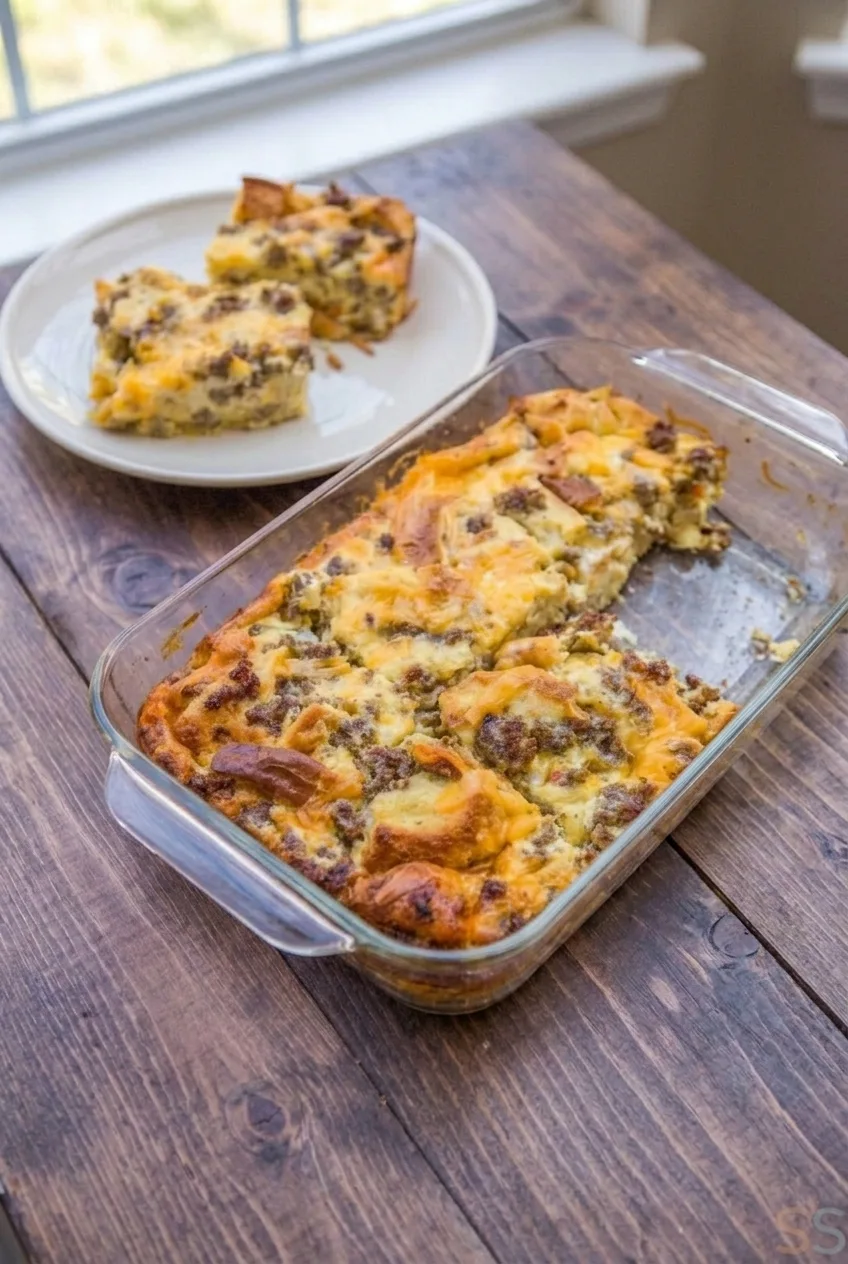
Full glass dish of golden sausage egg and cheese casserole with a portion on a plate behind it
  1. Prepare the bread: Lightly grease a 9-by-13-inch baking dish. Spread the bread cubes in an even, loose layer without pressing them flat.
  2. Cook the sausage: In a large skillet over medium heat, cook the sausage for 8–10 minutes, breaking it into coarse crumbles, until browned with no raw pink remaining. Drain off the excess fat, then scatter the sausage over the bread.
  3. Add the cheese and custard: Sprinkle 1 1/2 cups cheddar over the bread and sausage. Whisk the eggs, milk, salt, pepper, and optional Dijon in a large bowl. Pour evenly over the dish. Gently press the bread into the liquid to moisten it, leaving some upper corners exposed. Sprinkle with the remaining 1/2 cup cheddar.
  4. Soak and preheat: Let the casserole stand for 20 minutes while the oven preheats to 350°F (175°C). The bread should feel damp when gently pressed.
  5. Bake: Bake uncovered on the center rack for approximately 40–50 minutes. Start checking at 40 minutes; if there is still liquid egg in the center, continue baking and check again in about 5 minutes. The top should be puffed and golden, with browned bread corners and a set center. Loosely tent with foil if the top browns before the middle sets.
  6. Rest and serve: Let the casserole stand for 10 minutes so the portions hold together when cut and lifted from the dish.

How to Keep the Bread Soft With Golden Edges

Sturdy, roughly 1-inch cubes keep the casserole visibly chunky. Pour the custard evenly and press the bread down just enough to wet it; pressing it flat leaves fewer corners to toast. Give the bread the full 20 minutes to absorb the liquid before baking.

How to Tell When the Casserole Is Done

The top may brown before the middle finishes cooking. A knife inserted near the center should come out without liquid egg. For an additional check, the custard in the center should reach 160°F (70°C); keep the thermometer tip away from sausage pieces. Remove the casserole once the center is set so the eggs don’t become tough.

Make It Ahead

To assemble the casserole ahead, cover it and refrigerate it overnight instead of giving it the same-day soak. Bake from cold at 350°F; it may take roughly 45–60 minutes. Check for a set center rather than relying on the time alone.

Serving, Storage, and Reheating

Serve warm with fruit. For a crisp side, add crispy sweet potato hash browns.

Refrigerate cooked leftovers in a covered container for up to 4 days. Microwave individual portions at reduced power until heated through to help prevent rubbery eggs. For larger portions, cover with foil and warm in a 350°F oven until hot, about 20–25 minutes depending on their size.

For longer storage, freeze cooled, tightly wrapped cooked portions for up to 3 months for best quality. Thaw in the refrigerator before reheating in the oven.

Nutrition

Approximate per serving (1 of 8 portions): 480 calories, 26g protein, 33g fat, and 17g carbohydrates. Approximate per 100g of cooked casserole: 255 calories, 14g protein, 18g fat, and 9g carbohydrates. Values vary with the sausage, bread, cheese, amount of fat drained, and final cooked weight.

Sausage Egg and Cheese Breakfast Casserole

A bread-based breakfast casserole with browned sausage, cheddar, and soft egg-soaked centers.
Course: Breakfast
Cuisine: American
Prep: 40 min
Cook: 55 min
Total: 95 min
Servings: 8 Calories: 480 kcal

Equipment

  • 9-by-13-inch baking dish
  • Large skillet
  • Large mixing bowl
  • Whisk

Ingredients

Casserole

  • Cooking spray or butter, for greasing the dish
  • 6 cups sturdy day-old bread, cut into roughly 1-inch cubes (about 225 g)
  • 1 lb pork breakfast sausage (about 450 g)
  • 2 cups shredded sharp cheddar cheese, divided (about 225 g)
  • 10 large eggs
  • 1 1/2 cups whole milk
  • 1/2 teaspoon kosher salt
  • 1/4 teaspoon freshly ground black pepper
  • Optional: 1 teaspoon Dijon mustard

Instructions

  1. Lightly grease a 9-by-13-inch baking dish. Spread the bread cubes in a loose, even layer.
  2. Cook the sausage in a large skillet over medium heat for 8–10 minutes, breaking it into coarse crumbles, until browned with no raw pink remaining. Drain the excess fat and scatter the sausage over the bread.
  3. Sprinkle 1 1/2 cups cheddar over the bread and sausage.
  4. Whisk the eggs, milk, salt, pepper, and optional Dijon in a large bowl. Pour the mixture evenly over the casserole.
  5. Gently press the bread into the liquid to moisten it, leaving some upper corners exposed. Sprinkle the remaining 1/2 cup cheddar over the top.
  6. Let the casserole soak for 20 minutes while the oven preheats to 350°F (175°C).
  7. Bake uncovered on the center rack for 40–50 minutes, checking from 40 minutes. If liquid egg remains in the center, continue baking and check again in about 5 minutes. Tent loosely with foil if the top browns before the center sets.
  8. Remove the casserole when puffed and golden with a set center. Let it rest for 10 minutes before serving.

Tips

  • Drain the cooked sausage so excess fat does not make the custard greasy.
  • Use sturdy day-old bread cut into roughly 1-inch cubes to keep the casserole chunky.
  • Give the bread the full 20-minute soak before baking.
  • Check the center for liquid egg; the custard should reach 160°F (70°C).
  • Avoid pressing the bread flat so some corners can turn golden.

Variations

  • Dijon Breakfast Casserole: Whisk 1 teaspoon Dijon mustard into the egg mixture for a little tang.

Notes

For make-ahead preparation, cover and refrigerate overnight, then bake from cold at 350°F; it may take 45–60 minutes. Refrigerate leftovers for up to 4 days or freeze cooked portions for up to 3 months. Reheat individual portions in the microwave at reduced power, or larger portions covered with foil in a 350°F oven for about 20–25 minutes. Per 100 g: approximately 255 calories, 14 g protein, 18 g fat, and 9 g carbohydrates.

Nutrition

Calories: 480 kcal | Protein: 26 g | Fat: 33 g | Carbohydrates: 17 g

Breakfast Burritos

Tender folded eggs and cheddar form the warm center of these breakfast burritos. Avocado, thick red salsa, sour cream, and cilantro add fresh, creamy contrast without needing meat or potatoes.

Warm 10-inch flour tortillas so they roll without tearing, and measure the salsa and sour cream so the filling stays creamy rather than soggy. A brief skillet toast holds the seams closed and leaves a few light golden patches; a short rest in foil softens the cheese before serving.

Ingredients for Breakfast Burritos

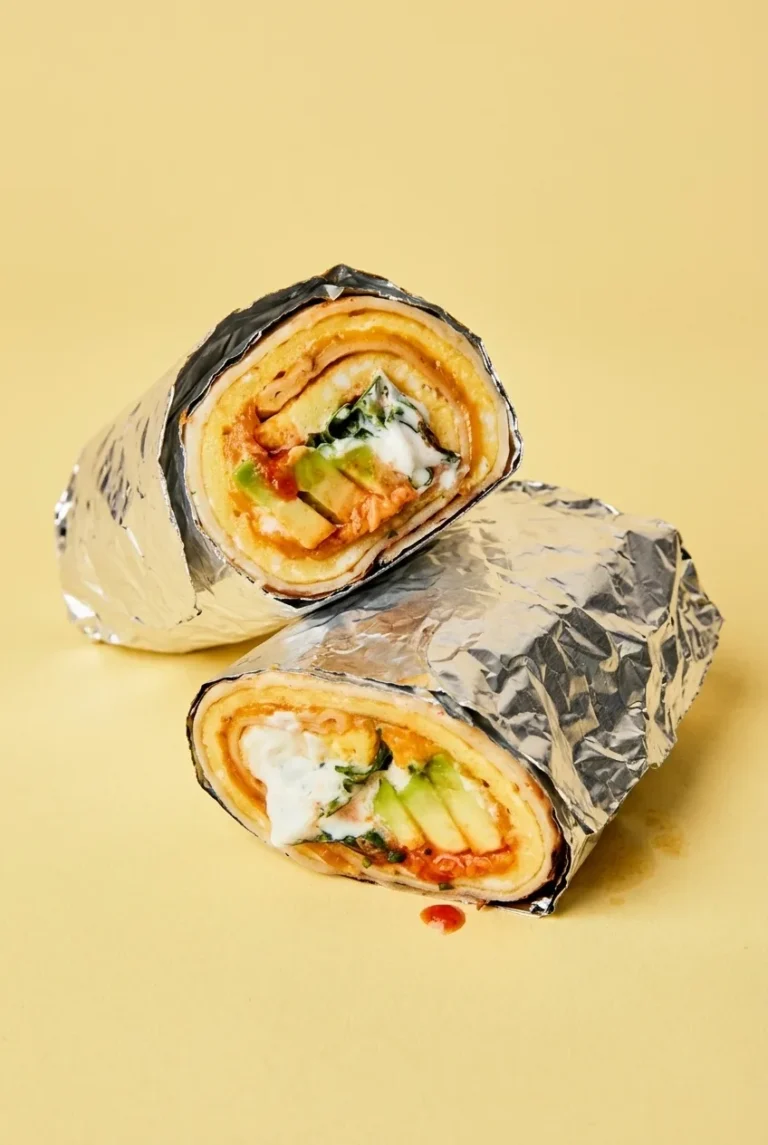
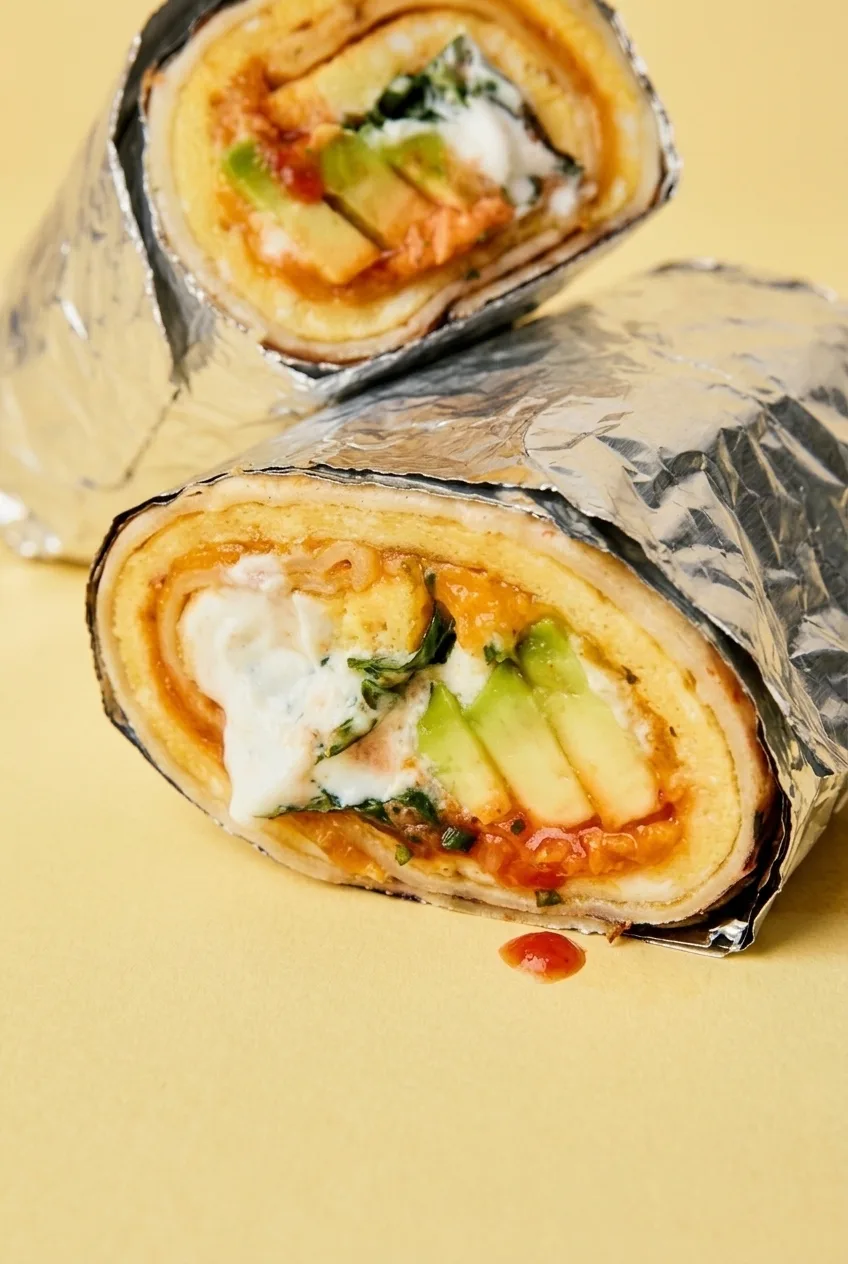
Close view of a breakfast burrito cut face with folded eggs, avocado and creamy filling
  • 4 large burrito-size flour tortillas, about 10 inches (about 280g total)
  • 8 large eggs
  • 1/2 teaspoon kosher salt, or to taste
  • 1/4 teaspoon freshly ground black pepper
  • 1 tablespoon unsalted butter (15g)
  • 1 cup shredded cheddar cheese (115g)
  • 2 medium ripe avocados, diced or thickly sliced (about 280g flesh)
  • 1/4 cup thick red salsa (60g)
  • 1/4 cup sour cream (60g)
  • 1/4 cup loosely packed chopped fresh cilantro

How to Make Breakfast Burritos in a Skillet

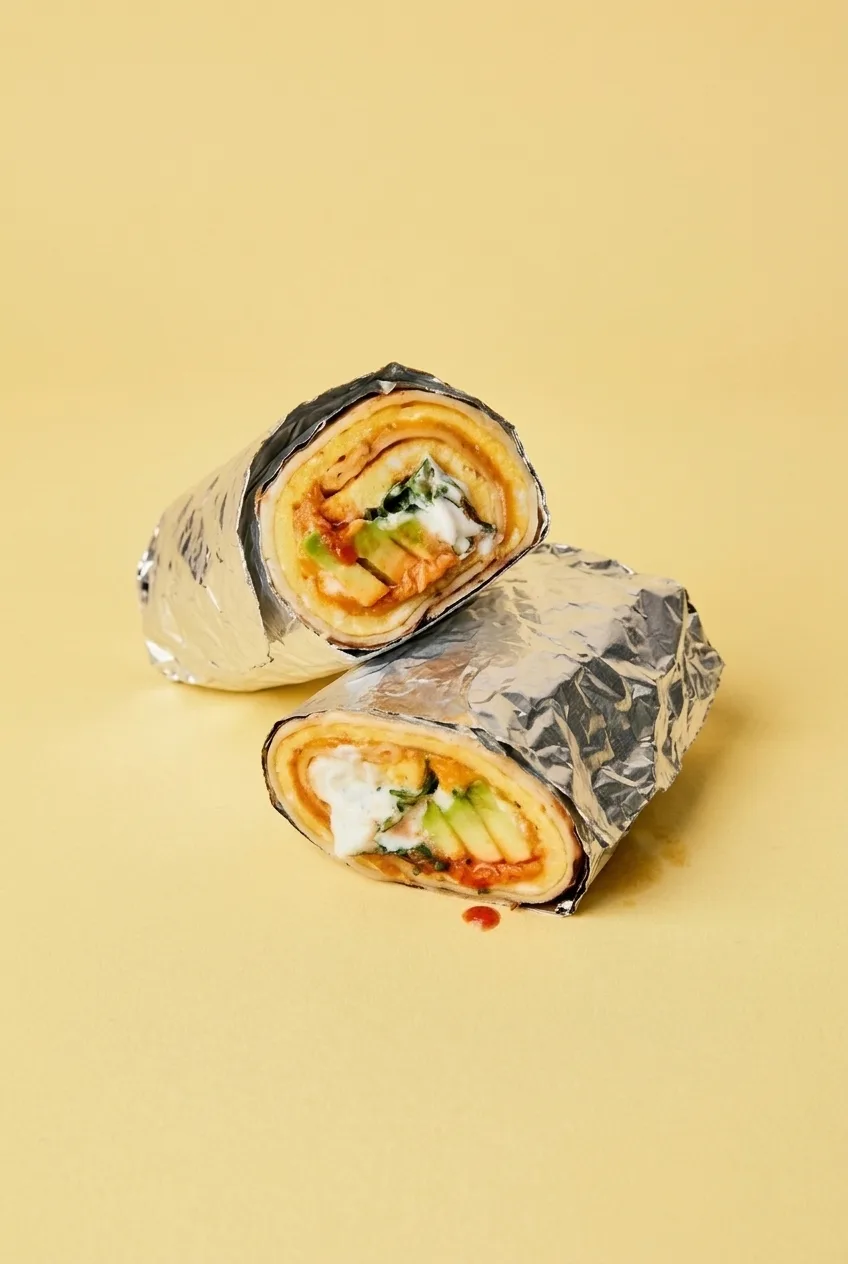
Two cut breakfast burrito halves in foil on a plain pale-yellow surface
  1. Prepare the fillings: Cut the avocados and chop the cilantro. Drain off any watery liquid from the salsa. Whisk the eggs with the salt and pepper.
  2. Cook the eggs: Warm a 10- to 12-inch nonstick skillet over medium-low heat and melt the butter. Add the eggs and gently push them into broad folds with a spatula. Cook uncovered for about 5 to 7 minutes, working in batches if the pan is crowded. Start checking after a few minutes and remove the eggs when no liquid remains; they should be tender, not browned.
  3. Warm the tortillas: Warm each tortilla briefly in a dry skillet over low heat or in the microwave until it bends easily. Keep the warmed tortillas covered while you assemble the burritos.
  4. Fill and roll: Divide the eggs and cheddar among the tortillas, keeping the filling in a compact strip across each center. Add the avocado, about 1 tablespoon each of salsa and sour cream per burrito, and the cilantro. Leave the edges bare, fold in both sides, and roll snugly with the seams underneath.
  5. Lightly toast: Set a dry skillet over medium heat. Add only as many burritos as fit without stacking, seam-side down. Check the seams after about 1 minute, then turn once. Toast for about 1 to 2 minutes per side, until the seams hold and the tortillas have light golden patches. Reduce the heat if they darken quickly.
  6. Wrap and serve: Wrap foil around the sides of each burrito and rest for about 2 minutes. Cut each burrito crosswise with a sharp knife, then peel the foil back from the cut ends so the filling is visible. Serve warm.

For a crispy breakfast side, serve the burritos with crispy sweet potato hash browns.

How to Keep Breakfast Burritos from Splitting or Getting Soggy

If a tortilla splits as you roll, warm it a little longer or reduce the filling. A flexible 10-inch tortilla gives you room to tuck the ends around the eggs and avocado.

Cook the eggs until fully set but still tender. Runny egg and watery salsa can soak into the wrapper, so use thick, drained salsa and keep the salsa and sour cream to about a tablespoon each per burrito. For a softer tortilla, you can skip the final skillet toast.

Make-Ahead, Storage, and Reheating

The burritos with avocado and sour cream are best the day they’re made. Refrigerate cooled leftovers promptly in an airtight container for up to 3 days. Remove all foil before microwaving, and reheat until hot throughout. A brief finish in a dry skillet can bring back some exterior texture.

For freezer breakfasts, cool the cooked eggs before assembling burritos with eggs and cheese only. Wrap them individually and freeze for up to 3 months. Reheat until hot throughout, removing foil before microwaving; the time depends on burrito size, reheating method, and whether they were thawed. Add avocado, salsa, sour cream, and cilantro after reheating.

Nutrition

Approximate per burrito, based on 4 servings: 650 calories, 28g protein, 41g fat, and 46g carbohydrates. Approximate per 100g of ingredients before cooking: 215 calories, 9g protein, 13g fat, and 15g carbohydrates. Values vary with tortilla size, ingredient brands, and moisture lost during cooking.

Breakfast Burritos

Tender eggs and cheddar are wrapped with avocado, salsa, sour cream, and cilantro in warm flour tortillas.
Course: Breakfast
Cuisine: American
Prep: 15 min
Cook: 15 min
Total: 32 min
Servings: 4 Calories: 650 kcal

Equipment

  • Nonstick skillet
  • Dry skillet
  • Mixing bowl
  • Whisk
  • Spatula
  • Sharp knife
  • Aluminum foil

Ingredients

For the Burritos

  • 4 large burrito-size flour tortillas, about 10 inches (about 280g total)
  • 8 large eggs
  • 1/2 teaspoon kosher salt, or to taste
  • 1/4 teaspoon freshly ground black pepper
  • 1 tablespoon unsalted butter (15g)
  • 1 cup shredded cheddar cheese (115g)
  • 2 medium ripe avocados, diced or thickly sliced (about 280g flesh)
  • 1/4 cup thick red salsa (60g)
  • 1/4 cup sour cream (60g)
  • 1/4 cup loosely packed chopped fresh cilantro

Instructions

  1. Dice or thickly slice the avocados and chop the cilantro. Drain any watery liquid from the salsa.
  2. Whisk the eggs with the salt and pepper.
  3. Warm a 10- to 12-inch nonstick skillet over medium-low heat and melt the butter.
  4. Add the eggs and gently push them into broad folds with a spatula. Cook uncovered for about 5 to 7 minutes, working in batches if needed, until no liquid remains. Keep the eggs tender and unbrowned.
  5. Warm each tortilla briefly in a dry skillet over low heat or in the microwave until it bends easily. Keep the tortillas covered.
  6. Divide the eggs and cheddar among the tortillas in compact strips across the centers.
  7. Top each with avocado, about 1 tablespoon each of salsa and sour cream, and some cilantro. Leave the tortilla edges bare.
  8. Fold in both sides of each tortilla and roll it snugly, keeping the seam underneath.
  9. Heat a dry skillet over medium heat. Toast the burritos seam-side down without stacking, checking the seams after about 1 minute. Turn once and toast for about 1 to 2 minutes per side, until the seams hold and the tortillas have light golden patches. Reduce the heat if they darken quickly.
  10. Wrap foil around the sides of each burrito and rest for about 2 minutes. Cut each burrito crosswise with a sharp knife and peel the foil back from the cut ends. Serve warm.

Tips

  • Warm tortillas until flexible so they are less likely to split.
  • Keep the filling compact and leave the tortilla edges bare for easier rolling.
  • Use thick, drained salsa and about 1 tablespoon each of salsa and sour cream per burrito to help prevent sogginess.
  • Cook the eggs until set but still tender; remove them as soon as no liquid remains.
  • For a softer tortilla, skip the final skillet toast.

Notes

Burritos with avocado and sour cream are best the day they are made. Refrigerate cooled leftovers in an airtight container for up to 3 days and reheat until hot throughout, removing foil before microwaving. For freezer breakfasts, freeze cooled egg-and-cheese burritos without avocado or sauces for up to 3 months; add those toppings after reheating.

Nutrition

Calories: 650 kcal | Protein: 28 g | Fat: 41 g | Carbohydrates: 46 g

Valentine’s Day Charcuterie Board

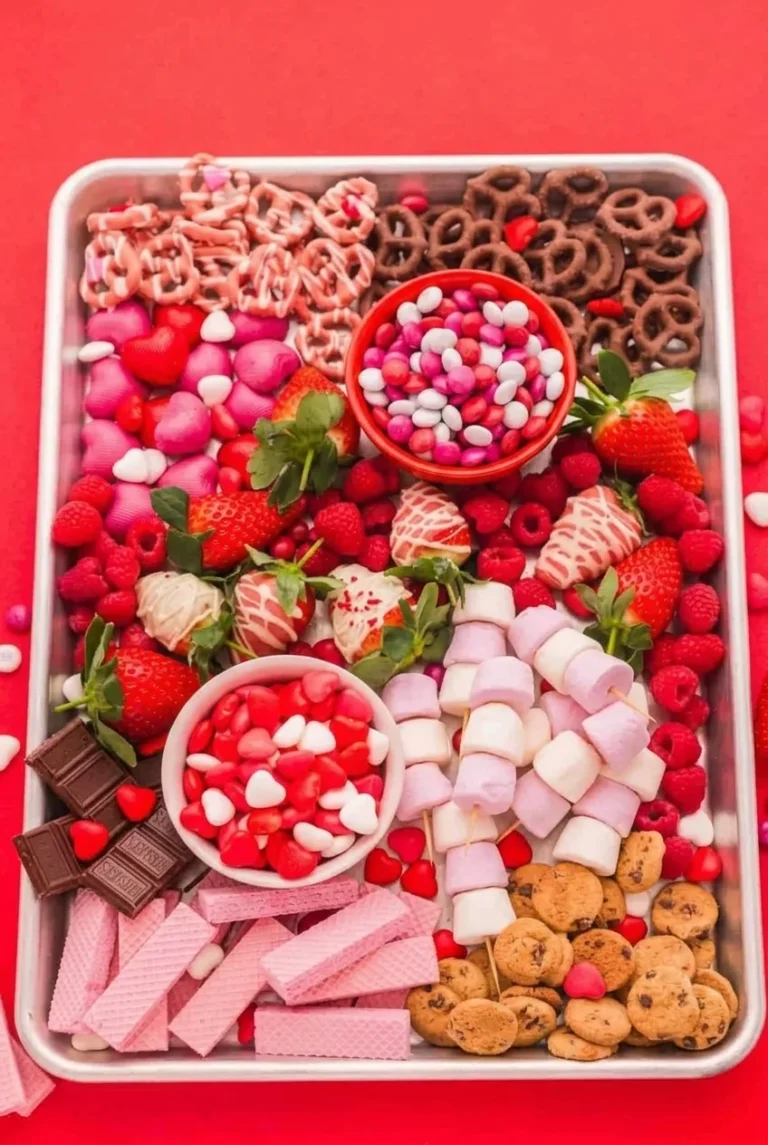
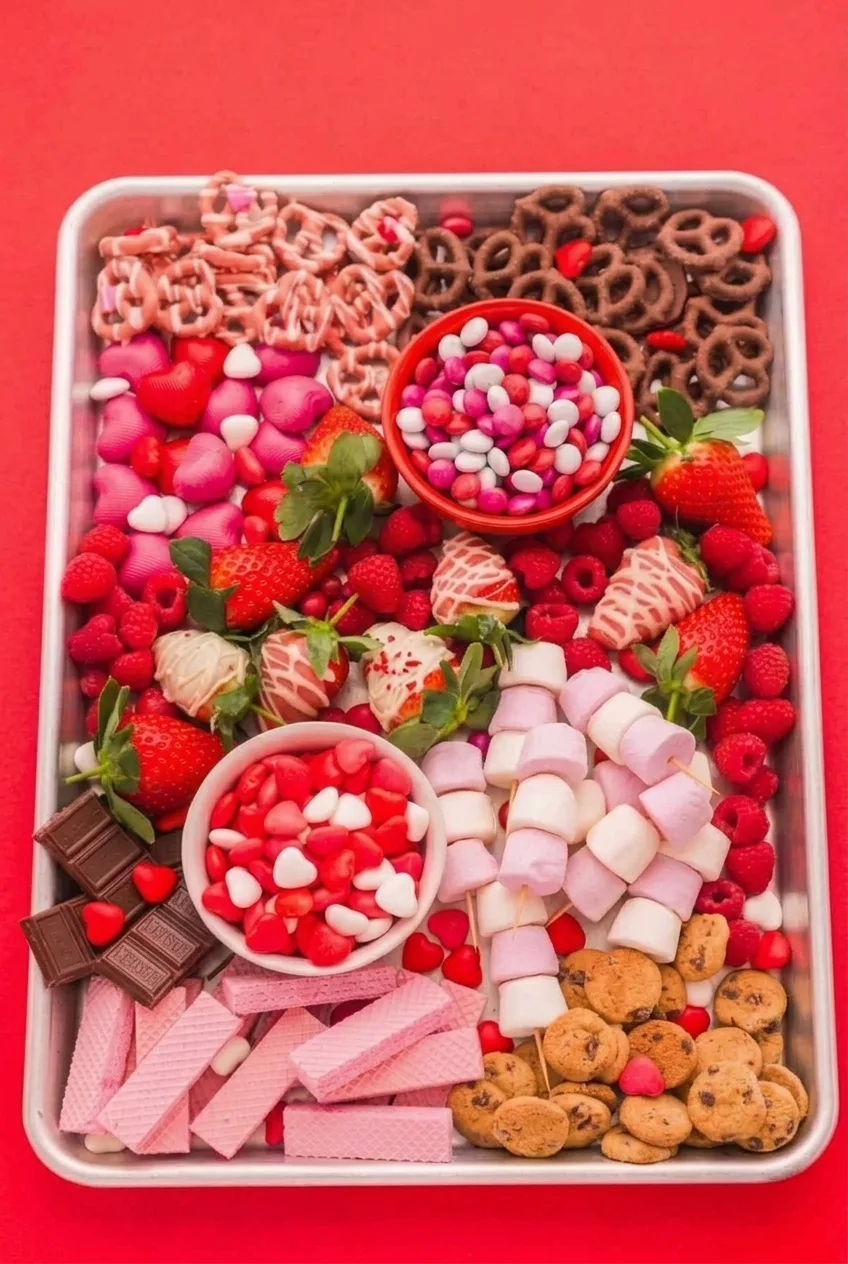
Pink pretzels, chocolate, cookies, marshmallows, and berries make this a dessert-only charcuterie board—no meat or cheese needed. A rectangular rimmed tray contains the small pieces, while two candy bowls give the assortment structure.

Assembly takes about 25 minutes and makes enough for approximately 8 to 10 dessert grazers. Place the bowls and larger snacks first, then add thoroughly dried berries near serving so the wafers stay crisp and the dipped strawberries keep their set coatings.

Ingredients for the Valentine’s Day Charcuterie Board

Complete Valentine's Day dessert tray with two candy bowls and distinct sweet clusters on a red surface
  • About 8 oz prepared pink-coated mini pretzels with white drizzle (225g)
  • About 8 oz chocolate-covered mini pretzels (225g)
  • About 1 cup red, pink, and white candy-coated chocolates (180g)
  • About 3/4 cup red and white heart-shaped candies (130g)
  • About 6 oz pink and red wrapped heart-shaped chocolates (170g)
  • About 12 medium fresh strawberries (300g)
  • About 6 prepared chocolate-dipped or white-chocolate-drizzled strawberries (180g), with coatings fully set
  • One 6-oz package fresh raspberries (170g)
  • About 18 to 24 medium pink and white marshmallows (140g)
  • About 6 oz pink wafer cookies (170g)
  • About 6 oz mini chocolate-chip cookies (170g)
  • About 3 oz segmented chocolate bar (85g)

You will also need a clean, food-safe rimmed sheet pan, approximately 18 by 13 inches, two small food-safe bowls, and three short food-safe skewers. Amounts are estimates for a full tray; save any extras rather than crowding or crushing the fruit.

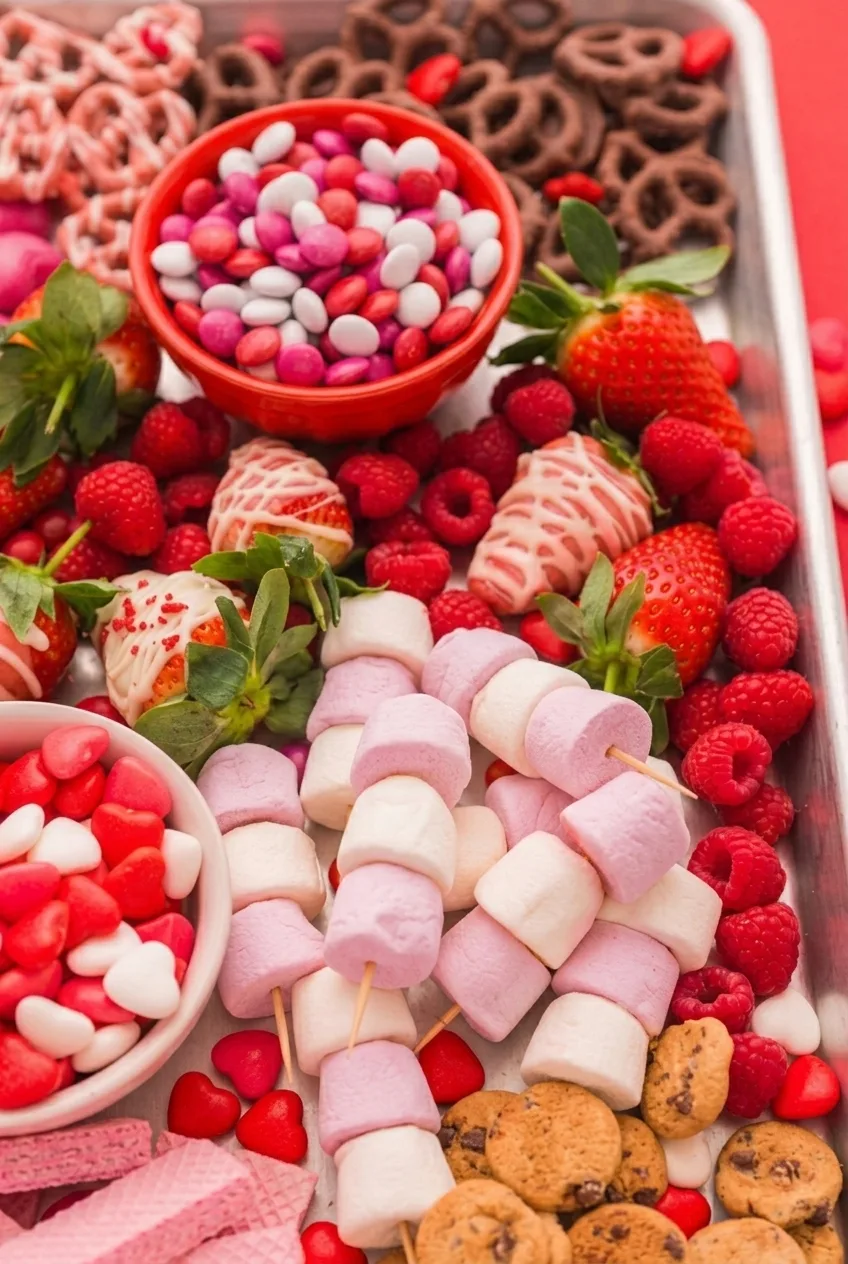
Close view of dipped strawberries, raspberries and pink-and-white marshmallow skewers on the dessert tray

How to Assemble the Board

  1. Prepare the fruit and tray: Wash the undipped strawberries and raspberries and dry them thoroughly. Set both empty bowls on the tray to check the space before opening every snack package. Keep the prepared dipped strawberries chilled until assembly.
  2. Place the candy bowls: Fill one bowl with candy-coated chocolates and set it near the upper center. Fill the other with heart-shaped candies and place it below center, toward the left. Check that both bowls sit flat.
  3. Build the snack clusters: Group the pink-coated pretzels at the upper left and chocolate-covered pretzels at the upper right. Place wrapped heart chocolates along the left side, pink wafers and chocolate squares toward the lower left, and mini cookies at the lower right. Keep the clusters distinct and the delicate cookies uncrushed.
  4. Add the marshmallow skewers: Thread alternating pink and white marshmallows onto three short skewers. Lay them diagonally in the middle-right area, entirely within the tray, with sharp points covered or otherwise out of guests’ reach.
  5. Finish near serving: Arrange whole strawberries and fully set dipped strawberries in loose groups through the middle. Add raspberries around them, away from the wafers and cookies. Tuck a few remaining heart candies into gaps. The tray should look full, but each piece should still be easy to pick up.

Adjusting the Board to Your Tray

If the tray fills before you use everything, reserve the extra snacks. If it looks sparse, add more of a dry snack already on the board or use a smaller rimmed tray. For a smaller tray, reduce the quantities while keeping both candy bowls and the contrasting clusters.

Seasonal candy varieties can change without changing the layout: keep the two bowls and a mix of red, pink, and white sweets. For guests with dietary restrictions, check each packaged ingredient’s label and consider cross-contact; candy color does not indicate allergen suitability.

Keeping Berries and Cookies Fresh

Water on washed berries can soften wafers and cookies, so dry the fruit completely and add it close to serving. Place dipped strawberries in a loose, single layer to avoid smearing their coatings. If decorating the strawberries yourself, let the coatings set fully before the 25-minute board assembly begins.

Make-Ahead and Leftovers

Set out the empty bowls and portion covered dry snacks ahead. Keep thoroughly dried fresh berries and prepared dipped strawberries chilled separately until you are ready to finish the board. Once fruit is on the tray, limit its time at room temperature to 2 hours, or 1 hour above 90°F (30°C).

After serving, separate leftover fruit and dipped strawberries from the dry sweets. Refrigerate the berries in covered containers, following any purchased product’s storage label. Store pretzels, candy, wafers, and cookies separately in airtight containers according to their package directions. The assembled board is not a good candidate for freezing.

Nutrition

Approximate nutrition per serving, based on 9 servings and using all listed ingredients: 870 calories, 8g protein, 38g fat, and 124g carbohydrates. Per 100g: approximately 365 calories, 3g protein, 16g fat, and 52g carbohydrates. Values vary substantially by brand, candy selection, and how much of each snack guests take.

Valentine's Day Charcuterie Board

A dessert-only board of pretzels, candies, cookies, marshmallows, chocolate, and fresh berries.
Course: Dessert
Cuisine: American
Prep: 25 min
Total: 25 min
Servings: 9 Calories: 870 kcal

Equipment

  • 18-by-13-inch rimmed sheet pan
  • 2 small food-safe bowls
  • 3 short food-safe skewers

Ingredients

For the Board

  • About 8 oz prepared pink-coated mini pretzels with white drizzle (225 g)
  • About 8 oz chocolate-covered mini pretzels (225 g)
  • About 1 cup red, pink, and white candy-coated chocolates (180 g)
  • About 3/4 cup red and white heart-shaped candies (130 g)
  • About 6 oz pink and red wrapped heart-shaped chocolates (170 g)
  • About 12 medium fresh strawberries (300 g)
  • About 6 prepared chocolate-dipped or white-chocolate-drizzled strawberries (180 g), with coatings fully set
  • One 6 oz package fresh raspberries (170 g)
  • About 18 to 24 medium pink and white marshmallows (140 g)
  • About 6 oz pink wafer cookies (170 g)
  • About 6 oz mini chocolate-chip cookies (170 g)
  • About 3 oz segmented chocolate bar (85 g)

Instructions

  1. Wash the undipped strawberries and raspberries, then dry them thoroughly. Keep the dipped strawberries chilled until assembly.
  2. Set two empty bowls on the tray to check the layout. Fill one with candy-coated chocolates and place it near the upper center; fill the other with heart-shaped candies and place it below center toward the left.
  3. Arrange the pink-coated pretzels at the upper left and chocolate-covered pretzels at the upper right. Place wrapped heart chocolates along the left side, wafers and chocolate squares toward the lower left, and mini cookies at the lower right.
  4. Thread alternating pink and white marshmallows onto three short skewers. Lay them diagonally in the middle-right area, keeping them within the tray and covering or pointing the sharp ends away from guests.
  5. Near serving, arrange the whole and dipped strawberries in loose groups through the middle. Add raspberries around them, away from the wafers and cookies, and tuck remaining heart candies into open spaces.

Tips

  • Dry washed berries completely to help keep the wafers and cookies crisp.
  • Add fresh berries close to serving time.
  • Arrange dipped strawberries in a loose single layer to avoid smearing their coatings.
  • Reserve extra snacks rather than crowding or crushing the fruit.
  • Check packaged ingredients for allergens and cross-contact; candy color does not indicate allergen suitability.

Variations

  • Seasonal Candy Board: Swap in seasonal candy varieties while keeping the two bowls and a mix of red, pink, and white sweets.

Notes

Keep berries and dipped strawberries chilled separately until assembly. Limit the assembled board’s time at room temperature to 2 hours, or 1 hour above 90°F (30°C). Refrigerate leftover fruit separately and store dry sweets in airtight containers. Do not freeze the assembled board.

Nutrition

Calories: 870 kcal | Protein: 8 g | Fat: 38 g | Carbohydrates: 124 g | Per 100g Calories: 365 kcal | Per 100g Protein: 3 g | Per 100g Fat: 16 g | Per 100g Carbohydrates: 52 g

Birthday Party Charcuterie Board

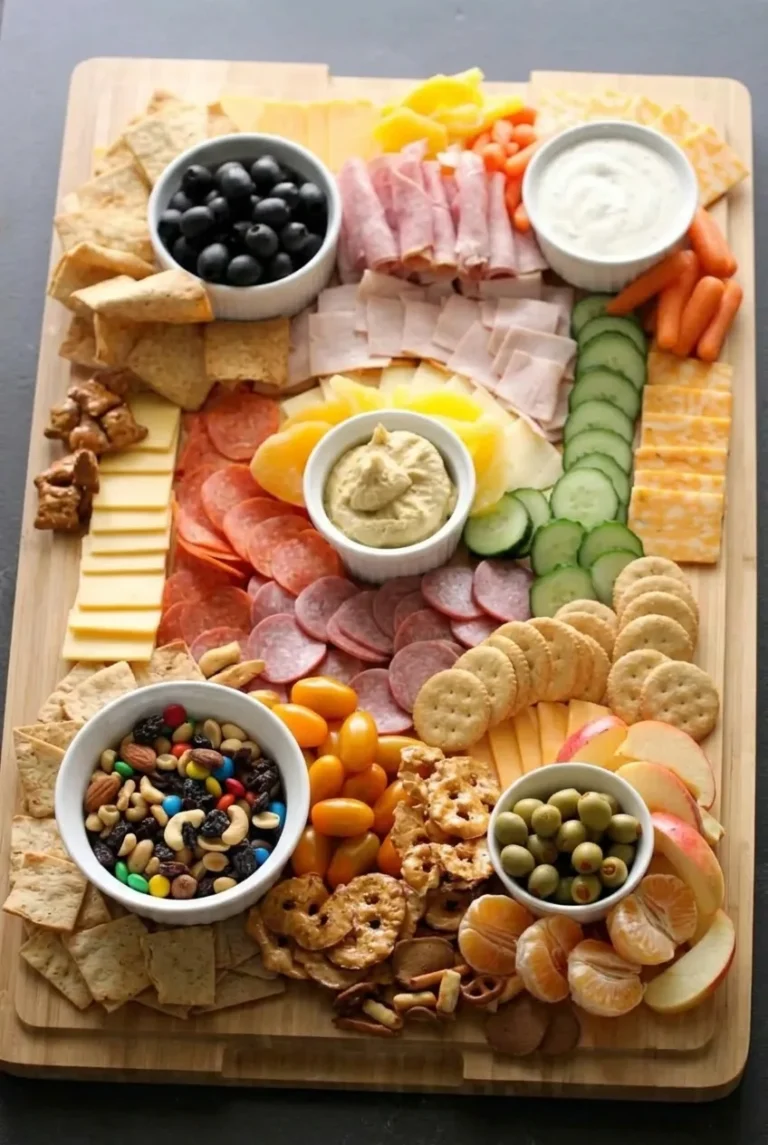
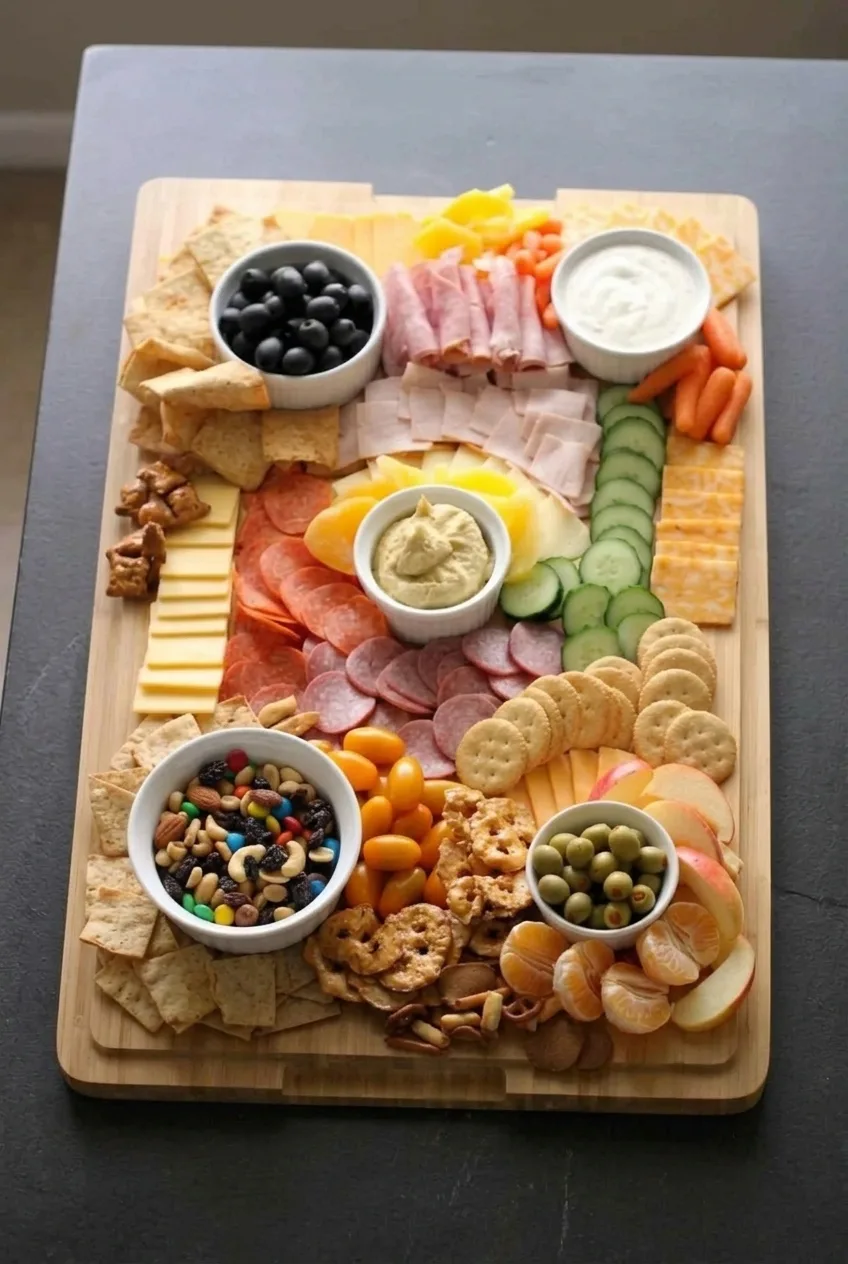
This no-cook birthday party charcuterie board serves about 12 as an appetizer. Five small bowls anchor a generous spread of folded meats, mild cheeses, crisp snacks, dips, olives, fruit, and vegetables. The result is a full, informal board with distinct clusters guests can pick from easily.

Set the bowls and larger foods in place first, then fill the gaps. Add crackers, pita chips, and pretzel crisps close to serving so they stay crisp.

Ingredients for a Birthday Party Charcuterie Board

Complete birthday party charcuterie board on a wooden board with five white bowls and assorted snacks
  • 6 ounces sliced mild cheddar cheese (170g)
  • 6 ounces sliced Monterey Jack cheese (170g)
  • 5 ounces ready-to-eat sliced ham (140g)
  • 5 ounces ready-to-eat sliced turkey (140g)
  • 6 ounces sliced salami and pepperoni, total (170g)
  • 1 package round crackers, about 8 ounces (225g)
  • 8 ounces pita chips and pretzel crisps, total (225g)
  • 3/4 cup hummus (180g)
  • 3/4 cup ranch dip (180g)
  • 3/4 cup pitted black olives, drained
  • 3/4 cup pitted green olives, drained (about 220g olives total)
  • 3/4 cup trail mix containing nuts, dried fruit, and small colorful pieces (105g)
  • 1 English cucumber
  • 8 ounces baby carrots (225g)
  • 1 pint small tomatoes
  • 2 apples
  • 4 mandarins

Optional: Add wedges from 1 orange if there is room.

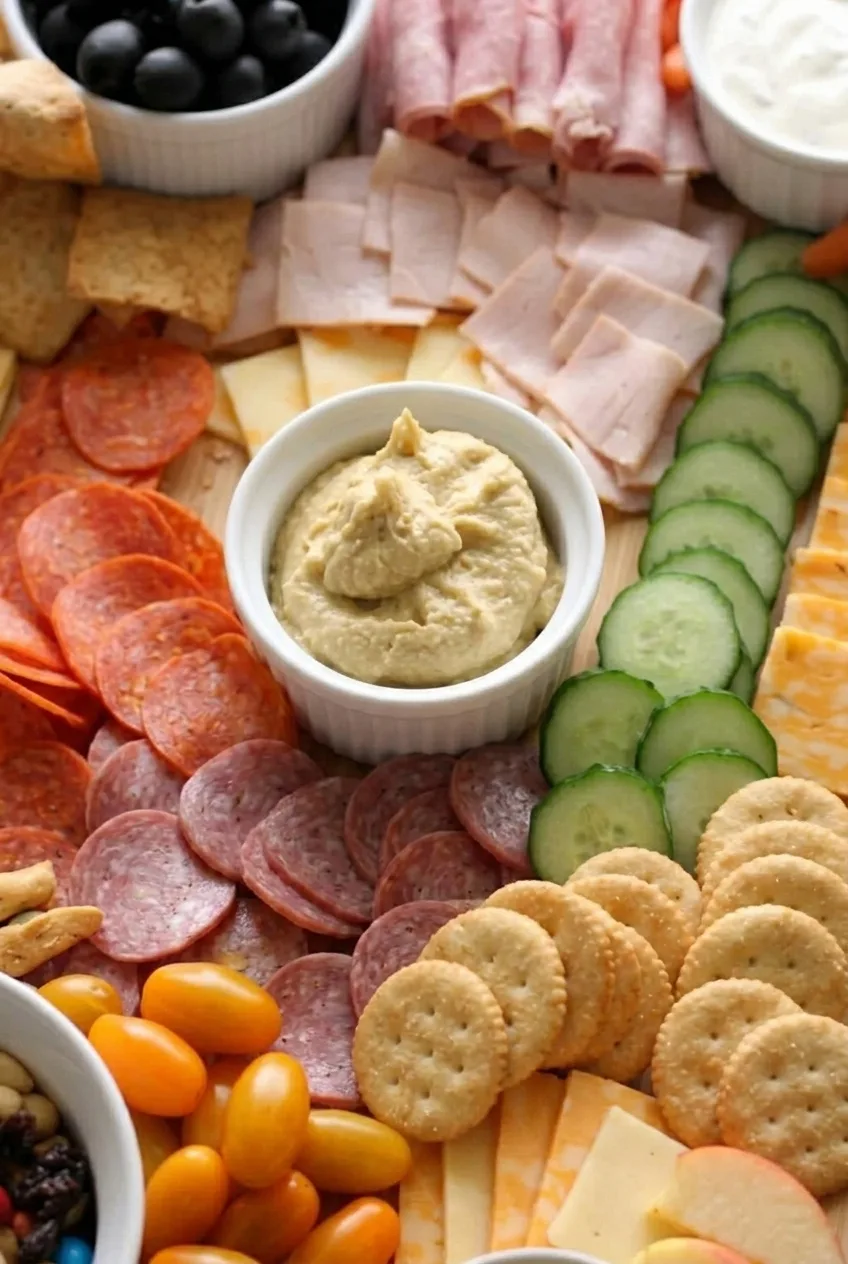
Close view of hummus, folded deli meats, cheese, crackers, and cucumber on the charcuterie board

How to Assemble the Board

Allow 25 to 30 minutes for preparation and assembly. Use a clean, food-safe rectangular board about 18 by 24 inches and five small bowls. You can divide the assortment between two smaller trays if needed; fit will depend on the size of your bowls and food pieces.

  1. Prepare the produce: Wash and dry the cucumber, carrots, tomatoes, apples, and mandarins. Slice the cucumber into rounds and the apples into easy-to-pick-up pieces. Peel and separate the mandarins, and drain both kinds of olives. Dry produce will help keep nearby crackers crisp.
  2. Place the five bowls: Put the hummus, ranch dip, black olives, green olives, and trail mix in separate bowls. Space them across the board so each sits flat and guests can reach the dips. Leave room between the bowls for larger food clusters.
  3. Arrange the meats and cheeses: Roll the ham, loosely fold the turkey, and overlap the salami and pepperoni in distinct clusters. Fan out both cheeses nearby, cutting some slices into cracker-size pieces if needed.
  4. Add fruit and vegetables: Place the cucumber, carrots, and tomatoes near the dips. Tuck the apple slices and mandarin segments into larger open spaces and around the outer edges.
  5. Finish with crisp foods: Just before serving, add the round crackers, pita chips, and pretzel crisps in separate clusters, away from wet produce and the dips. Fill small gaps, but leave enough space to lift individual pieces. Refrigerate any reserved meat, cheese, and dips for replenishing the board.

Set out small tongs or dedicated spoons for the bowls. For a bigger gathering, see this large charcuterie board for a crowd.

Serving Younger Guests and Managing Allergens

Use pitted olives. Cut olives, small tomatoes, and other round foods as appropriate for the ages of the children being served; baby carrots may also need to be cut into manageable pieces. Do not assume every item on the assembled board is suitable for young children.

Trail mix contains nuts and may contain other allergens. Keep its bowl and utensil separate and away from guests who should not have it. For a nut-free adaptation, replace it with an appropriate nut-free snack in its own bowl, and check labels and cross-contact rather than assuming the entire board is allergy-safe. For a separate meat-free spread, try this vegetarian charcuterie board.

Make-Ahead, Replenishment, and Storage

Wash and cut sturdy produce ahead of time, and portion the bowl ingredients. Cover and refrigerate perishable components until assembly. Slice the apples and add the crunchy foods close to serving. For a longer party, start with only some of the meat, cheese, and dips on the board and refill from chilled reserves.

Do not leave perishable foods at room temperature for more than 2 hours, or more than 1 hour when it is above 90°F (30°C). Promptly refrigerate suitable leftovers in separate covered containers, considering their packaging, handling, and time out of refrigeration. Discard perishables that exceed those limits. Freezing the assembled board is not recommended.

Nutrition

Approximate per appetizer portion, based on 12 portions: 535 calories, 21g protein, 31g fat, and 46g carbohydrates. Approximate per 100g: 185 calories, 7g protein, 11g fat, and 16g carbohydrates. Values will vary with brands, portion sizes, and which foods each guest selects.

Birthday Party Charcuterie Board

A no-cook appetizer board with meats, cheeses, dips, olives, fruit, vegetables, and crunchy snacks for about 12 people.
Course: Appetizer
Cuisine: American
Prep: 30 min
Total: 30 min
Servings: 12

Equipment

  • 18-by-24-inch food-safe board
  • 5 small bowls
  • Knife
  • Tongs or serving spoons

Ingredients

  • 6 ounces sliced mild cheddar cheese (170 g)
  • 6 ounces sliced Monterey Jack cheese (170 g)
  • 5 ounces ready-to-eat sliced ham (140 g)
  • 5 ounces ready-to-eat sliced turkey (140 g)
  • 6 ounces sliced salami and pepperoni, total (170 g)
  • 1 package round crackers, about 8 ounces (225 g)
  • 8 ounces pita chips and pretzel crisps, total (225 g)
  • 3/4 cup hummus (180 g)
  • 3/4 cup ranch dip (180 g)
  • 3/4 cup pitted black olives, drained
  • 3/4 cup pitted green olives, drained (about 220 g olives total)
  • 3/4 cup trail mix containing nuts, dried fruit, and small colorful pieces (105 g)
  • 1 English cucumber
  • 8 ounces baby carrots (225 g)
  • 1 pint small tomatoes
  • 2 apples
  • 4 mandarins
  • Optional: Wedges from 1 orange

Instructions

  1. Wash and dry the cucumber, carrots, tomatoes, apples, and mandarins. Drain both kinds of olives.
  2. Slice the cucumber into rounds and the apples into easy-to-pick-up pieces. Peel and separate the mandarins.
  3. Spoon the hummus, ranch dip, black olives, green olives, and trail mix into five separate bowls. Arrange the bowls across the board.
  4. Roll the ham, loosely fold the turkey, and arrange the salami and pepperoni in separate clusters.
  5. Fan out the cheddar and Monterey Jack nearby. Cut some slices into cracker-size pieces if needed.
  6. Arrange the cucumber, carrots, and tomatoes near the dips. Tuck the apple slices and mandarin segments into open spaces and around the edges.
  7. Just before serving, add the crackers, pita chips, and pretzel crisps in separate clusters away from wet produce and dips.
  8. Set out tongs or dedicated spoons for the bowls. Refrigerate reserved meat, cheese, and dips for replenishing the board.

Tips

  • Use a clean, food-safe board and make sure the produce is dry to help keep crackers crisp.
  • Add crackers, pita chips, and pretzel crisps close to serving.
  • For a longer party, put only some of the meat, cheese, and dips on the board and replenish from chilled reserves.
  • Use two smaller trays if the assortment does not fit comfortably on one board.

Variations

  • Nut-Free Board: Replace the trail mix with an appropriate nut-free snack in its own bowl, and check labels and cross-contact.
  • Orange-Finished Board: Add wedges from 1 orange if there is room.

Notes

Keep perishable foods at room temperature no longer than 2 hours, or 1 hour above 90°F (30°C). Cut round foods and baby carrots appropriately for young children; keep trail mix and its utensil separate from guests avoiding allergens. Refrigerate suitable leftovers promptly in covered containers; do not freeze the assembled board.

Nutrition

Per Serving Calories: 535 kcal | Per Serving Protein: 21 g | Per Serving Fat: 31 g | Per Serving Carbohydrates: 46 g | Per 100g Calories: 185 kcal | Per 100g Protein: 7 g | Per 100g Fat: 11 g | Per 100g Carbohydrates: 16 g

Vegetarian Charcuterie Board

Tabbouleh and roasted red pepper hummus anchor this Mediterranean-inspired vegetarian charcuterie board. Cucumber, radishes, fruit, pita, crackers, olives, and artichokes fill out the round platter without cheese or meat substitutes.

The key is to set out seven bowls first, then arrange the dippers and produce around them. Bowls contain the moist ingredients, while separate pita and cracker clusters stay easy to reach. Assembly takes about 25 minutes and serves eight as an appetizer.

Ingredients for the Board

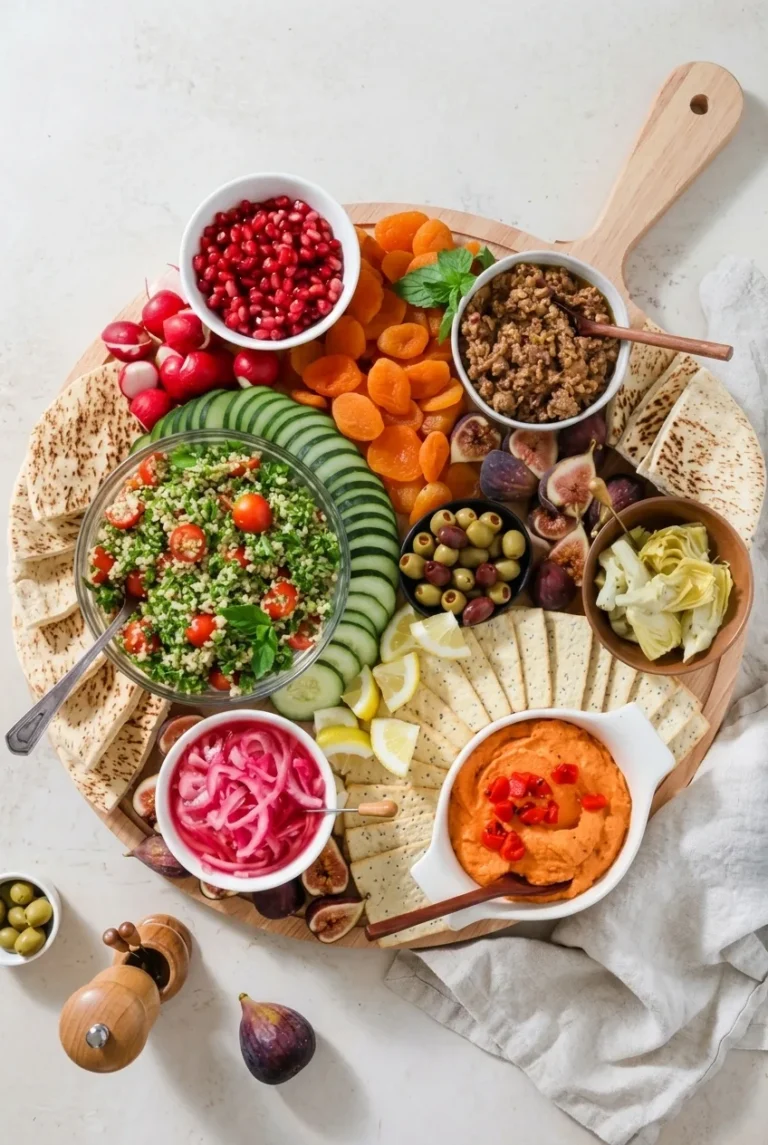
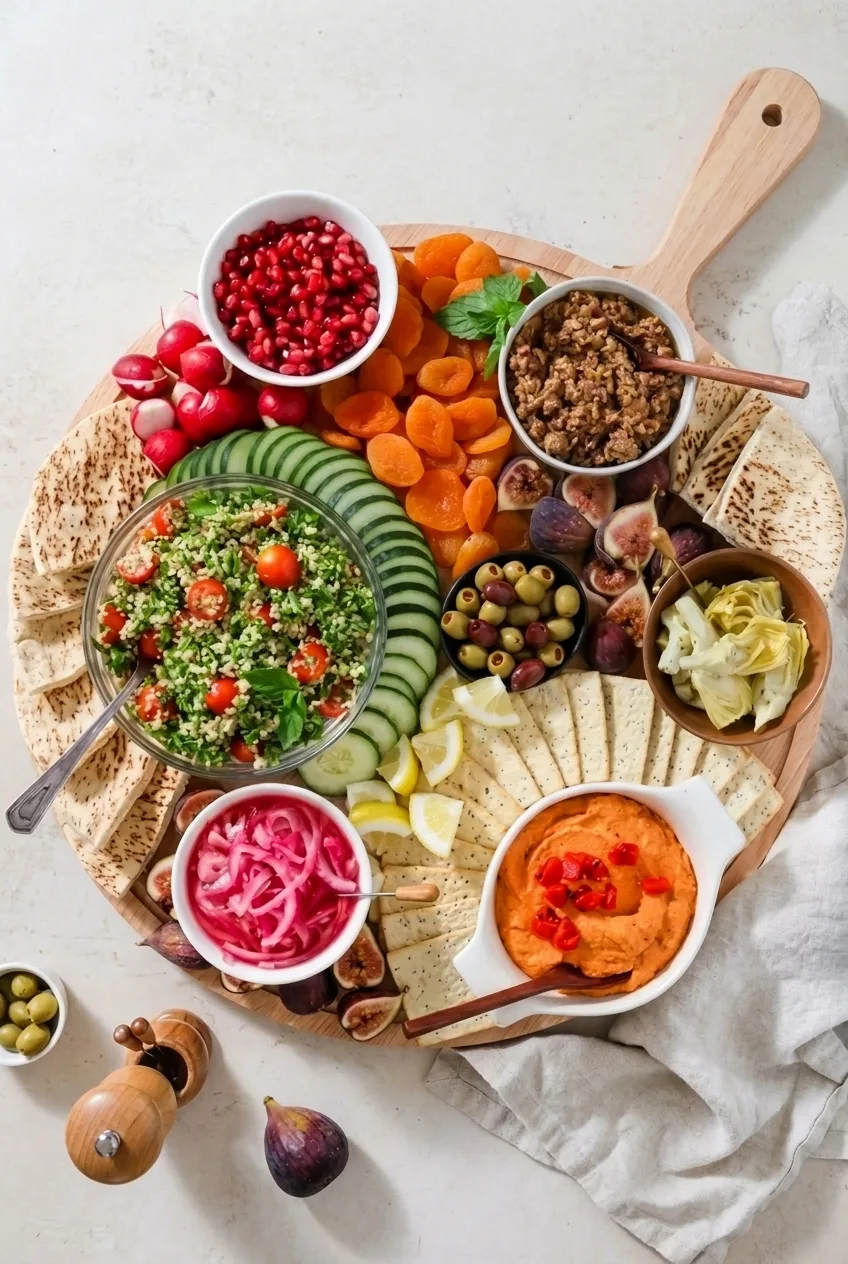
Full vegetarian charcuterie board on a round wooden platter with neutral tabletop visible around it
  • 2 cups prepared tabbouleh (about 400g)
  • 1 1/2 cups prepared roasted red pepper hummus (about 360g)
  • 2 tablespoons diced roasted red pepper
  • 3/4 cup prepared pickled red onions, drained (about 90g)
  • 3/4 cup pomegranate arils (about 130g)
  • 3/4 cup mixed olives, drained (about 115g)
  • 1 cup marinated artichoke hearts, drained (about 170g)
  • 1/2 cup coarsely chopped walnuts (about 60g)
  • 1 large English cucumber, thinly sliced (about 300g)
  • 4 pita rounds, cut into wedges (about 240g)
  • 4 ounces rectangular crackers or crispbreads (about 115g)
  • 1 small bunch radishes, about 8, trimmed (about 150g)
  • 1 cup dried apricots (about 130g)
  • 5 or 6 fresh figs, halved (about 250g)
  • 1 lemon, cut into small wedges
  • 2 or 3 small fresh mint sprigs, optional

These amounts are practical estimates for a 16- to 18-inch round board. You’ll also need seven small food-safe bowls, serving spoons, and, if helpful, small tongs or picks.

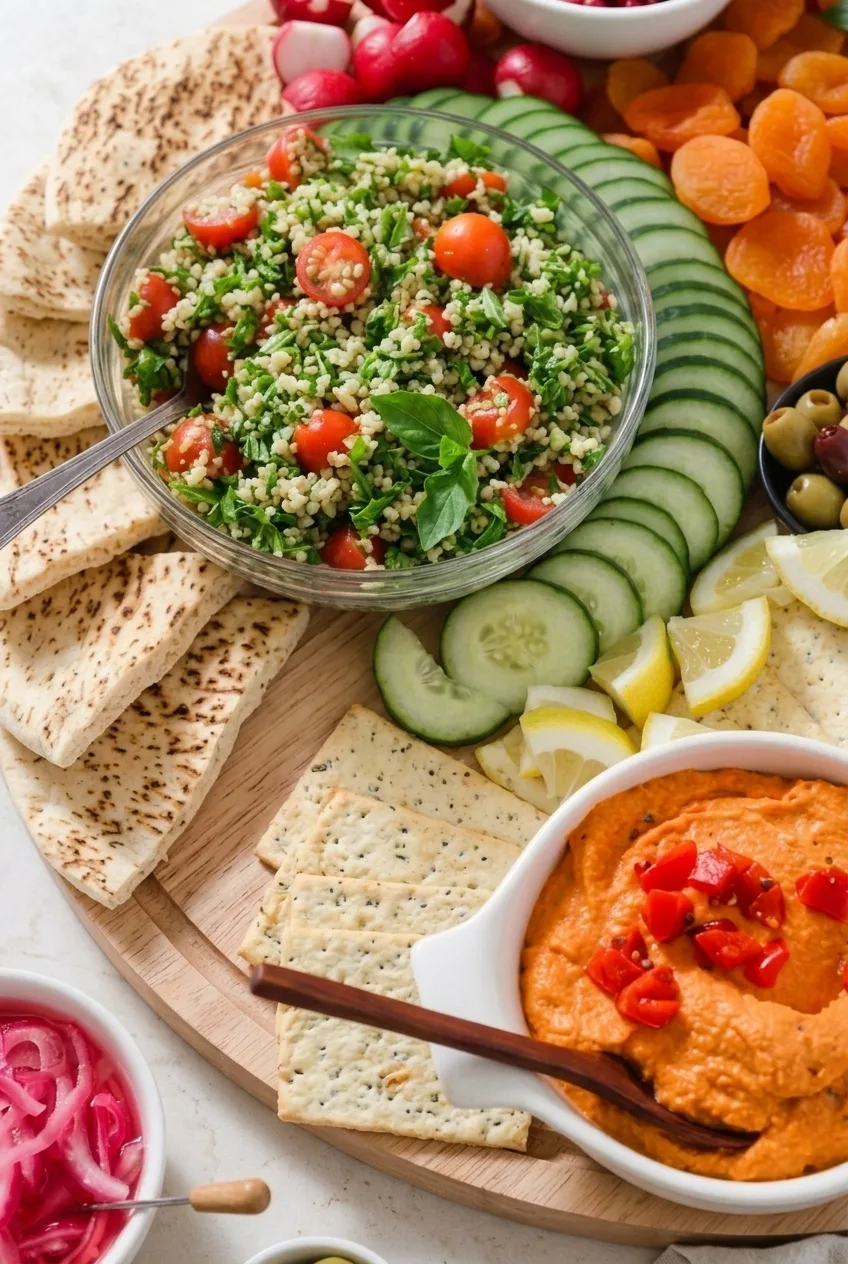
Close view of tabbouleh, roasted red pepper hummus, overlapping cucumber, pita, and crackers

How to Assemble the Vegetarian Charcuterie Board

  1. Prepare the components: Wash and dry the cucumber, radishes, figs, and lemon. Slice the cucumber, halve the figs, trim the radishes, and cut the lemon and pita into wedges. Drain the onions, olives, and artichokes until moist but not dripping.
  2. Place the seven bowls: Put the tabbouleh and hummus in two larger bowls. Fill five smaller bowls with the onions, pomegranate arils, olives, artichokes, and walnuts. Top the hummus with diced roasted red pepper. Set the bowls securely across the board, leaving room beside the tabbouleh for cucumber and along the edges for pita and crackers.
  3. Arrange the cucumber and dippers: Overlap the cucumber slices in a broad curve between the tabbouleh and the center of the board. Fan the pita wedges along the left side and the rectangular crackers along the lower right. Keep the crackers away from damp produce and brined foods so they stay crisp.
  4. Fill the open spaces: Add the radishes, dried apricots, fig halves, and lemon wedges in separate clusters. Tuck in mint, if using. Leave enough space to reach each bowl and lift a cracker without disturbing nearby food. Serve with spoons and small tongs or picks.

If the bowls crowd your board, move some components to a second platter rather than covering the cucumber arc or packing the crackers too tightly.

What to Prepare Ahead

Buy or prepare the tabbouleh, hummus, and pickled onions ahead and refrigerate them separately. Cut the pita in advance if convenient, but keep the crackers sealed and dry. Slice the figs and cucumber and assemble the board close to serving so the produce looks fresh and the crackers stay crisp. Ready-to-eat pita needs no heating.

Figs, Nuts, and Dietary Checks

If fresh figs are unavailable, use a similar-sized cluster of fresh grapes. Let guests know the board contains walnuts.

The main board has no cheese, but it is not automatically vegan: check prepared tabbouleh, hummus, pickles, pita, and crackers for animal-derived ingredients. If adding cheese to a vegetarian version, choose an animal-rennet-free variety and place it on a larger board or separate platter. For a different fruit-and-cheese format, see this summer charcuterie board.

Storing Leftovers

Refrigerate perishable leftovers promptly in airtight containers. Keep moist components separate from pita and crackers, and store crackers dry. Some components may remain suitable for up to three days, but judge each separately; cut cucumber and figs may lose quality sooner. Freezing the assembled board is not recommended.

Nutrition

Approximate nutrition per serving, based on 8 appetizer servings: 475 calories, 11g protein, 19g fat, and 69g carbohydrates. Approximate values per 100g: 145 calories, 3g protein, 6g fat, and 21g carbohydrates. Values vary with the prepared ingredients and how much of each component guests take.

Vegetarian Charcuterie Board

A Mediterranean-inspired appetizer board with tabbouleh, roasted red pepper hummus, fresh produce, pita, crackers, olives, and artichokes.
Course: Appetizer
Cuisine: Mediterranean
Prep: 25 min
Total: 25 min
Servings: 8 Calories: 475 kcal

Equipment

  • 16- to 18-inch round serving board
  • Seven small food-safe bowls
  • Serving spoons
  • Small tongs or picks
  • Knife
  • Cutting board

Ingredients

Bowls

  • 2 cups prepared tabbouleh (about 400 g)
  • 1 1/2 cups prepared roasted red pepper hummus (about 360 g)
  • 2 tablespoons diced roasted red pepper
  • 3/4 cup prepared pickled red onions, drained (about 90 g)
  • 3/4 cup pomegranate arils (about 130 g)
  • 3/4 cup mixed olives, drained (about 115 g)
  • 1 cup marinated artichoke hearts, drained (about 170 g)
  • 1/2 cup coarsely chopped walnuts (about 60 g)

Produce and Dippers

  • 1 large English cucumber, thinly sliced (about 300 g)
  • 4 pita rounds, cut into wedges (about 240 g)
  • 4 ounces rectangular crackers or crispbreads (about 115 g)
  • 1 small bunch radishes, about 8, trimmed (about 150 g)
  • 1 cup dried apricots (about 130 g)
  • 5 or 6 fresh figs, halved (about 250 g)
  • 1 lemon, cut into small wedges
  • 2 or 3 small fresh mint sprigs, optional

Instructions

  1. Wash and dry the cucumber, radishes, figs, and lemon.
  2. Thinly slice the cucumber, trim the radishes, halve the figs, and cut the lemon and pita into wedges.
  3. Drain the pickled onions, olives, and artichokes until moist but not dripping.
  4. Spoon the tabbouleh and hummus into two larger bowls. Fill five smaller bowls with the onions, pomegranate arils, olives, artichokes, and walnuts.
  5. Top the hummus with the diced roasted red pepper, then arrange all seven bowls securely across the board.
  6. Overlap the cucumber slices in a broad curve between the tabbouleh and the center of the board.
  7. Fan the pita wedges along the left side and the crackers along the lower right, away from damp produce and brined foods.
  8. Arrange the radishes, dried apricots, fig halves, and lemon wedges in separate clusters. Add mint, if using.
  9. Leave room to reach each bowl and lift the crackers easily. Serve with spoons and small tongs or picks.

Tips

  • Drain brined ingredients well so they do not make nearby foods soggy.
  • Keep crackers away from moist produce and brined foods to help them stay crisp.
  • Assemble close to serving time so the cucumber and figs look fresh.
  • If the bowls crowd the board, move some components to a second platter.
  • Keep crackers sealed and dry until serving.

Variations

  • Grape and Fig Swap: Replace the fresh figs with a similar-sized cluster of fresh grapes.
  • Vegetarian Cheese Addition: Add an animal-rennet-free cheese and serve it on a larger board or separate platter.

Notes

Refrigerate perishable leftovers promptly in airtight containers, keeping moist components separate from pita and crackers. Some components may keep for up to three days, though cucumber and figs may lose quality sooner. Do not freeze the assembled board. Check prepared ingredients for animal-derived ingredients if serving vegan guests; the board contains walnuts. Approximate nutrition per 100 g: 145 calories, 3 g protein, 6 g fat, and 21 g carbohydrates.

Nutrition

Calories: 475 kcal | Protein: 11 g | Fat: 19 g | Carbohydrates: 69 g

Dessert Charcuterie Board

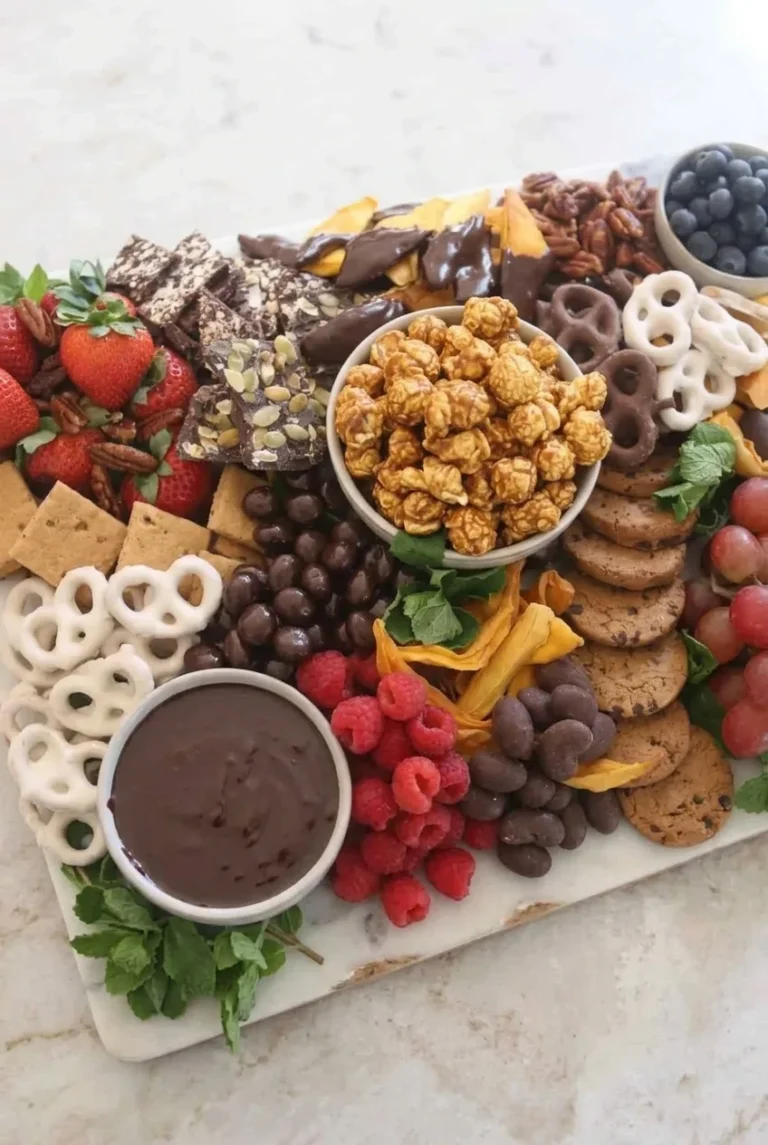
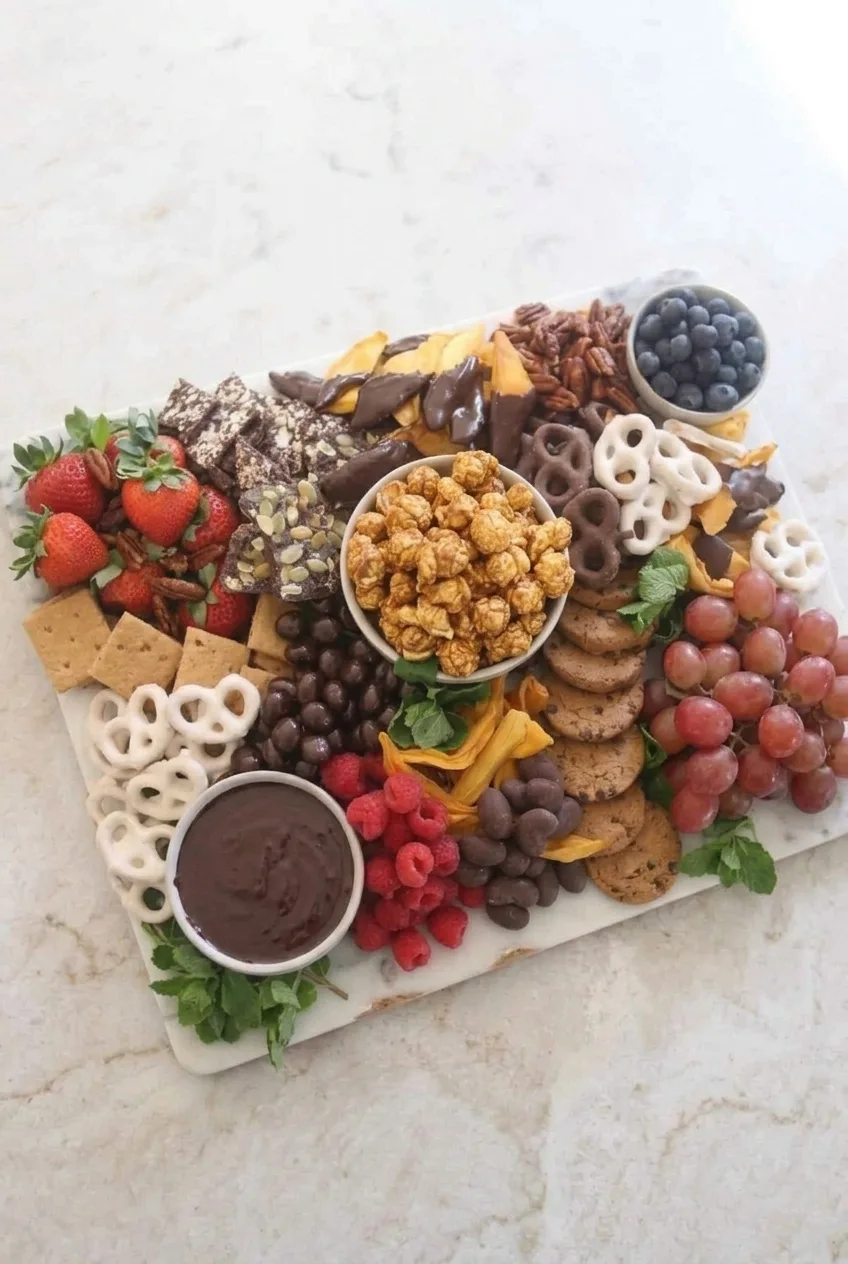
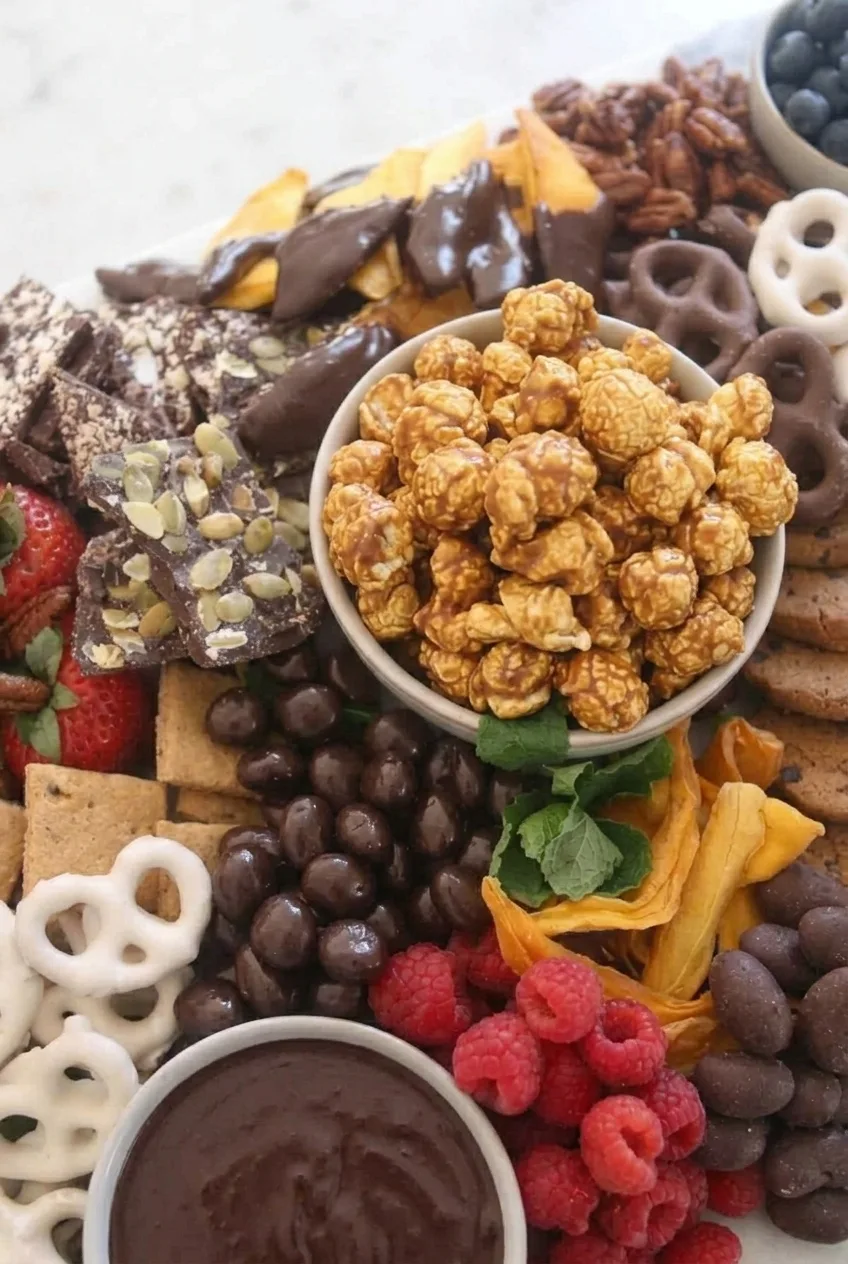
A bowl of caramel popcorn anchors this no-cook dessert board, with chocolate dip and blueberries in separate bowls nearby. Clusters of fresh fruit, cookies, chocolate bark, coated pretzels, pecans, and dried mango fill the platter with bites guests can easily pick up and share.

Placing the bowls and larger treats first makes the crowded arrangement easier to build without burying the dip or fruit. The amounts make an abundant grazing dessert for about eight people, though what fits will depend on the size of your platter.

Ingredients for the Dessert Board

Full dessert charcuterie board on a light platter, surrounded by a simple neutral tabletop
  • 4 cups caramel popcorn
  • 3/4 cup ready-to-serve chocolate dessert dip, spoonable at serving temperature
  • 1 lb fresh strawberries (450g)
  • 1 container fresh raspberries, about 6 oz (170g)
  • 1 cup fresh blueberries (about 150g)
  • 1 lb seedless grapes (450g)
  • 8 oz assorted chocolate bark, including textured or nut-topped pieces, broken into pieces (225g)
  • About 4 oz chocolate-coated mini pretzels (115g)
  • About 4 oz white-coated mini pretzels (115g)
  • 12 medium chocolate chip cookies
  • 6 full graham cracker sheets, broken into squares
  • 1 cup pecan halves (about 100g)
  • About 4 oz plain dried mango strips and 4 oz chocolate-dipped dried mango strips (225g total)
  • About 1 cup chocolate-covered bite-size candies or fruit

Optional: A few small fresh mint sprigs.

Close view of caramel popcorn beside textured chocolate bark, coated pretzels, and fresh fruit

How to Assemble the Dessert Charcuterie Board

Prep time: 20–25 minutes with purchased, ready-to-serve treats. Cook time: 0 minutes. Serves: About 8 as a grazing dessert. You’ll need a large serving board or platter, three small bowls, and a clean towel or paper towels for drying the fruit.

  1. Prepare the fruit: Wash the strawberries, raspberries, blueberries, and grapes, then dry them thoroughly. Leave the strawberries whole and, if desired, keep the grapes in small, easy-to-grab bunches. No water should collect beneath the fruit.
  2. Place the bowls: Fill one bowl with caramel popcorn and set it near the center of the platter. Place the chocolate dip toward a lower corner and the blueberries in a third bowl across the platter near an upper corner. Leave room for guests to reach each bowl.
  3. Add the largest clusters: Mound the strawberries and grapes in separate areas. Overlap the bark for height, then stack or fan the cookies and graham crackers in other open spaces. Check how much room remains before adding the smaller treats.
  4. Arrange the remaining fruit and crunch: Pile the chocolate-coated and white-coated pretzels in separate spots. Add distinct clusters of raspberries and pecans, then arrange the plain and chocolate-dipped mango strips where their orange color stays visible.
  5. Fill the gaps: Tuck the chocolate-covered bites into spaces between larger clusters. Add mint sprigs if using. Little platter should show, but the dip should remain reachable and individual treats should be easy to lift.

How to Keep Cookies and Pretzels Crisp

Dry the washed fruit well before arranging it. Where possible, keep juicy fruit from resting directly against graham crackers, cookies, and pretzels; another treat or a little space can serve as a buffer. The bowls contain loose popcorn and blueberries, while larger clusters help keep small bites from rolling across the platter.

Choosing and Scaling the Treats

These quantities are a guide, not fixed grazing portions. For a smaller gathering, reduce the amounts and use smaller bowls while keeping the central popcorn, separate dip and blueberries, fruit, and contrasting treat clusters. If the full assortment crowds the bowls or buries the larger items, use two platters.

Purchased treats keep the assembly time short. For a homemade addition, cut lemon bars with shortbread crust into small squares in place of some purchased treats; prepare them separately before assembling the board.

Serving and Storing Leftovers

Serve with small plates or napkins. Coffee or cocoa can be offered alongside the board. You can gather purchased treats in advance, but wash and dry the fruit and finish arranging the platter closer to serving.

Put leftovers away by component, following package directions and the storage needs of the fresh fruit and dip. No reheating is needed; freezing the assembled board is not recommended.

Nutrition

Approximate nutrition per serving, based on dividing the full assortment among 8 people: 980 calories, 13g protein, 45g fat, and 137g carbohydrates. Approximate values per 100g: 275 calories, 4g protein, 12g fat, and 38g carbohydrates. Brands, cookie sizes, dip, and individual grazing portions can change these estimates substantially.

Dessert Charcuterie Board

A no-cook dessert board with fresh fruit, cookies, chocolate treats, pretzels, and caramel popcorn served with chocolate dip.
Course: Dessert
Cuisine: American
Prep: 25 min
Total: 25 min
Servings: 8 Calories: 980 kcal

Equipment

  • Large serving board or platter
  • 3 small bowls
  • Clean towel or paper towels

Ingredients

For the Board

  • 4 cups caramel popcorn
  • 3/4 cup ready-to-serve chocolate dessert dip
  • 1 lb fresh strawberries (450 g)
  • 1 container fresh raspberries, about 6 oz (170 g)
  • 1 cup fresh blueberries (about 150 g)
  • 1 lb seedless grapes (450 g)
  • 8 oz assorted chocolate bark, broken into pieces (225 g)
  • About 4 oz chocolate-coated mini pretzels (115 g)
  • About 4 oz white-coated mini pretzels (115 g)
  • 12 medium chocolate chip cookies
  • 6 full graham cracker sheets, broken into squares
  • 1 cup pecan halves (about 100 g)
  • About 4 oz plain dried mango strips and 4 oz chocolate-dipped dried mango strips (225 g total)
  • About 1 cup chocolate-covered bite-size candies or fruit
  • A few small fresh mint sprigs (optional)

Instructions

  1. Wash the strawberries, raspberries, blueberries, and grapes, then dry them thoroughly. Leave the strawberries whole and, if desired, keep the grapes in small bunches.
  2. Fill one bowl with caramel popcorn and place it near the center of the platter. Put the chocolate dip in a bowl near a lower corner and the blueberries in a third bowl near an upper corner.
  3. Arrange the strawberries and grapes in separate clusters. Overlap the chocolate bark for height, then stack or fan the cookies and graham crackers in open spaces.
  4. Place the chocolate-coated and white-coated pretzels in separate clusters. Add the raspberries and pecans, then arrange the plain and chocolate-dipped mango strips.
  5. Tuck the chocolate-covered bites into the remaining gaps and add mint sprigs if using. Keep the dip reachable and the treats easy to lift.

Tips

  • Dry washed fruit thoroughly so water does not collect on the platter.
  • Keep juicy fruit away from cookies, graham crackers, and pretzels; use another treat or a little space as a buffer.
  • Place bowls and larger treats first to make the arrangement easier to build.
  • Use two platters if the assortment crowds the bowls or buries larger items.

Variations

  • Lemon Bar Dessert Board: Replace some purchased treats with small squares of lemon bars with shortbread crust, prepared separately before assembling the board.

Notes

Store leftovers by component according to package directions and the storage needs of the fresh fruit and dip. No reheating is needed; freezing the assembled board is not recommended. Approximate nutrition per 100 g: 275 calories, 4 g protein, 12 g fat, and 38 g carbohydrates.

Nutrition

Calories: 980 kcal | Protein: 13 g | Fat: 45 g | Carbohydrates: 137 g

Breakfast Charcuterie Board

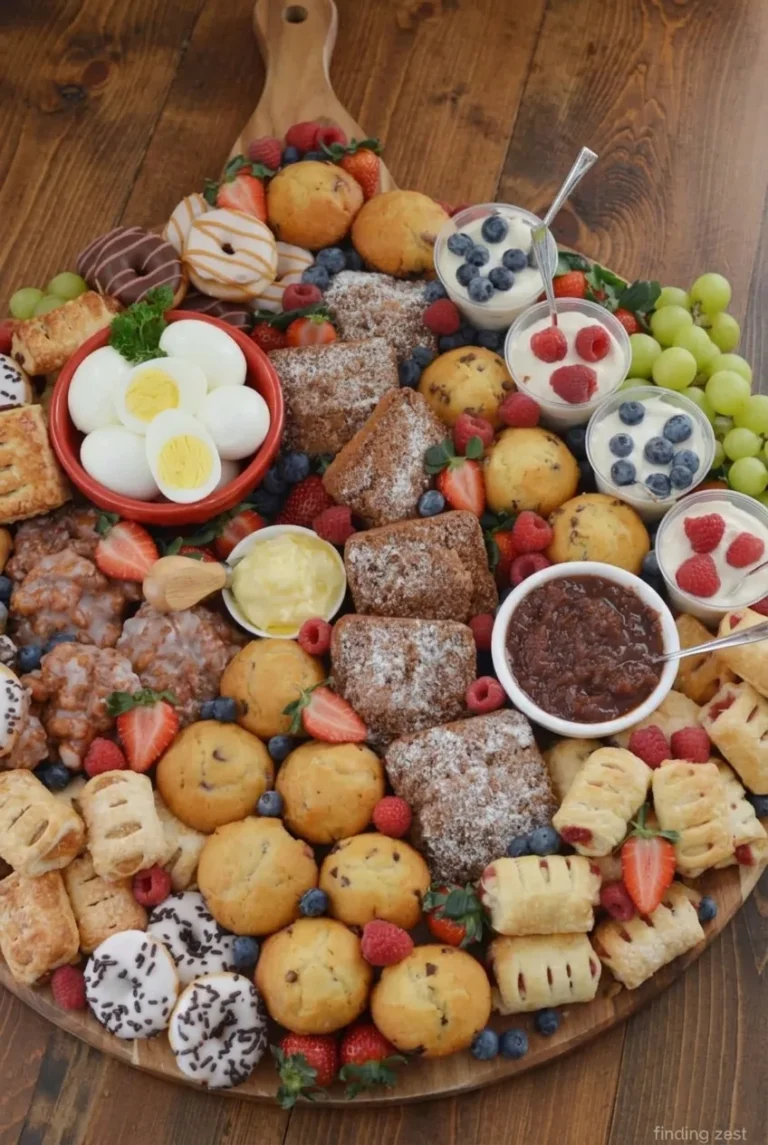
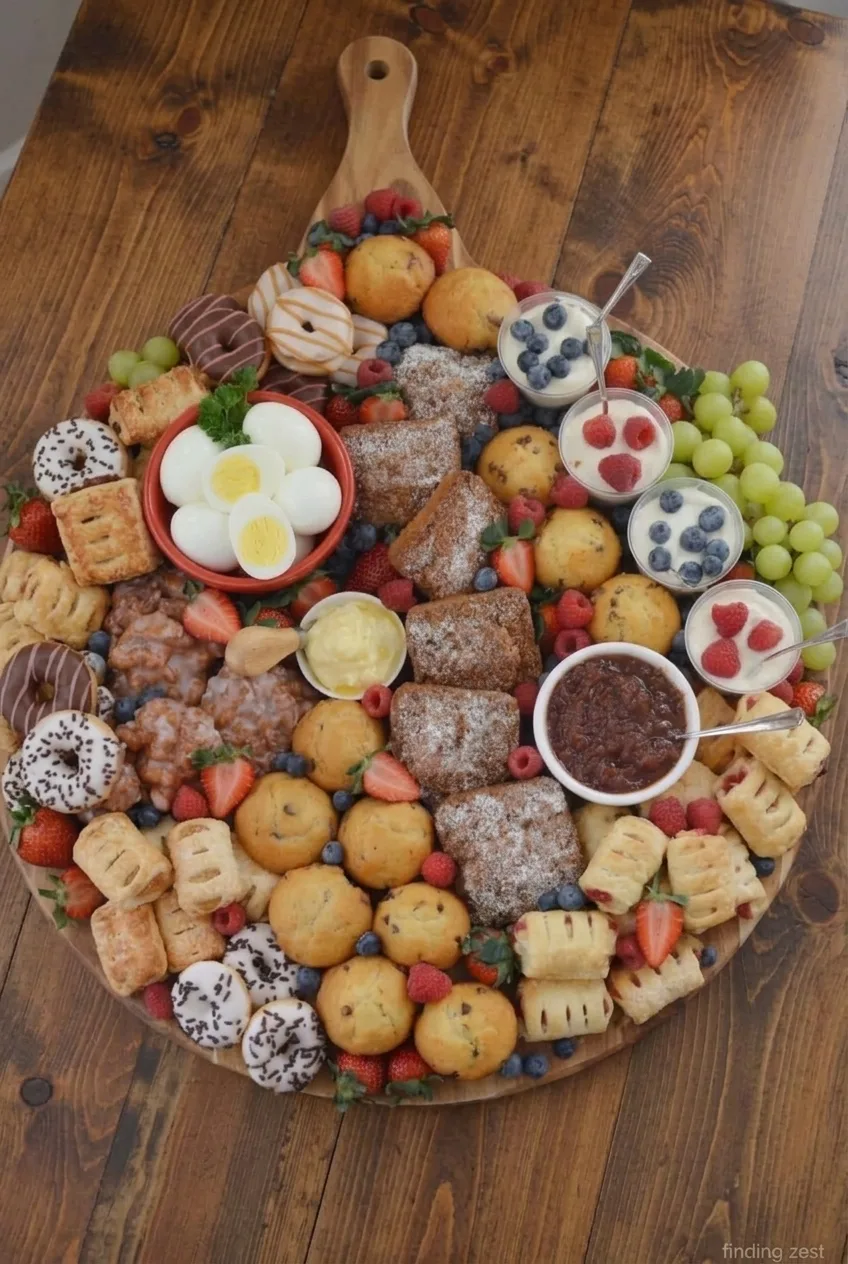
This breakfast charcuterie board is a sweet-leaning brunch spread with five kinds of mini pastries, hard-boiled eggs, berry-topped yogurt cups, two spreads, and fresh fruit. It serves 8 to 10 people as part of a brunch buffet, with plenty of choices rather than one of every item per guest.

Prepared eggs and bakery pastries keep the assembly to about 25 to 30 minutes, with no cooking required. Place the bowls and cups first, then arrange the pastries in distinct groups. Add thoroughly dried fruit last so it fills the spaces without making the baked goods damp.

Ingredients for a Breakfast Charcuterie Board

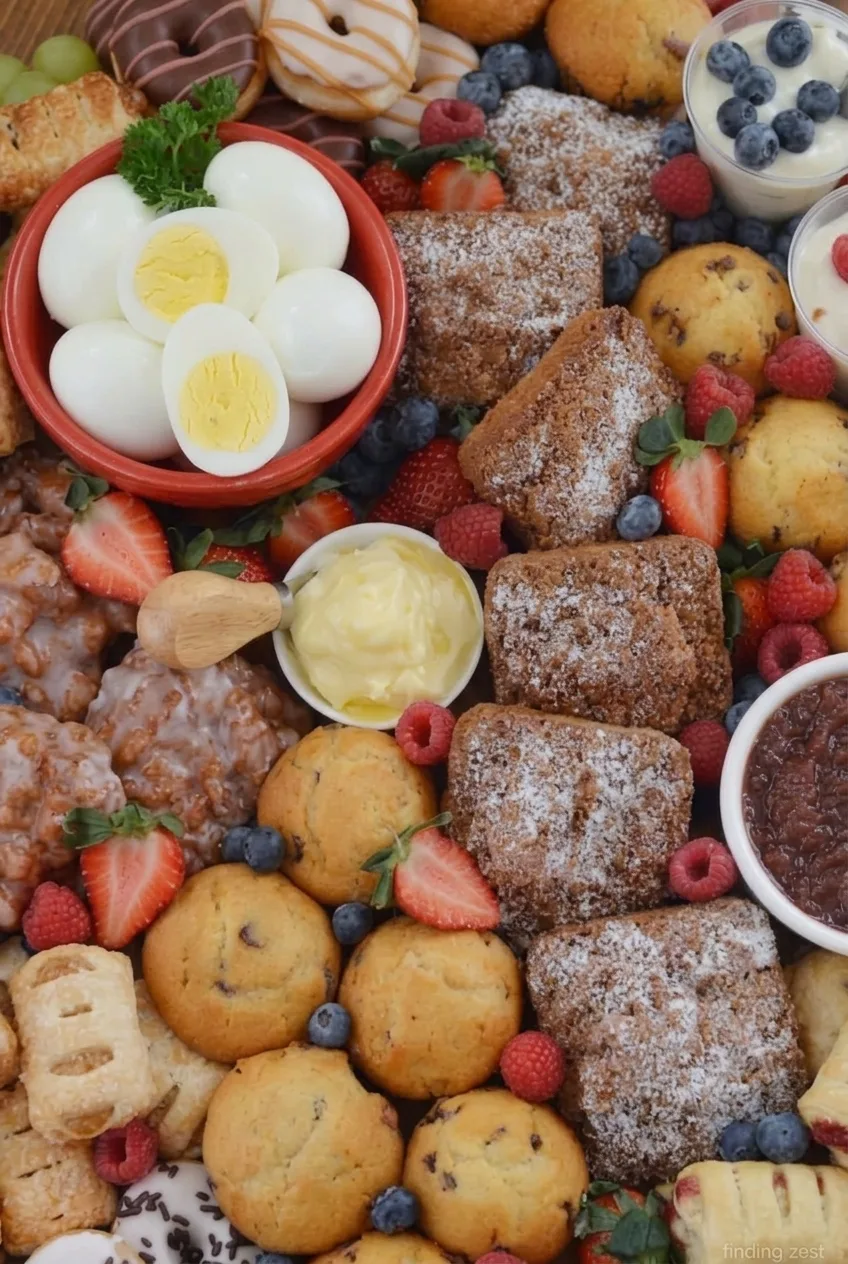
Close view of halved eggs, berry-topped yogurt, and powdered coffee-cake squares on the breakfast board
  • 8 prepared hard-boiled eggs, peeled
  • 2 cups plain or vanilla Greek yogurt (about 450g)
  • 10 to 12 mini muffins
  • 8 to 10 assorted iced mini donuts
  • 8 small squares prepared coffee cake
  • 1 to 2 tablespoons powdered sugar
  • 5 to 6 mini glazed fritters
  • 8 to 10 mini fruit-filled pastries
  • 1 lb strawberries (about 450g)
  • 1 pint blueberries
  • 6 oz raspberries (about 170g)
  • 1 lb green grapes (about 450g)
  • 1/2 cup unsalted butter, softened (about 115g)
  • 2 tablespoons honey
  • 3/4 cup apple butter

Equipment: An 18- to 24-inch wooden serving board or roomy platter, a bowl for the eggs, four small yogurt cups, two spread bowls, and small spoons. If the bowls and cups will not fit comfortably on one board, use two smaller platters.

How to Make a Breakfast Charcuterie Board

Complete breakfast charcuterie board on a wooden table, surrounded by space for serving
  1. Prepare the fruit and eggs: Wash the fruit and dry it thoroughly. Halve 2 or 3 eggs to show the set yolks; leave the others whole. Arrange them in a bowl and keep chilled until assembly.
  2. Fill the cups and bowls: Divide the yogurt among four cups and top each with some blueberries and raspberries. Mix the softened butter with the honey. Spoon the honey butter and apple butter into separate bowls, with a spoon for each spread.
  3. Set the anchors: Place the egg bowl, yogurt cups, and spread bowls on the empty board. Make sure each sits flat and is easy to reach, with enough space between them for the pastries.
  4. Arrange the pastries: Group the muffins, iced donuts, glazed fritters, and filled pastries separately. Place the coffee-cake squares through the center and dust them lightly with powdered sugar just before serving.
  5. Fill the gaps: Tuck strawberries and small grape clusters into larger openings. Add the remaining blueberries and raspberries to smaller spaces, keeping the pastry groups easy to see and pick up. Serve promptly.

Portions and Easy Swaps

The ingredient counts are shopping estimates for 8 to 10 people alongside other brunch dishes; guests can choose among the pastries, eggs, yogurt, and fruit. Package sizes vary, so the assortment matters more than an exact count of each pastry.

Another thick plain or vanilla yogurt works in the individual cups, but a runny yogurt is harder to serve this way. A dark fruit preserve can replace the apple butter. If you swap a bakery item, keep several different shapes and finishes rather than making every pastry group the same.

What to Prepare Ahead

Purchase the pastries and prepared eggs ahead of time. Wash and thoroughly dry the fruit in advance, and keep the eggs, yogurt, and other perishable components refrigerated. Assemble the board close to serving so the fruit stays fresh and the pastries stay dry; dust the coffee cake at the end.

Serving and Leftovers

Set out small spoons for the yogurt cups and spreads. For a larger buffet, chia overnight oats with strawberries and banana can be made ahead. For a separate warm savory side, serve crispy sweet potato hash browns.

Do not leave perishable foods such as eggs and yogurt at room temperature for more than 2 hours, or 1 hour above 90°F (30°C). For a longer brunch, set out smaller portions and replenish them from the refrigerator.

Promptly refrigerate suitable leftover eggs, yogurt, spreads, and cut fruit in separate covered containers. Keep leftover baked goods separately in an airtight container. Discard perishable foods left out beyond the serving limits.

Nutrition

Approximate nutrition per serving: Based on 1/10 of the entire board, about 900 calories, 18g protein, 43g fat, and 110g carbohydrates. Approximate values per 100g: 185 calories, 4g protein, 9g fat, and 23g carbohydrates. Values vary with bakery item sizes, yogurt choice, and what each guest takes.

Breakfast Charcuterie Board

A brunch board with mini pastries, eggs, berry-topped yogurt, spreads, and fresh fruit for 8 to 10 people.
Course: Breakfast
Cuisine: American
Prep: 30 min
Total: 30 min
Servings: 8 Calories: About 900 kcal per serving; 185 kcal per 100 g

Equipment

  • 18- to 24-inch serving board or roomy platter
  • Egg bowl
  • Four small yogurt cups
  • Two spread bowls
  • Small spoons

Ingredients

For the Board

  • 8 prepared hard-boiled eggs, peeled
  • 10 to 12 mini muffins
  • 8 to 10 assorted iced mini donuts
  • 8 small squares prepared coffee cake
  • 1 to 2 tablespoons powdered sugar
  • 5 to 6 mini glazed fritters
  • 8 to 10 mini fruit-filled pastries
  • 1 lb strawberries (about 450 g)
  • 1 pint blueberries
  • 6 oz raspberries (about 170 g)
  • 1 lb green grapes (about 450 g)

For the Yogurt and Spreads

  • 2 cups plain or vanilla Greek yogurt (about 450 g)
  • 1/2 cup unsalted butter, softened (about 115 g)
  • 2 tablespoons honey
  • 3/4 cup apple butter

Instructions

  1. Wash the fruit and dry it thoroughly.
  2. Halve 2 or 3 eggs to show the yolks. Arrange them with the remaining whole eggs in a bowl and keep chilled until assembly.
  3. Divide the yogurt among four cups and top each with some blueberries and raspberries.
  4. Mix the softened butter with the honey. Spoon the honey butter and apple butter into separate bowls, with a spoon for each.
  5. Place the egg bowl, yogurt cups, and spread bowls on the serving board, leaving space for the pastries.
  6. Arrange the muffins, iced donuts, glazed fritters, and fruit-filled pastries in separate groups.
  7. Place the coffee-cake squares through the center and dust them lightly with powdered sugar just before serving.
  8. Tuck strawberries and small grape clusters into larger openings. Fill smaller spaces with the remaining blueberries and raspberries, keeping the pastry groups easy to reach.
  9. Serve promptly.

Tips

  • Dry the fruit thoroughly before adding it so the pastries stay dry.
  • Set out the bowls and cups before arranging the pastries.
  • Use two smaller platters if the bowls and cups do not fit comfortably on one board.
  • Dust the coffee cake with powdered sugar just before serving.
  • For a longer brunch, set out smaller portions and replenish them from the refrigerator.

Variations

  • Fruit Preserve Spread: Replace the apple butter with a dark fruit preserve.
  • Yogurt Swap: Use another thick plain or vanilla yogurt in the individual cups.
  • Pastry Swap: Swap in another bakery item while keeping a mix of shapes and finishes.

Notes

Keep eggs, yogurt, and other perishables refrigerated. Do not leave them at room temperature for more than 2 hours, or 1 hour above 90°F (30°C). Refrigerate suitable leftovers promptly in separate covered containers; discard perishables left out beyond these limits.

Nutrition

Calories: About 900 kcal per serving; 185 kcal per 100 g | Protein: 18 g per serving; 4 g per 100 g | Fat: 43 g per serving; 9 g per 100 g | Carbohydrates: 110 g per serving; 23 g per 100 g

Brunch Charcuterie Board

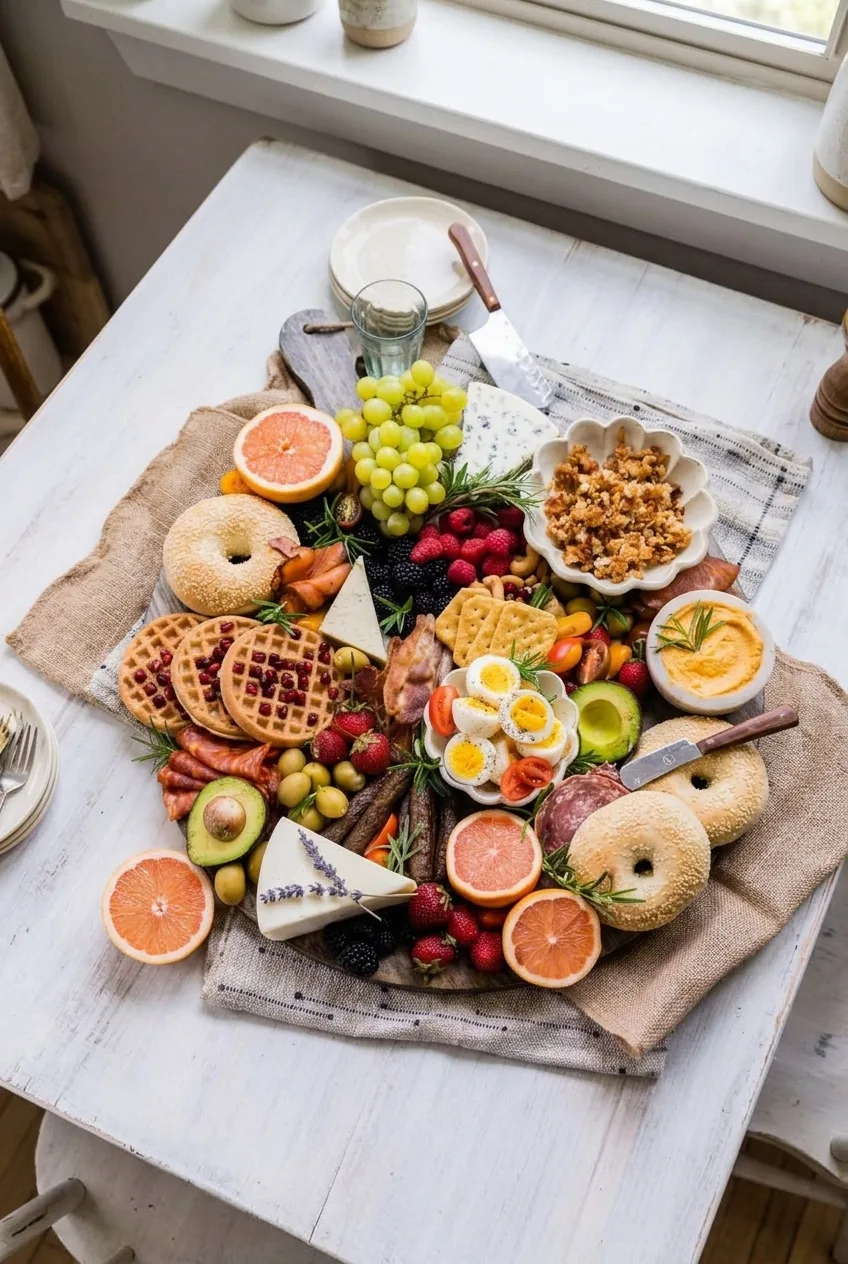
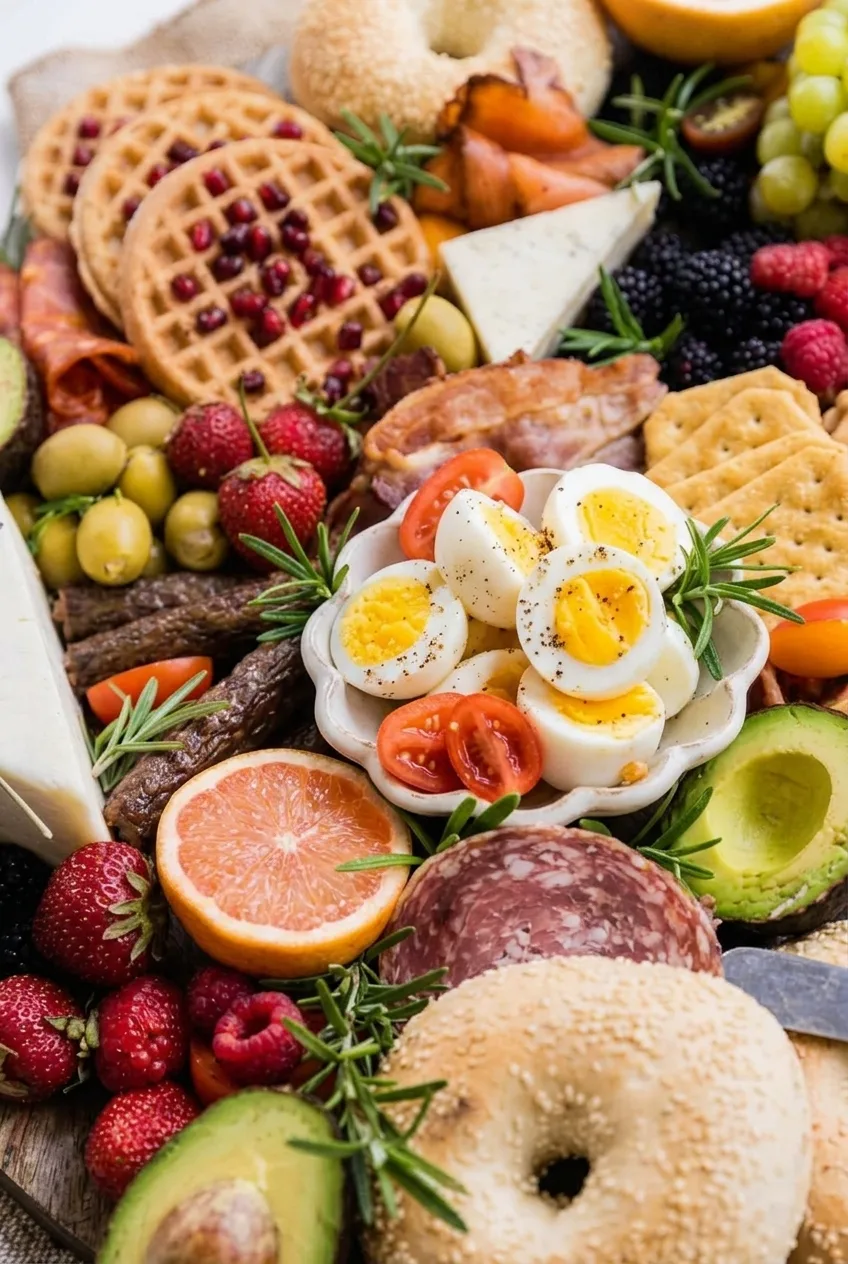
Whole sesame bagels and mini waffles anchor this round brunch board, with eggs, cheese, fruit, and small clusters of savory proteins filling the spaces between them. Three bowls hold the halved eggs, granola, and hummus, so the board can be generously filled without becoming difficult to serve.

Most ingredients are purchased ready to eat or prepared ahead. Set out the bowls and large foods first, keep juicy fruit away from the waffles and crackers, and add the avocado just before serving.

Ingredients for a Brunch Charcuterie Board

Complete round brunch charcuterie board on a pale table with neutral linen visible around it

Makes one grazing board for about 8 people. Use an approximately 20- to 24-inch round board and three small bowls, or divide the ingredients between two smaller platters.

  • 4 whole sesame bagels
  • 8 prepared mini round waffles
  • 4 hard-boiled eggs, peeled and halved
  • 6 ounces cooked bacon (170g)
  • 8 ounces fully cooked breakfast sausage links (225g)
  • 4 ounces smoked salmon (115g)
  • 4 ounces sliced salami (115g)
  • 1 Brie wedge, about 8 ounces (225g)
  • 1 Gruyère wedge, about 6 ounces (170g)
  • 2 pink grapefruit, halved
  • 1 small bunch green grapes, about 1 pound (450g)
  • About 3 cups mixed strawberries, raspberries, and blackberries
  • 2 avocados
  • 1 cup cherry tomatoes, some halved (150g)
  • 3/4 cup green olives, drained
  • About 4 ounces plain crisp crackers (115g)
  • 3/4 cup granola
  • 3/4 cup hummus
  • 1/3 cup pomegranate arils
  • 4 to 6 small fresh rosemary sprigs

If desired, offer 1/2 cup maple syrup for the waffles or about 4 ounces cream cheese for the bagels and salmon. Keep both separate from the board.

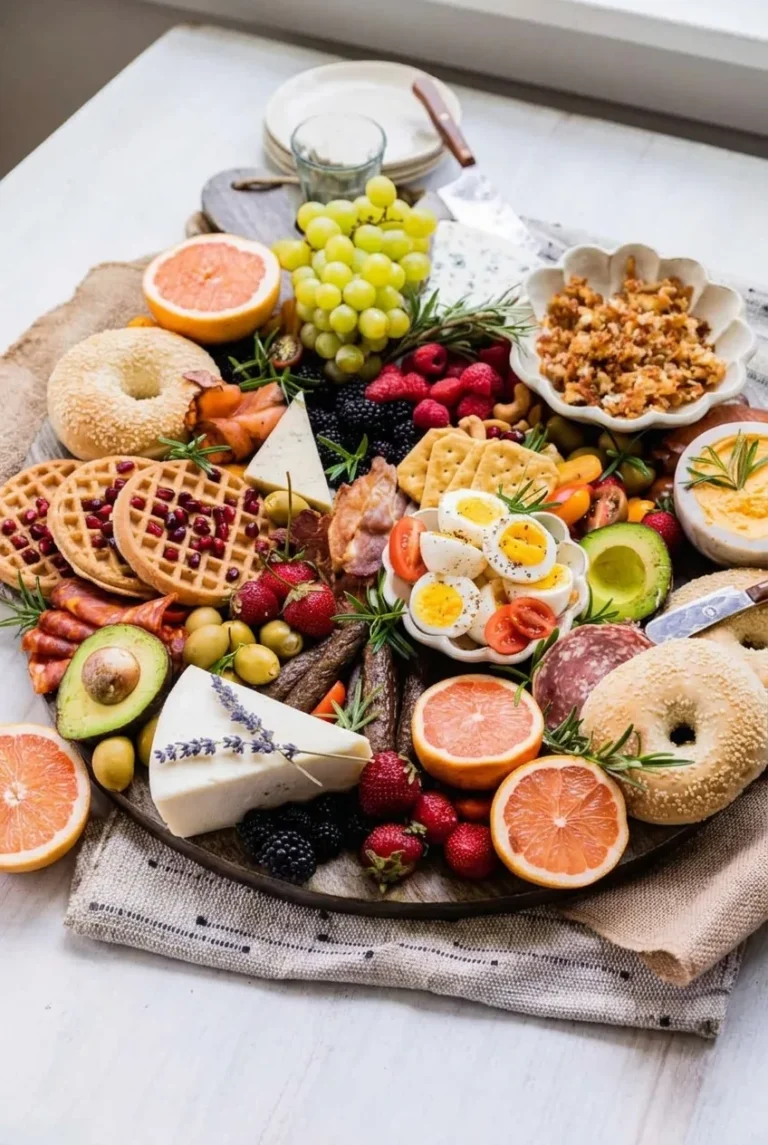
Close view of halved eggs, pomegranate-topped mini waffles, berries, and bacon on the brunch board

How to Assemble the Brunch Board

  1. Prepare the ingredients: Make sure the eggs, bacon, and sausage are fully cooked and ready to eat. Wash and thoroughly dry the fruit. Halve the eggs and grapefruit, drain the olives, and halve some of the tomatoes.
  2. Warm foods if desired: Toast the mini waffles for a crisp exterior. Reheat fully cooked bacon or sausage according to package directions if serving them warm. Let warmed foods stop steaming before placing them near cheese or fruit. Keep the bagels whole and provide a knife for serving.
  3. Set out the bowls and large foods: Fill the three bowls with eggs, granola, and hummus, then stagger them across the board within easy reach. Arrange the bagels, overlapping waffles, grapefruit halves, grape bunch, Brie, and Gruyère around them.
  4. Add savory clusters: Place the smoked salmon near a bagel. Arrange the bacon, sausage, salami, olives, and tomatoes in distinct clusters. Tuck crackers near the cheese or hummus, leaving space between them and the grapefruit, dip, and moist proteins.
  5. Finish just before serving: Halve and pit the avocados, then add them and the berries to the remaining spaces. Scatter pomegranate arils over the waffles and tuck rosemary sprigs between clusters. Fill the board nearly to the edges without burying the bowls or cheese. Serve with a cheese knife and small spoons or tongs.

How to Keep the Board Easy to Serve

A full board works best when each food stays in a recognizable, reachable cluster. Keep extra ingredients off the board for replenishing rather than piling them over the bowls or serving edges. On a wooden board, food-safe parchment or wax paper beneath especially juicy foods can help protect the surface.

For a lighter spread alongside other brunch dishes, keep the fruit, bakery foods, and cheese but serve fewer meats. For a smaller gathering, try this small charcuterie board for two.

What to Prepare Ahead

Cook or purchase the eggs and meats ahead and keep them refrigerated. Wash and dry the fruit in advance, and gather the bowls and utensils before assembly. Add the crackers and waffles close to serving so they stay crisp; halve the avocados at the last minute to limit browning.

Allow 25 to 30 minutes to prepare and arrange the board, plus 5 to 10 minutes if you choose to toast or warm any components. The board itself requires no cooking.

Keeping the Board Fresh and Storing Leftovers

Keep eggs, meats, cheese, hummus, and other perishables chilled until close to serving. For a longer brunch, set out smaller portions and replenish them from the refrigerator. Do not leave perishable foods at room temperature for more than two hours; discard any that exceed that limit.

If food stayed within the serving window, promptly refrigerate leftover perishables in separate covered containers. Store bagels, crackers, and granola separately so they do not absorb moisture, and follow package guidance for individual storage times. Reheat only individual cooked meat components according to their package directions, not the assembled board.

Nutrition

Approximate nutrition per serving, based on 8 grazing servings of the listed ingredients and excluding optional syrup or cream cheese: 1,035 calories, 46g protein, 56g fat, and 87g carbohydrates. Per 100g, that is approximately 190 calories, 8g protein, 10g fat, and 16g carbohydrates. Actual amounts will vary with the foods each guest chooses.

Brunch Charcuterie Board

A brunch grazing board of bagels, waffles, eggs, cheeses, fruit, and savory proteins arranged for sharing.
Course: Breakfast
Cuisine: American
Prep: 30 min
Total: 30 min
Servings: 8 Calories: 1,035 kcal

Equipment

  • 20- to 24-inch round board
  • 3 small bowls
  • Cheese knife
  • Small spoons or tongs
  • Serving knife

Ingredients

For the Board

  • 4 whole sesame bagels
  • 8 prepared mini round waffles
  • 4 hard-boiled eggs, peeled and halved
  • 6 ounces cooked bacon (170g)
  • 8 ounces fully cooked breakfast sausage links (225g)
  • 4 ounces smoked salmon (115g)
  • 4 ounces sliced salami (115g)
  • 1 Brie wedge, about 8 ounces (225g)
  • 1 Gruyère wedge, about 6 ounces (170g)
  • 2 pink grapefruit, halved
  • 1 small bunch green grapes, about 1 pound (450g)
  • About 3 cups mixed strawberries, raspberries, and blackberries
  • 2 avocados
  • 1 cup cherry tomatoes, some halved (150g)
  • 3/4 cup green olives, drained
  • About 4 ounces plain crisp crackers (115g)
  • 3/4 cup granola
  • 3/4 cup hummus
  • 1/3 cup pomegranate arils
  • 4 to 6 small fresh rosemary sprigs

Optional, Served Separately

  • 1/2 cup maple syrup
  • About 4 ounces cream cheese

Instructions

  1. Make sure the eggs, bacon, and sausage are fully cooked and ready to eat.
  2. Wash and thoroughly dry the fruit. Drain the olives, halve some of the tomatoes, and halve the eggs and grapefruit.
  3. Toast the mini waffles if desired. Reheat the cooked bacon or sausage according to package directions if serving warm, then let them stop steaming.
  4. Fill three small bowls with the eggs, granola, and hummus. Stagger the bowls across the board.
  5. Arrange the bagels, waffles, grapefruit, grapes, Brie, and Gruyère around the bowls.
  6. Place the smoked salmon near a bagel. Arrange the bacon, sausage, salami, olives, and tomatoes in separate clusters.
  7. Tuck crackers near the cheese or hummus, leaving space between them and the grapefruit, dip, and moist proteins.
  8. Halve and pit the avocados just before serving, then add them and the berries to the board.
  9. Scatter pomegranate arils over the waffles and tuck rosemary sprigs between clusters. Serve with a cheese knife and small spoons or tongs.

Tips

  • Use a 20- to 24-inch round board, or divide the ingredients between two smaller platters.
  • Set out the bowls and larger items first, then fill the open spaces with smaller clusters.
  • Keep juicy fruit away from the waffles and crackers so they stay crisp.
  • Add the avocado just before serving to limit browning.
  • Keep extra ingredients off the board and replenish from the refrigerator as needed.

Variations

  • Lighter Brunch Board: Keep the fruit, bakery foods, and cheese, and serve fewer meats alongside other brunch dishes.
  • Smaller Brunch Board: Scale down the ingredients or arrange them between two smaller platters for a smaller gathering.

Notes

Keep eggs, meats, cheese, hummus, and other perishable foods chilled until serving. Do not leave perishables at room temperature for more than two hours. Refrigerate leftovers promptly in separate covered containers; store bagels, crackers, and granola separately.

Nutrition

Calories: 1,035 kcal | Protein: 46 g | Fat: 56 g | Carbohydrates: 87 g