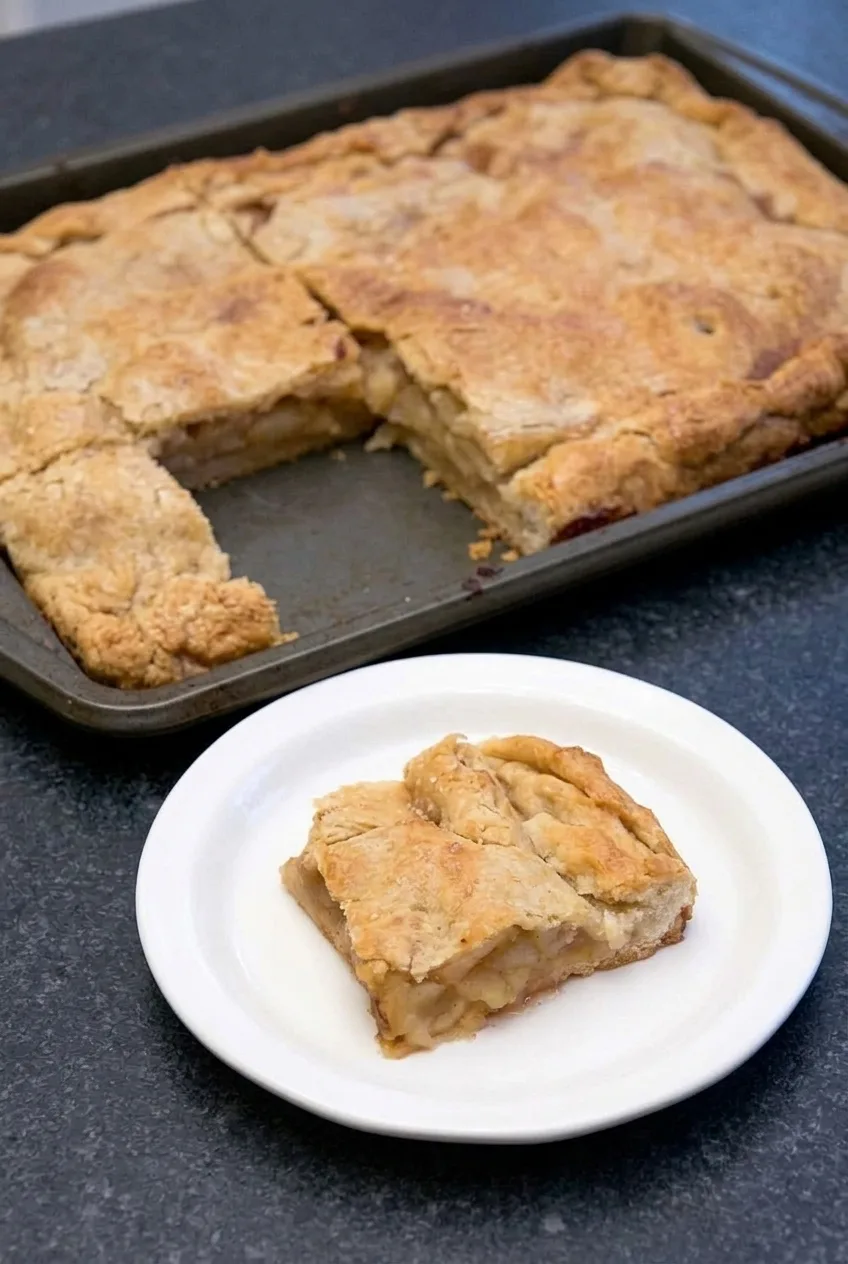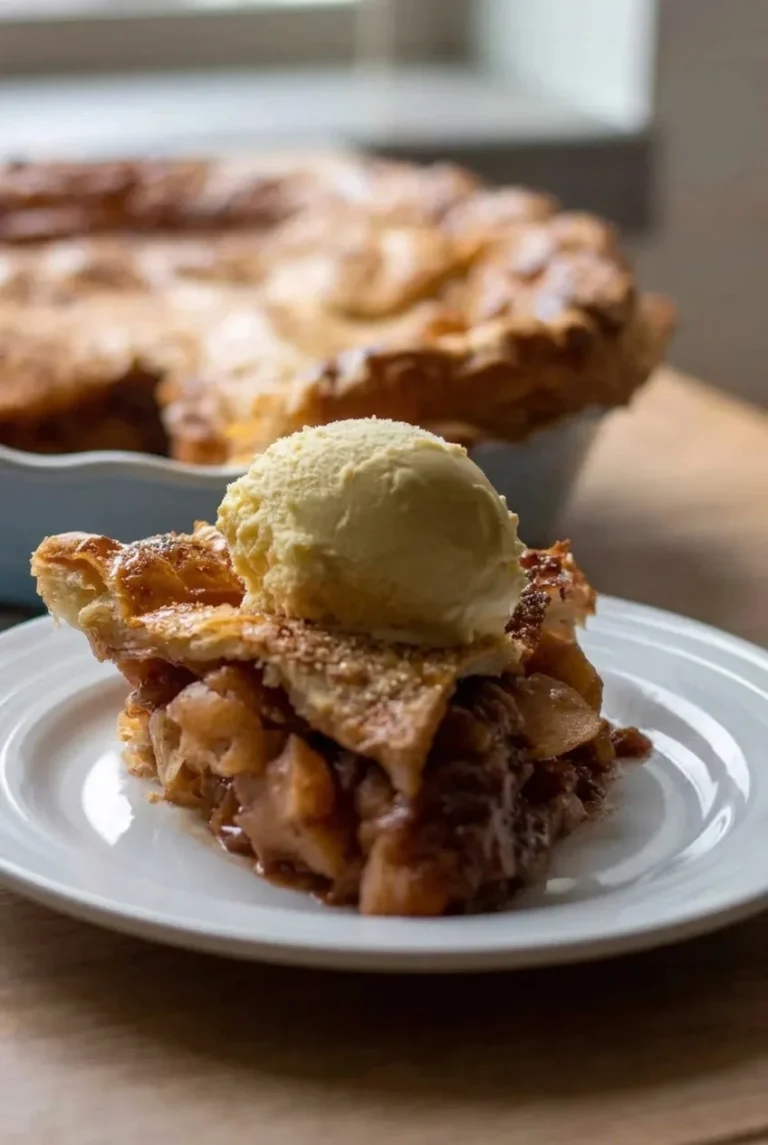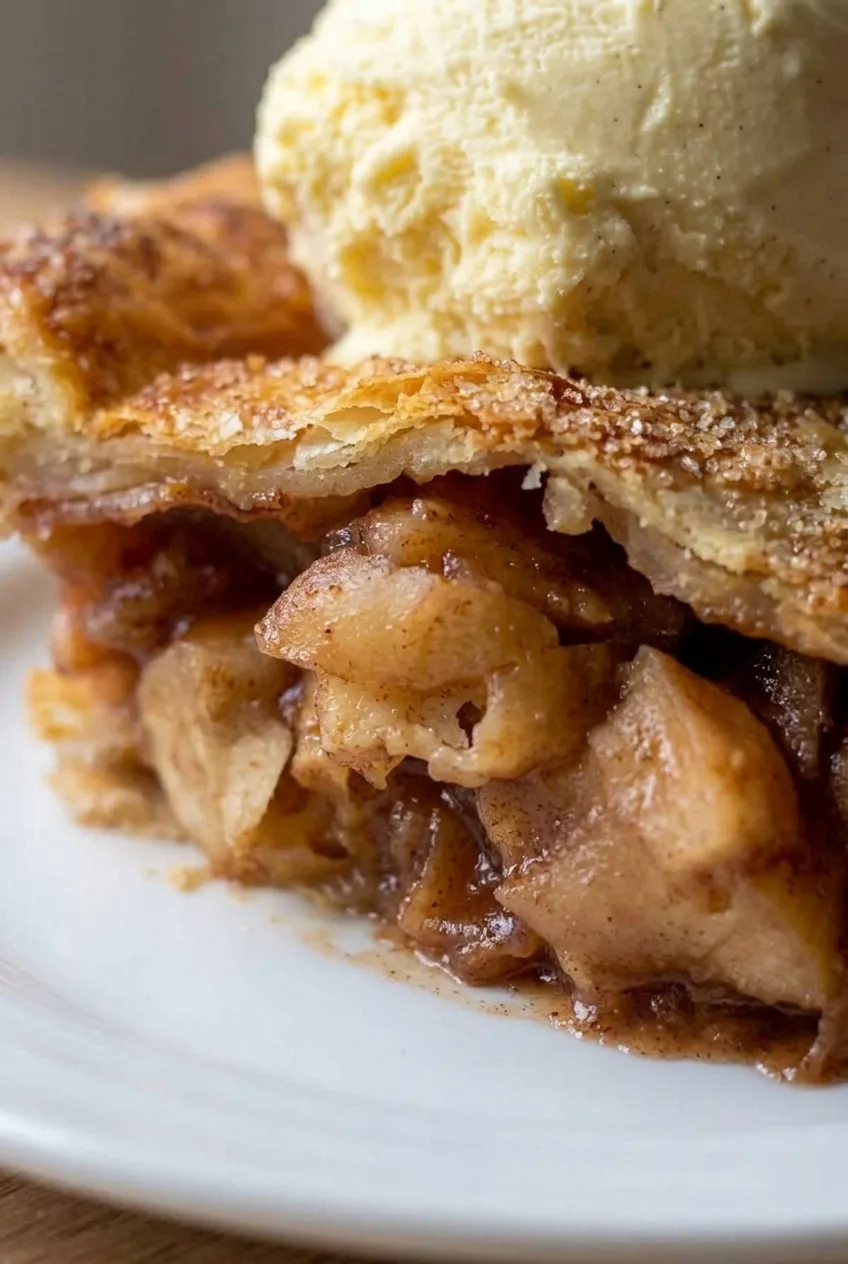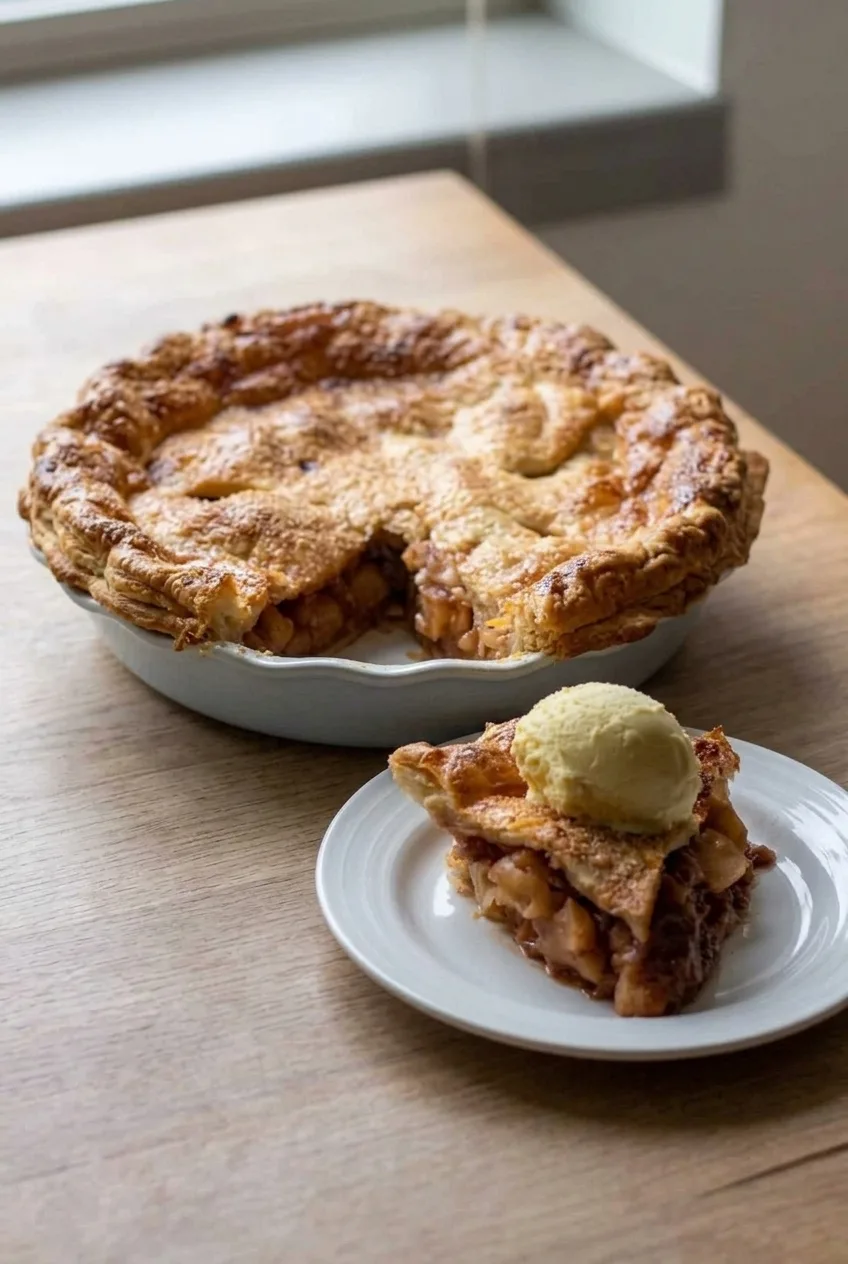
Author

Julia

Browsing

Apple Strudel

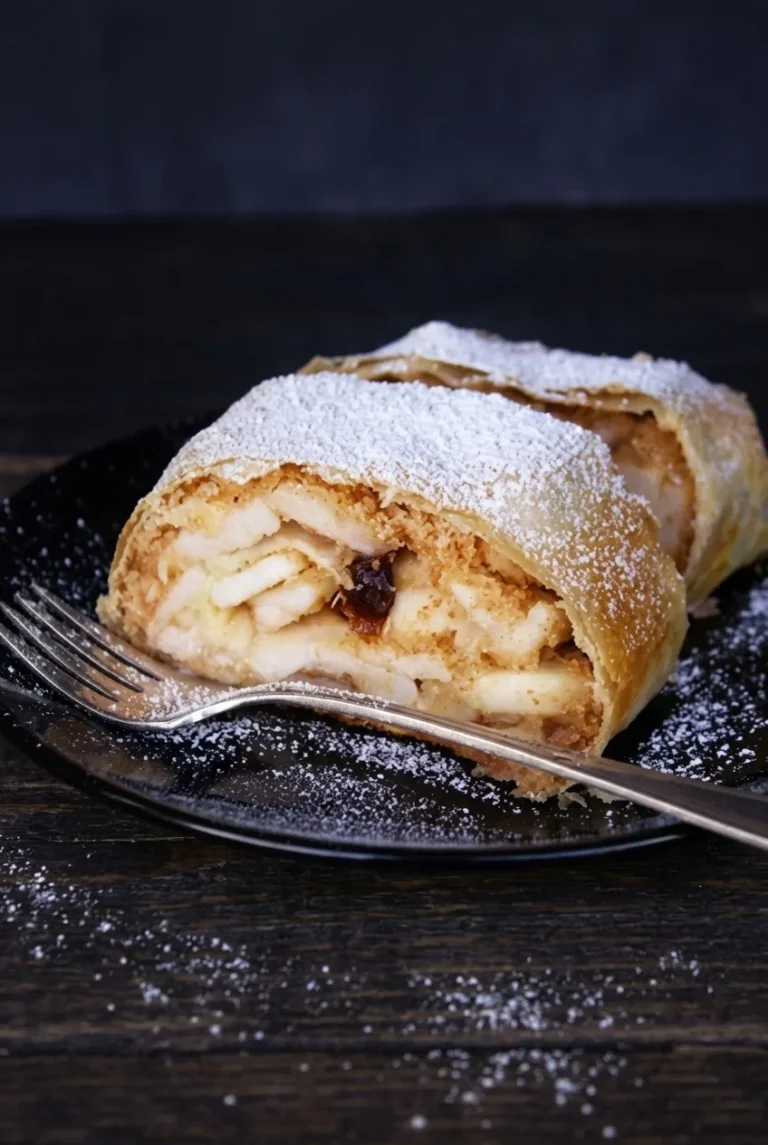
This apple strudel is one enclosed puff-pastry roll, cut into thick slices that show tender apple layers and a few raisins. Store-bought puff pastry makes it a shortcut rather than a hand-stretched strudel. A narrow strip of filling gives the pastry room to overlap, while breadcrumbs beneath the apples absorb some of their juice. Cool the baked roll before dusting it with powdered sugar and slicing it so the filling holds together.

Makes 8 thick slices. Allow about 20 minutes to prepare, 30–40 minutes to bake, and 20 minutes to cool, plus time to thaw the pastry.

Ingredients for Apple Strudel
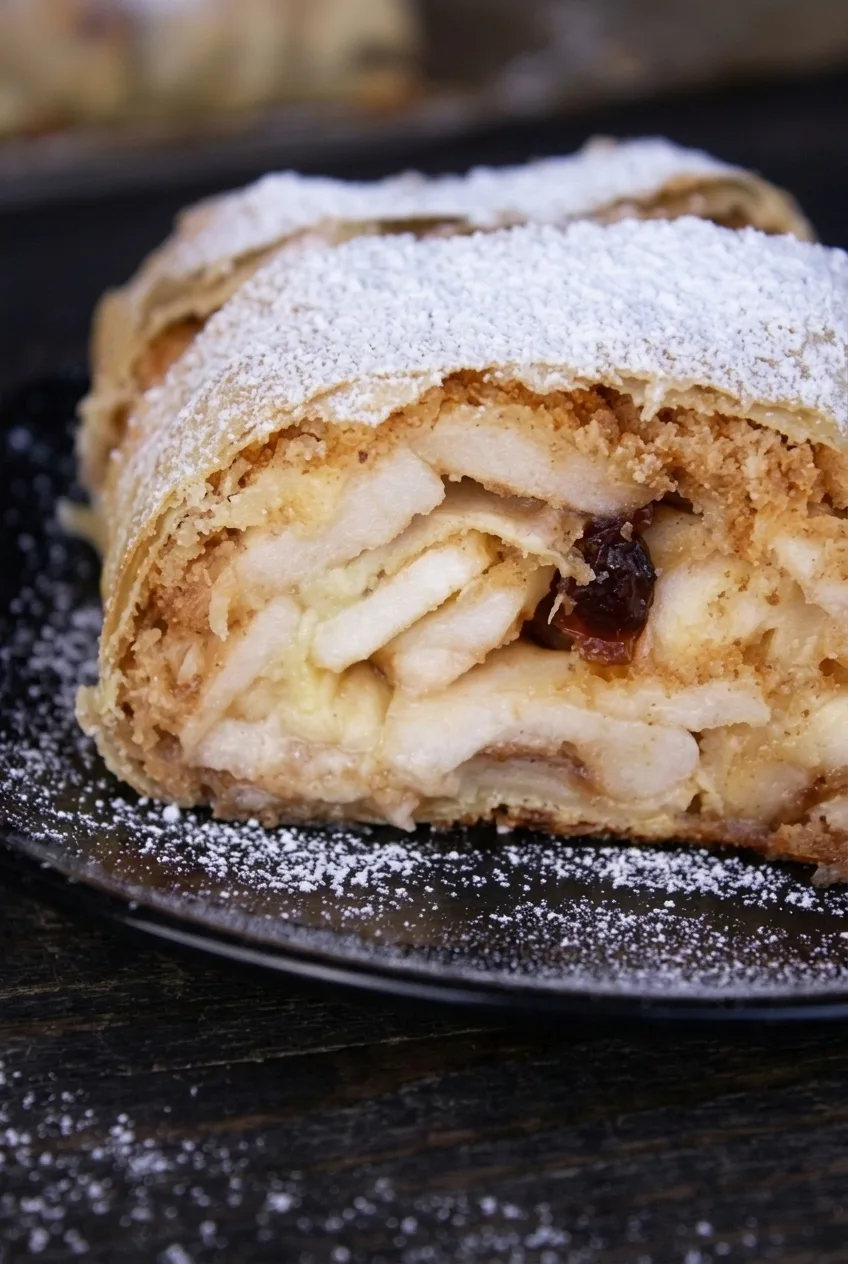
Close view of sliced apples and a few raisins inside the golden pastry crust of apple strudel
  • 1 sheet puff pastry, thawed according to the package but still cool, about 10 by 12 inches (245g)
  • About 2 medium sweet-tart baking apples, peeled, cored, and thinly sliced to yield 2 1/2 cups (330g)
  • 1/4 cup granulated sugar (50g)
  • 1 teaspoon ground cinnamon
  • 1 teaspoon lemon juice
  • 3 tablespoons raisins (25g)
  • 3 tablespoons plain dry breadcrumbs (15g)
  • 1 large egg, beaten
  • 1–2 tablespoons powdered sugar, for dusting (about 15g)

Use unseasoned breadcrumbs; fine crumbs or panko will work. If the pastry sheet is smaller than 10 by 12 inches, gently roll it to about that size.

How to Make Apple Strudel
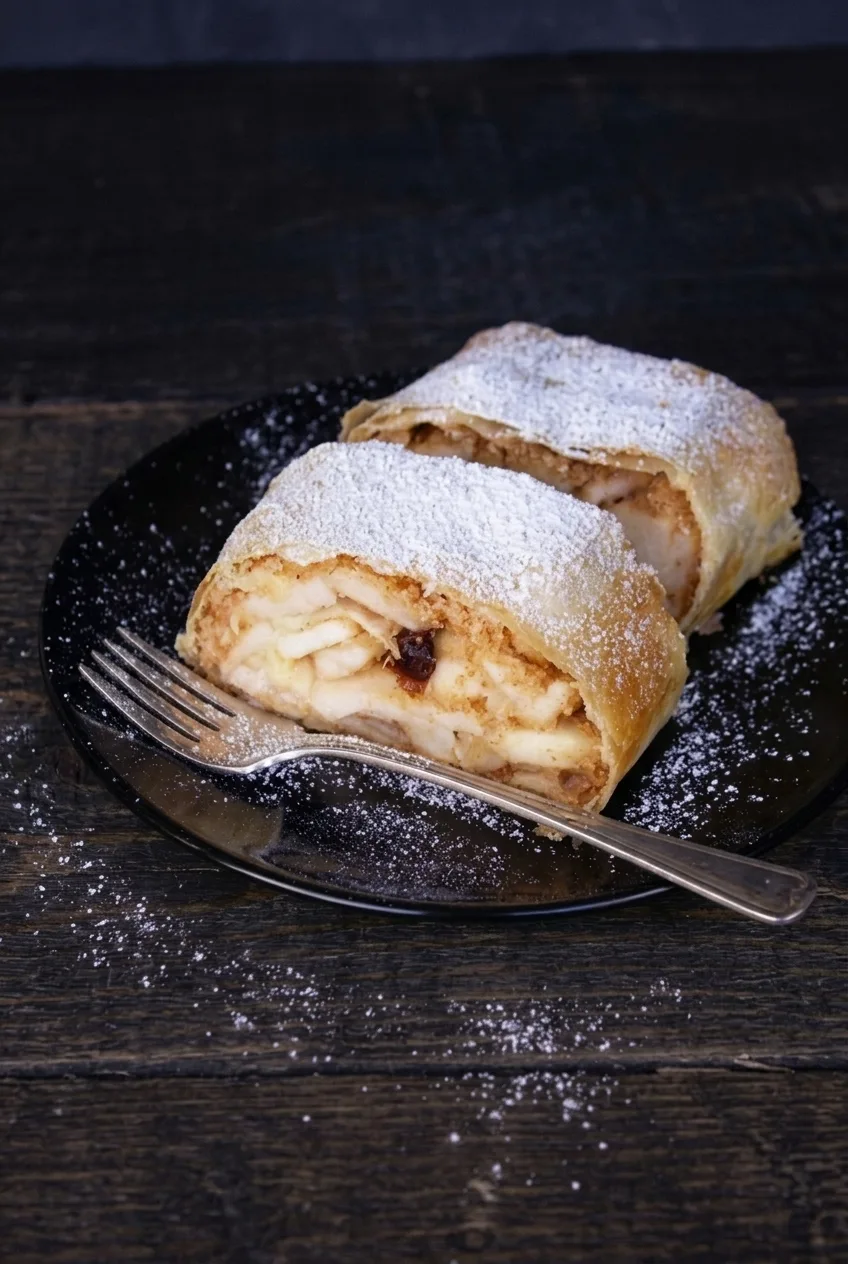
Wider view of powdered-sugar-dusted apple strudel and a thick cut slice on a dark plate
  1. Prepare the oven and pastry: Preheat the oven to 400°F (205°C) with a rack in the middle position. Line a rimmed baking sheet large enough to hold the roll with parchment paper. Unfold the cool pastry on the parchment and gently roll it to about 10 by 12 inches if needed.
  2. Mix the filling: Cut the apples into even slices about 1/8 inch thick. Just before assembling, toss them with the granulated sugar, cinnamon, lemon juice, and raisins. Mixing late gives the sugar less time to draw out juice.
  3. Add the breadcrumbs and apples: Sprinkle the breadcrumbs in a strip about 3 inches wide down the 12-inch length of the pastry, leaving about 1 inch clear at each short end. Spoon the apples over the crumbs, leaving any pooled juice in the bowl. Keep the mound narrow enough for the long pastry sides to overlap.
  4. Fold and seal: Fold the long sides over the filling. Brush a little beaten egg where they overlap, then press to seal. Tuck and press both short ends closed so no apples protrude. Carefully turn the roll seam-side down, using the parchment to help move it. Cut 4 or 5 small vents in the top and brush the exposed pastry with egg.
  5. Bake: Bake uncovered for 30–40 minutes, beginning to check at 28–30 minutes. The pastry should be puffed and deep golden, including near the bottom edge. Gently test an apple slice through a vent with the tip of a knife; it should feel tender. Rotate the sheet only if your oven browns unevenly. If the top browns well before the apples soften, loosely shield it with foil while it finishes baking.
  6. Cool and slice: Let the strudel cool on the baking sheet for about 20 minutes. Dust generously with powdered sugar, then cut crosswise into roughly 1 1/2-inch slices with a serrated knife. Use a gentle sawing motion to keep the pastry and apple layers together.

How to Keep Apple Strudel from Getting Soggy

Place the breadcrumbs directly beneath the apples, where they can absorb some juice before it reaches the bottom crust. Stick to the measured 2 1/2 cups of sliced apples and leave any liquid collected in the bowl behind. Extra filling also makes the roll harder to seal. For the crispest pastry, serve the strudel the day it is baked.

How to Tell When the Strudel Is Done

A golden top alone does not mean the apples are ready. Check that the pastry near the bottom edge is golden and that an apple slice feels tender through a vent. Thin, even slices are especially important here: thick pieces may still be firm when the pastry has browned.

Apple Strudel Questions

Can I leave out the raisins?

Yes. Omit them without adding more apples. The roll will still work, though it will not have the dark pieces visible among the apples in this version.

Can I substitute phyllo for puff pastry?

Not directly. Phyllo requires layered sheets brushed with fat and a different assembly method; it will not work as a one-sheet swap.

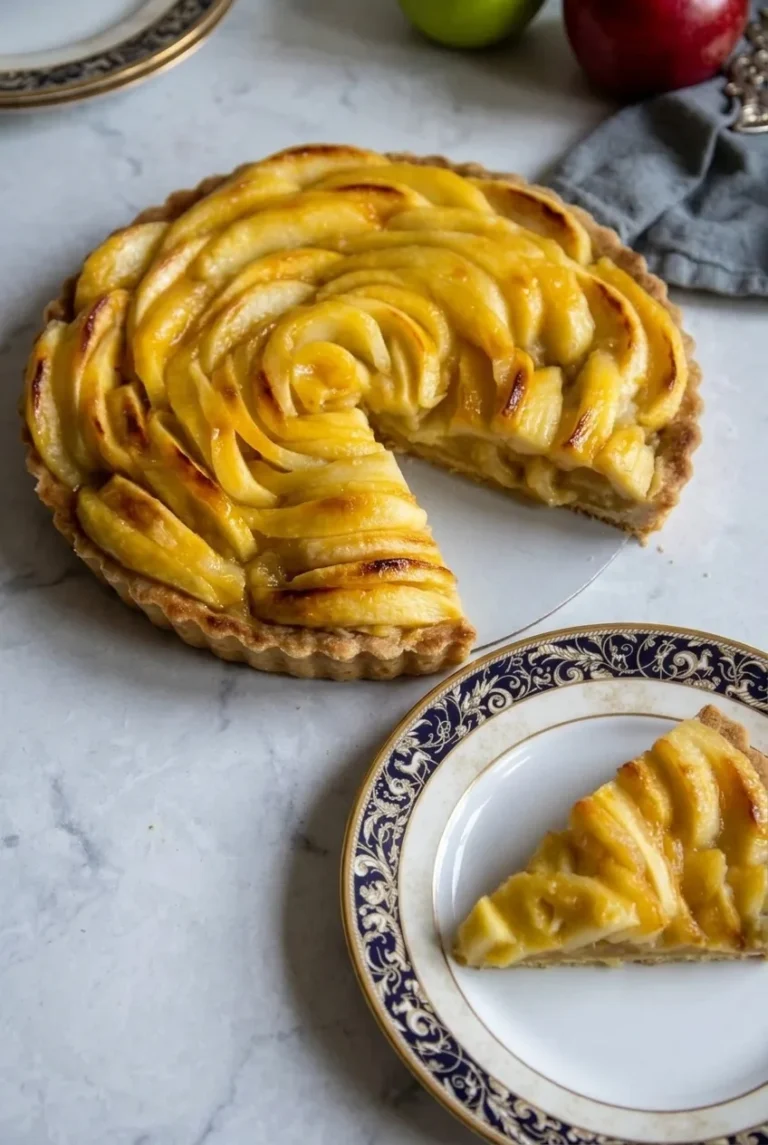
For an open-faced apple dessert, try this rustic apple galette. If you prefer apples arranged on top, see this French apple tart.

Storage and Reheating

Once completely cool, cover leftovers and keep them at room temperature for up to 2 days, or refrigerate in an airtight container for up to 4 days. The pastry will soften in storage. Warm refrigerated slices briefly in a moderate oven until heated through to improve the crust.

To freeze, wrap the completely cooled baked strudel tightly and freeze for up to 3 months. Thaw overnight in the refrigerator, then warm in a 325°F (165°C) oven until heated through. Add a fresh dusting of powdered sugar before serving.

Nutrition

Approximate nutrition per thick slice, based on 8 slices: 210 calories, 3g protein, 9g fat, and 32g carbohydrates. Approximate values per 100g of finished strudel: 260 calories, 4g protein, 11g fat, and 39g carbohydrates. Values vary with the puff pastry brand, slice size, and moisture lost during baking.

Apple Strudel

A puff pastry roll filled with cinnamon apples and raisins, baked until golden and dusted with powdered sugar.
Course: Dessert
Cuisine: Austrian
Prep: 20 min
Cook: 40 min
Total: 80 min
Servings: 8 Calories: 210 kcal per slice; 260 kcal per 100 g

Equipment

  • Oven
  • Rimmed baking sheet
  • Parchment paper
  • Mixing bowl
  • Pastry brush
  • Serrated knife

Ingredients

  • 1 sheet puff pastry, thawed but still cool, about 10 by 12 inches (245 g)
  • About 2 medium sweet-tart baking apples, peeled, cored, and thinly sliced to yield 2 1/2 cups (330 g)
  • 1/4 cup granulated sugar (50 g)
  • 1 teaspoon ground cinnamon
  • 1 teaspoon lemon juice
  • 3 tablespoons raisins (25 g)
  • 3 tablespoons plain dry breadcrumbs (15 g)
  • 1 large egg, beaten
  • 1–2 tablespoons powdered sugar, for dusting (about 15 g)

Instructions

  1. Preheat the oven to 400°F (205°C) with a rack in the middle position. Line a rimmed baking sheet with parchment paper.
  2. Unfold the cool pastry on the parchment. If needed, gently roll it to about 10 by 12 inches.
  3. Slice the apples evenly, about 1/8 inch thick. Just before assembling, toss them with the granulated sugar, cinnamon, lemon juice, and raisins.
  4. Sprinkle the breadcrumbs in a strip about 3 inches wide down the 12-inch length of the pastry, leaving about 1 inch clear at each short end. Spoon the apples over the crumbs, leaving any pooled juice behind.
  5. Fold the long sides of the pastry over the filling. Brush beaten egg where they overlap and press to seal. Close both short ends, turn the roll seam-side down, cut 4 or 5 small vents in the top, and brush the exposed pastry with egg.
  6. Bake uncovered for 30–40 minutes, beginning to check at 28–30 minutes. Bake until the pastry is puffed and deep golden, including near the bottom edge, and an apple slice feels tender when tested through a vent.
  7. Cool the strudel on the baking sheet for about 20 minutes. Dust with powdered sugar and cut crosswise into roughly 1 1/2-inch slices using a gentle sawing motion.

Tips

  • Use unseasoned breadcrumbs; fine crumbs or panko both work.
  • Leave any liquid collected with the apples in the bowl to help prevent a soggy bottom.
  • Keep the filling strip narrow enough for the long pastry sides to overlap and seal.
  • If the top browns before the apples soften, loosely cover it with foil while it finishes baking.
  • Use thin, even apple slices so they become tender before the pastry overbrowns.

Variations

  • Strudel Without Raisins: Omit the raisins without adding extra apples.
Notes

For the crispest pastry, serve the day it is baked. Store covered at room temperature for up to 2 days or refrigerate airtight for up to 4 days; reheat refrigerated slices in a moderate oven. Freeze tightly wrapped for up to 3 months, thaw overnight in the refrigerator, and warm at 325°F (165°C).

Nutrition

Calories: 210 kcal per slice; 260 kcal per 100 g | Protein: 3 g per slice; 4 g per 100 g | Fat: 9 g per slice; 11 g per 100 g | Carbohydrates: 32 g per slice; 39 g per 100 g

Apple Pie Turnovers

These apple pie turnovers fold tender cinnamon apples into flaky puff-pastry triangles. Briefly cooking the filling thickens the apple juices; cooling it before assembly helps the pastry stay firm enough to puff. Egg wash and a light cinnamon-sugar sprinkle give the crust a golden finish.

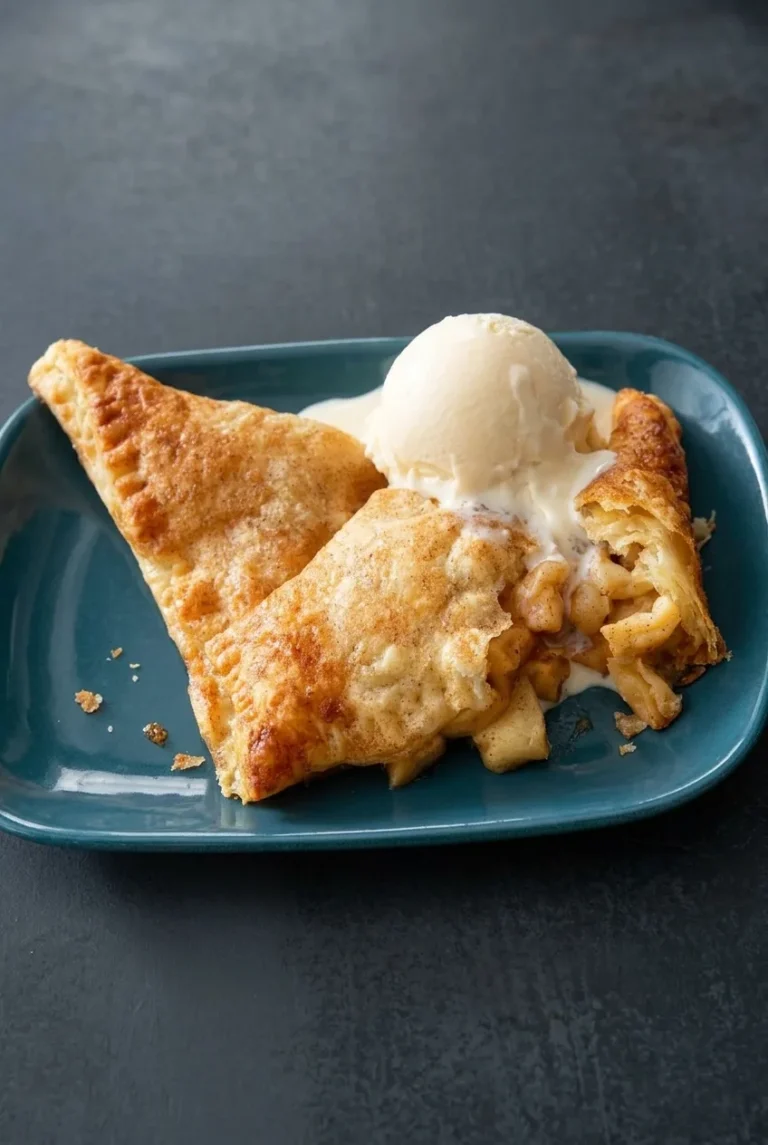
Serve the turnovers slightly warm. For a plated dessert, open one to show the apple pieces and add vanilla ice cream just before serving.

Ingredients for Apple Pie Turnovers

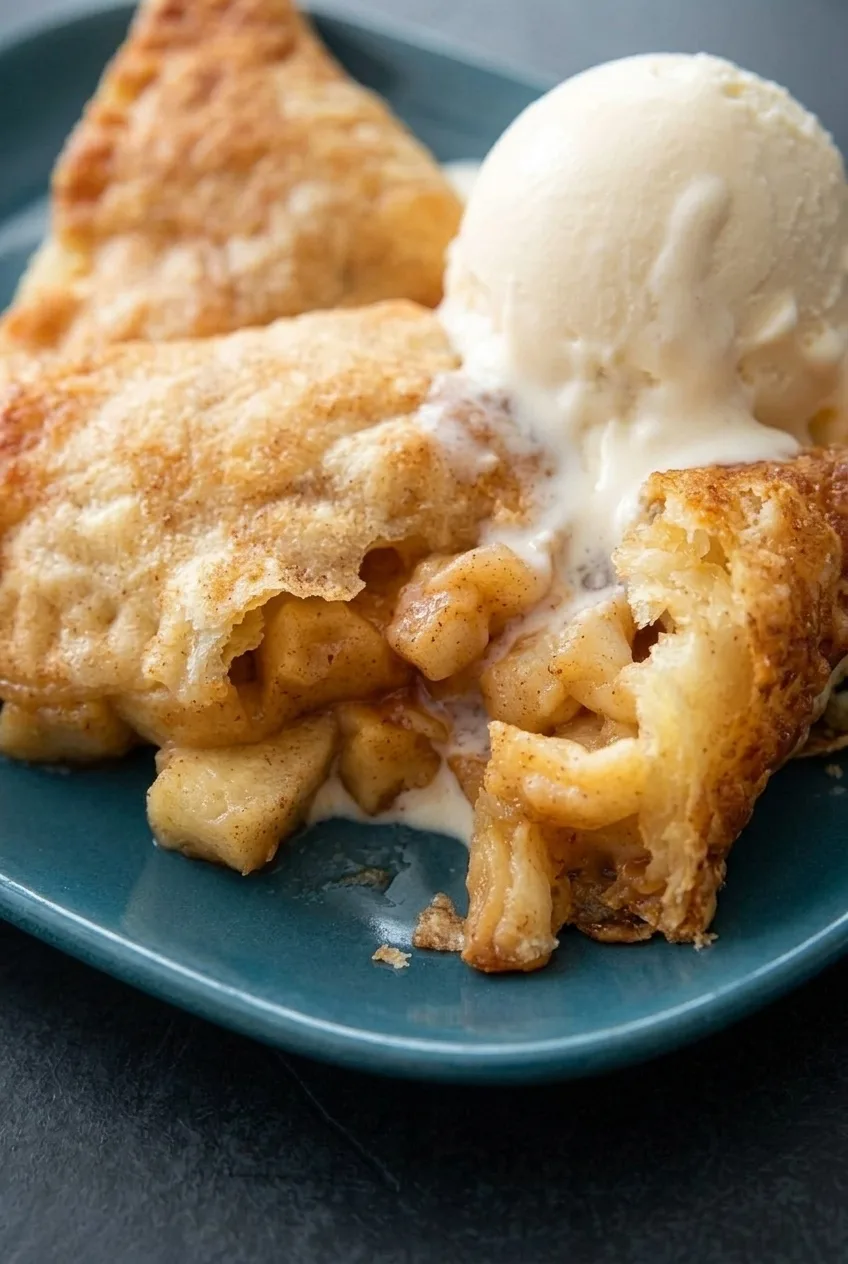
Close view of flaky turnover layers and chunky cinnamon-apple filling beside melting vanilla ice cream
  • 1 package frozen puff pastry, 2 sheets (about 490g), thawed until pliable but still cool
  • 2 medium apples, peeled, cored, and diced into roughly 1/2-inch pieces (about 2 cups or 300g); Granny Smith or Honeycrisp
  • 1/4 cup packed light brown sugar (50g)
  • 1 1/4 teaspoons ground cinnamon, divided
  • 1 tablespoon cornstarch
  • 1 tablespoon unsalted butter
  • 1 large egg, beaten with 1 tablespoon water
  • 1 tablespoon granulated sugar
  • About 1 pint vanilla ice cream, for serving

How to Make Apple Pie Turnovers

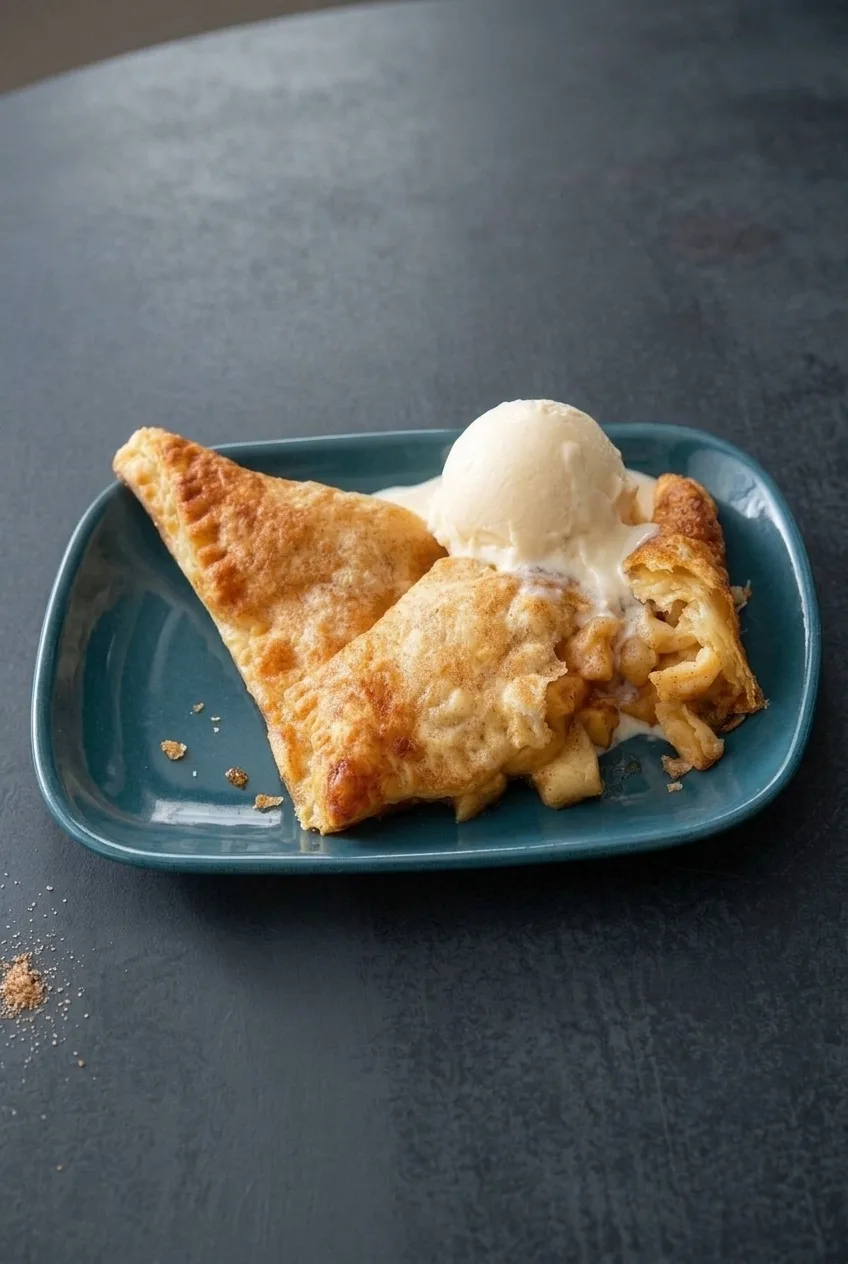
Wider view of a teal plate with an intact apple turnover, an opened turnover, and vanilla ice cream
  1. Cook the filling: In a medium saucepan over medium heat, cook the apples, brown sugar, 1 teaspoon cinnamon, cornstarch, and butter, stirring, for 6 to 8 minutes. The apples should be tender but hold their shape, with thickened juices clinging to the pieces rather than pooling in the pan.
  2. Cool and prepare: Spread the filling in a shallow bowl and let it cool for 15 to 20 minutes, until no longer hot to the touch. Meanwhile, preheat the oven to 400°F (205°C) and line two baking sheets with parchment paper.
  3. Cut and fill: Unfold each cool pastry sheet and cut it into four roughly equal squares, making eight squares total. Place about 2 to 3 tablespoons of filling on one half of each square, leaving a clean 1/2-inch border. Use less filling if your squares are small.
  4. Fold and seal: Lightly brush the borders with egg wash. Fold each square diagonally into a triangle, press the edges together, and crimp firmly with a fork. Space the turnovers apart on the baking sheets and cut one or two small slits through the top layer of each to release steam.
  5. Finish and bake: Brush the tops with the remaining egg wash. Mix the granulated sugar with the remaining 1/4 teaspoon cinnamon and sprinkle lightly over the pastry. Bake for approximately 18 to 22 minutes, beginning to check at 16 minutes. Rotate or switch the sheets if they brown unevenly. The turnovers are done when well puffed and golden, including at the seams and underside.
  6. Rest and serve: Let the turnovers rest for 8 to 10 minutes; the filling will still be hot. For a plated dessert, set an intact turnover beside one opened to show the apple pieces. Add vanilla ice cream just before serving.

How to Keep Turnovers from Leaking

Keep apples and syrup off the full 1/2-inch border so the pastry edges can meet. If a square looks too small for 3 tablespoons of filling, use less. Lightly brush the border, crimp firmly, and vent the top. Overfilling, filling caught in a seam, or trapped steam can cause a turnover to burst.

How to Keep the Pastry Flaky

Thaw puff pastry until it folds without cracking, but keep it cool as you work. Hot filling or overly warm dough can soften the layers before baking. If the pastry becomes greasy or limp, briefly chill it until cool and pliable again.

Don’t rely on the timer alone: pale seams or undersides need more time, even if the tops have puffed. For a full-size dessert made with similar pastry, try this puff pastry apple pie.

Can I Use Canned Apple Filling?

Yes. Chop any large apple pieces and use only enough filling to leave a clean border on each square. Skip the saucepan step and the fresh-apple filling ingredients; prepared filling does not automatically need more sugar or cornstarch.

Serving, Storage, and Reheating

Add ice cream only to turnovers you’re serving. The pastries can also be eaten plain as a handheld snack. For a version made by a different method, see these fried apple hand pies.

Cool leftover turnovers completely, then refrigerate them without ice cream in an airtight container for up to 3 days. The pastry will gradually soften. Reheat in a 350°F (175°C) oven for a few minutes, until heated through and beginning to crisp again. Microwaving is faster but softens the crust.

To freeze baked turnovers, cool them completely, wrap them individually, and freeze for up to 1 month. Reheat in the oven and add ice cream only after warming.

Nutrition

Approximate per turnover with one-eighth of the vanilla ice cream: 530 calories, 7g protein, 32g fat, and 55g carbohydrates. Approximate per 100g of ingredients before baking: 305 calories, 4g protein, 18g fat, and 32g carbohydrates. Values vary with the puff pastry and ice cream used; baking changes the finished weight.

Apple Pie Turnovers

Flaky puff-pastry triangles are filled with cinnamon apples, baked until golden, and served with vanilla ice cream.
Course: Dessert
Cuisine: American
Prep: 45 min
Cook: 30 min
Total: 75 min
Servings: 8

Equipment

  • Medium saucepan
  • Shallow bowl
  • Baking sheets
  • Parchment paper
  • Pastry brush

Ingredients

For the turnovers

  • 1 package frozen puff pastry, 2 sheets (about 490 g), thawed until pliable but still cool
  • 2 medium apples, peeled, cored, and diced into roughly 1/2-inch pieces (about 2 cups or 300 g); Granny Smith or Honeycrisp
  • 1/4 cup packed light brown sugar (50 g)
  • 1 1/4 teaspoons ground cinnamon, divided
  • 1 tablespoon cornstarch
  • 1 tablespoon unsalted butter
  • 1 large egg, beaten with 1 tablespoon water
  • 1 tablespoon granulated sugar

For serving

  • About 1 pint vanilla ice cream

Instructions

  1. In a medium saucepan over medium heat, cook the apples, brown sugar, 1 teaspoon cinnamon, cornstarch, and butter, stirring, for 6 to 8 minutes, until the apples are tender but hold their shape and the juices have thickened.
  2. Spread the filling in a shallow bowl and cool for 15 to 20 minutes, until no longer hot to the touch.
  3. Preheat the oven to 400°F (205°C) and line two baking sheets with parchment paper.
  4. Unfold each cool pastry sheet and cut it into four roughly equal squares, making eight squares total.
  5. Place 2 to 3 tablespoons of filling on one half of each square, leaving a clean 1/2-inch border. Use less filling if the squares are small.
  6. Lightly brush the borders with egg wash. Fold each square diagonally into a triangle, press the edges together, and crimp firmly with a fork.
  7. Arrange the turnovers on the baking sheets and cut one or two small slits through the top layer of each to release steam.
  8. Brush the tops with the remaining egg wash. Mix the granulated sugar with the remaining 1/4 teaspoon cinnamon and sprinkle lightly over the pastry.
  9. Bake for approximately 18 to 22 minutes, beginning to check at 16 minutes. Rotate or switch the sheets if they brown unevenly. Bake until well puffed and golden, including at the seams and underside.
  10. Rest the turnovers for 8 to 10 minutes before serving. Add vanilla ice cream just before serving, if desired.

Tips

  • Keep filling and syrup off the full 1/2-inch pastry border so the edges can seal.
  • Avoid overfilling; use less than 2 to 3 tablespoons if a square is small.
  • Keep the pastry cool while assembling. Briefly chill it if it becomes greasy or limp.
  • Check the seams and undersides for golden color; puffed tops alone do not mean the turnovers are done.

Variations

  • Canned Apple Filling: Chop any large apple pieces, use only enough filling to leave a clean border, and skip the saucepan step and fresh-apple filling ingredients.

Notes

Cool leftovers completely and refrigerate without ice cream in an airtight container for up to 3 days. Reheat in a 350°F (175°C) oven until heated through and beginning to crisp. Baked turnovers can be wrapped individually and frozen for up to 1 month.

Nutrition

Per Turnover With One Eighth Of The Ice Cream Calories: 530 kcal | Per Turnover With One Eighth Of The Ice Cream Protein: 7 g | Per Turnover With One Eighth Of The Ice Cream Fat: 32 g | Per Turnover With One Eighth Of The Ice Cream Carbohydrates: 55 g | Per 100g Of Ingredients Before Baking Calories: 305 kcal | Per 100g Of Ingredients Before Baking Protein: 4 g | Per 100g Of Ingredients Before Baking Fat: 18 g | Per 100g Of Ingredients Before Baking Carbohydrates: 32 g

Apple Pear Pie

Apple pear pie should cut into a generous wedge with distinct fruit slices, thickened juices, and golden pastry above and below. This version pairs roughly equal amounts of apples and ripe but firm pears under a full, vented crust. Bake until the juices bubble through the center vents, then let the pie cool so the filling holds together when sliced. Add one scoop of vanilla ice cream to each plated wedge just before serving.

Ingredients for Apple Pear Pie

Makes one standard-depth 9-inch pie, or 8 slices. Prep time: about 35 minutes, including a 15-minute chill. Bake time: about 55 to 65 minutes. Total time: about 4 hours 30 minutes to 4 hours 40 minutes, including about 3 hours of cooling.

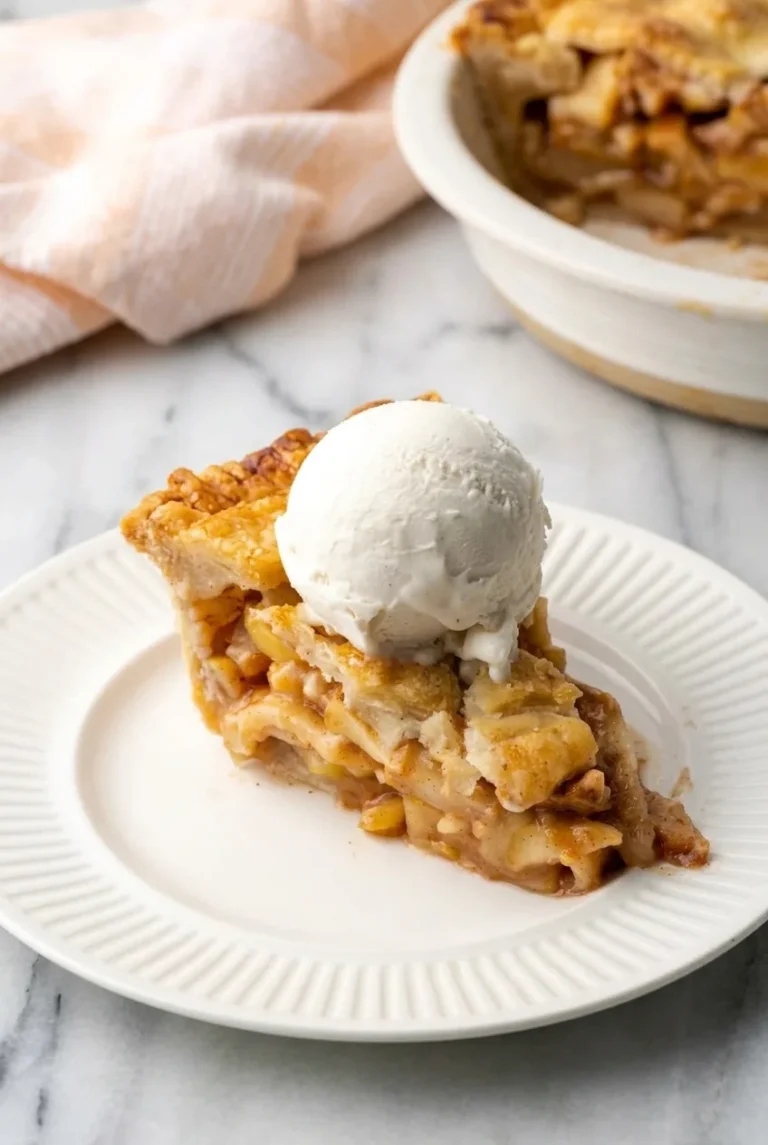
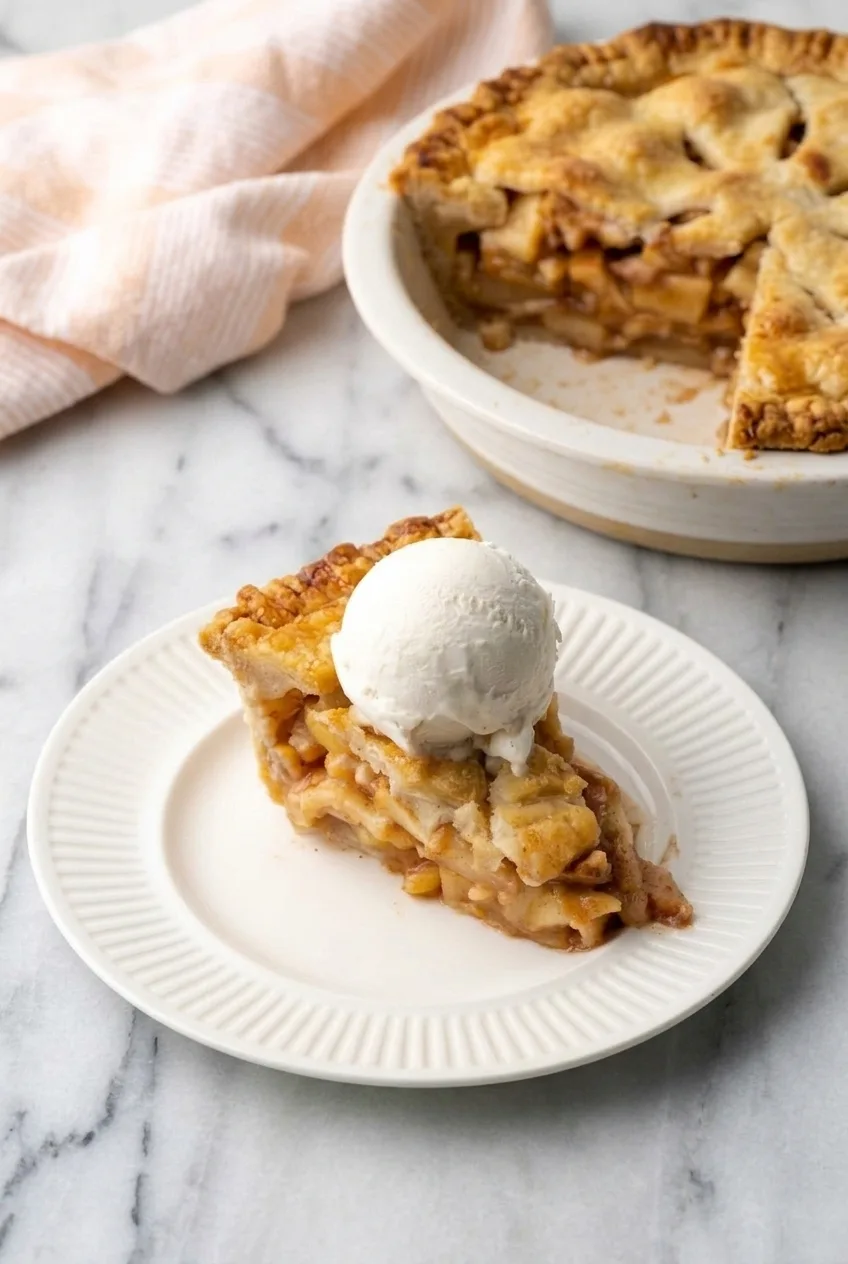
Plated apple pear pie wedge with ice cream beside the remaining double-crust pie
  • Pastry for a 9-inch double crust, 2 crusts (about 400g; package weights vary)
  • 3 1/2 cups peeled, cored apples, sliced about 1/4 inch thick (about 450g, from 3 to 4 medium apples)
  • 3 1/2 cups peeled, cored ripe but firm pears, sliced about 1/4 inch thick (about 490g, from 3 to 4 medium pears)
  • 2/3 cup packed light brown sugar (140g)
  • 1/4 cup cornstarch (about 30g)
  • 1 tablespoon lemon juice
  • 1 1/2 teaspoons ground cinnamon
  • 1/4 teaspoon ground ginger
  • 1/4 teaspoon fine salt
  • 1 large egg, beaten
  • 8 scoops vanilla ice cream, about 1/3 cup each, for serving

Optional: 1 tablespoon coarse sugar for the top crust.

Close view of sliced apple and pear filling between flaky pie crusts beneath vanilla ice cream

How to Bake Apple Pear Pie

  1. Preheat and line the plate: Place a rimmed baking sheet on a lower-middle oven rack and preheat to 425°F (220°C). Fit one crust into a standard-depth 9-inch pie plate without stretching it. Keep the crust chilled while you prepare the filling.
  2. Coat the fruit: Toss the apples and pears with the brown sugar, cornstarch, lemon juice, cinnamon, ginger, and salt in a large bowl. Mix until the fruit is evenly coated and no dry pockets of cornstarch remain.
  3. Assemble the pie: Transfer the fruit and any coated juices to the bottom crust, mounding the slices evenly. Add the second crust, trim and seal the edges, and crimp. Cut several vents near the center, all the way through the pastry, to let steam escape and make bubbling juices visible.
  4. Chill and finish: Refrigerate the assembled pie for about 15 minutes, until the pastry feels cool and firm. Lightly brush the top with beaten egg and sprinkle with coarse sugar, if using.
  5. Bake: Carefully set the pie on the hot baking sheet. Bake uncovered for 15 minutes at 425°F, then reduce the oven to 375°F (190°C) and bake for approximately 40 to 50 minutes more. Check the crust when you lower the heat; loosely shield any areas browning too quickly with foil. Rotate the pie carefully if your oven browns unevenly. Begin checking the filling at about 50 minutes total. Continue baking until thick juices bubble through the center vents, the top and visible bottom edge are golden, and a thin knife inserted through a vent meets little resistance from the fruit.
  6. Cool and serve: Cool on a rack for about 3 hours so the juices can set. Cut into 8 generous wedges and place one scoop of vanilla ice cream on each plated slice just before serving.

Choosing and Slicing the Fruit

Choose pears that are ripe but still firm. Very soft pears can break down and release more juice as they bake. Cut both fruits into roughly 1/4-inch slices so they cook at a similar rate; if the pears are noticeably softer than the apples, slice them slightly thicker to help them hold their shape.

How to Tell When the Pie Is Done

A golden top alone does not mean the raw fruit is cooked. Look for thick juices bubbling through the center vents, not just around the rim, and check that the visible bottom edge has browned rather than stayed pale. The preheated sheet helps the bottom crust color, but it does not replace these checks. If the pastry darkens before the filling bubbles and the fruit is tender, shield the browned areas loosely with foil and keep baking. Juicy pears, thicker slices, or a deeper pie plate may extend the bake beyond the stated range.

Storing and Rewarming Leftover Pie

Cover and refrigerate leftover pie for up to 4 days, keeping the ice cream separate. To warm a slice, microwave it briefly and check after about 30 seconds; the crust may soften. For a whole chilled pie, cover loosely with foil and warm at 350°F (175°C) until the center is warm, approximately 30 to 45 minutes. Add fresh ice cream after plating.

An assembled unbaked pie can be frozen well wrapped, but it needs a longer bake from frozen. The fresh-pie bake time above will not apply.

Other Apple Pie Styles

For an all-apple alternative, try classic homemade apple pie. If you prefer crumbs to a pastry lid, see this Dutch apple pie with streusel topping; it uses a different topping from the pie made here.

Nutrition

Approximate nutrition per slice, including one scoop of vanilla ice cream: 500 calories, 6g protein, 21g fat, and 75g carbohydrates. Approximate values per 100g of served pie and ice cream: 210 calories, 3g protein, 9g fat, and 32g carbohydrates. Values vary with the pastry, ice cream, and size of each slice.

Apple Pear Pie

A double-crust pie filled with cinnamon-spiced apples and pears, baked until bubbling and cooled until sliceable.
Course: Dessert
Cuisine: American
Prep: 35 min
Cook: 60 min
Total: 275 min
Servings: 8 Calories: 500 kcal

Equipment

  • 9-inch pie plate
  • Rimmed baking sheet
  • Large mixing bowl
  • Pastry brush
  • Cooling rack
  • Aluminum foil

Ingredients

For the Pie

  • Pastry for a 9-inch double crust, 2 crusts (about 400 g; package weights vary)
  • 3 1/2 cups peeled, cored apples, sliced about 1/4 inch thick (about 450 g, from 3 to 4 medium apples)
  • 3 1/2 cups peeled, cored ripe but firm pears, sliced about 1/4 inch thick (about 490 g, from 3 to 4 medium pears)
  • 2/3 cup packed light brown sugar (140 g)
  • 1/4 cup cornstarch (about 30 g)
  • 1 tablespoon lemon juice
  • 1 1/2 teaspoons ground cinnamon
  • 1/4 teaspoon ground ginger
  • 1/4 teaspoon fine salt
  • 1 large egg, beaten
  • 1 tablespoon coarse sugar, optional

For Serving

  • 8 scoops vanilla ice cream, about 1/3 cup each

Instructions

  1. Place a rimmed baking sheet on a lower-middle oven rack and preheat the oven to 425°F (220°C).
  2. Fit one crust into a standard-depth 9-inch pie plate without stretching it. Keep it chilled while preparing the filling.
  3. Toss the apples and pears with the brown sugar, cornstarch, lemon juice, cinnamon, ginger, and salt until evenly coated with no dry pockets of cornstarch.
  4. Transfer the fruit and any coated juices to the bottom crust, mounding the slices evenly.
  5. Add the second crust, trim and seal the edges, and crimp. Cut several vents near the center through the pastry.
  6. Refrigerate the assembled pie for about 15 minutes, until the pastry feels cool and firm.
  7. Brush the top lightly with beaten egg and sprinkle with coarse sugar, if using.
  8. Set the pie on the hot baking sheet and bake uncovered for 15 minutes at 425°F (220°C).
  9. Reduce the oven to 375°F (190°C) and bake for about 40 to 50 minutes more. Loosely shield areas browning too quickly with foil and rotate the pie if needed.
  10. Check for doneness starting at about 50 minutes total. Continue baking until thick juices bubble through the center vents, the top and visible bottom edge are golden, and a thin knife inserted through a vent meets little resistance from the fruit.
  11. Cool the pie on a rack for about 3 hours. Cut into 8 wedges and add a scoop of vanilla ice cream to each slice just before serving.

Tips

  • Use pears that are ripe but still firm so they hold their shape as they bake.
  • Slice both fruits about 1/4 inch thick for even cooking; slice softer pears slightly thicker.
  • Look for bubbling juices through the center vents, not just around the rim, before taking the pie out of the oven.
  • Shield pastry loosely with foil if it browns before the filling is cooked.
  • Let the pie cool for about 3 hours so the filling can set before slicing.

Notes

Cover and refrigerate leftovers for up to 4 days, keeping ice cream separate. Rewarm a slice briefly in the microwave or warm a whole chilled pie, loosely covered with foil, at 350°F (175°C) for about 30 to 45 minutes. An assembled unbaked pie can be frozen, but it needs a longer bake from frozen.

Nutrition

Calories: 500 kcal | Protein: 6 g | Fat: 21 g | Carbohydrates: 75 g

Apple Cranberry Pie

This apple cranberry pie has one bottom crust, a filling of distinct apple slices and tart red cranberries, and a chunky oat crumble instead of a pastry lid. Bake it until the fruit bubbles thickly and the apples near the center are tender; a golden topping alone does not mean the filling is done. Let the whole pie cool before cutting it into wedges, then add a scoop of vanilla ice cream to each slice just before serving.

Ingredients for Apple Cranberry Pie

Crust and filling

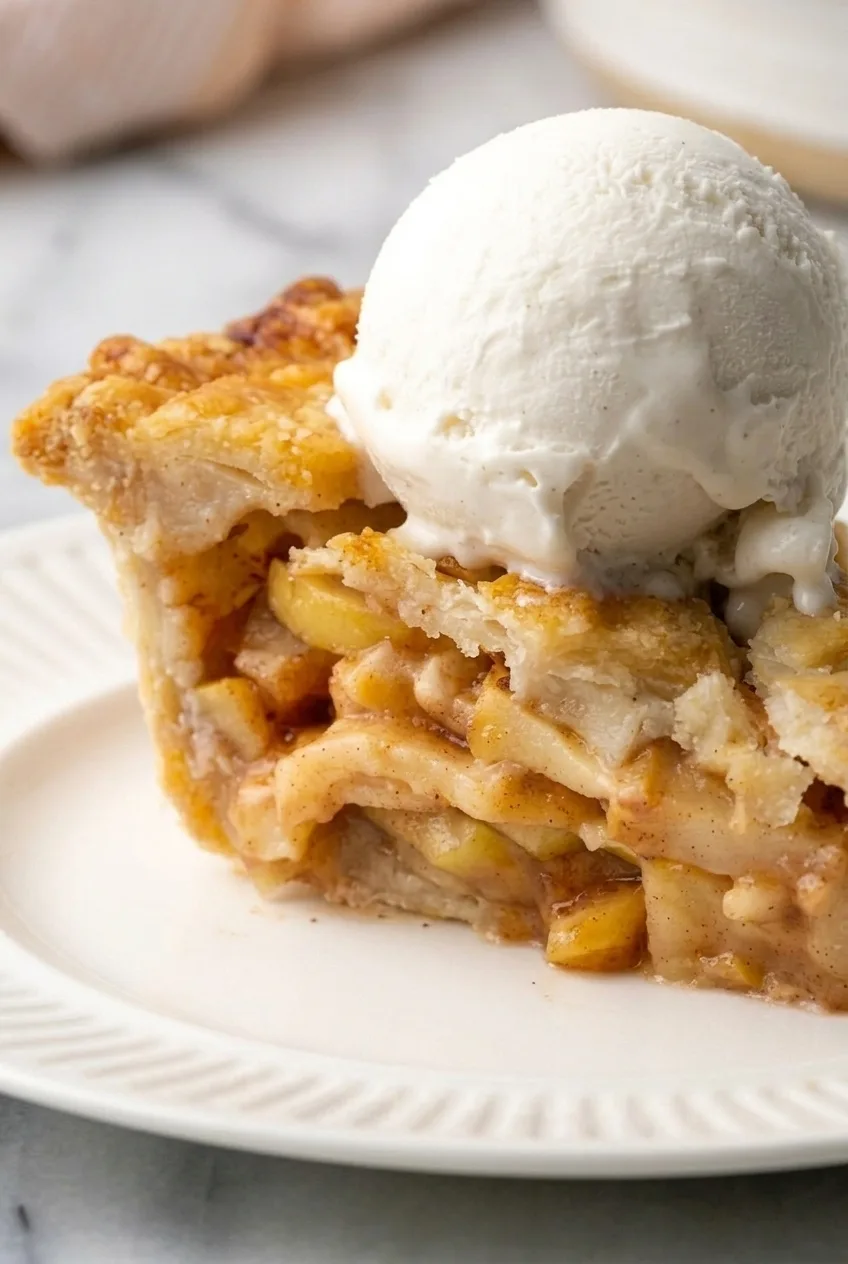
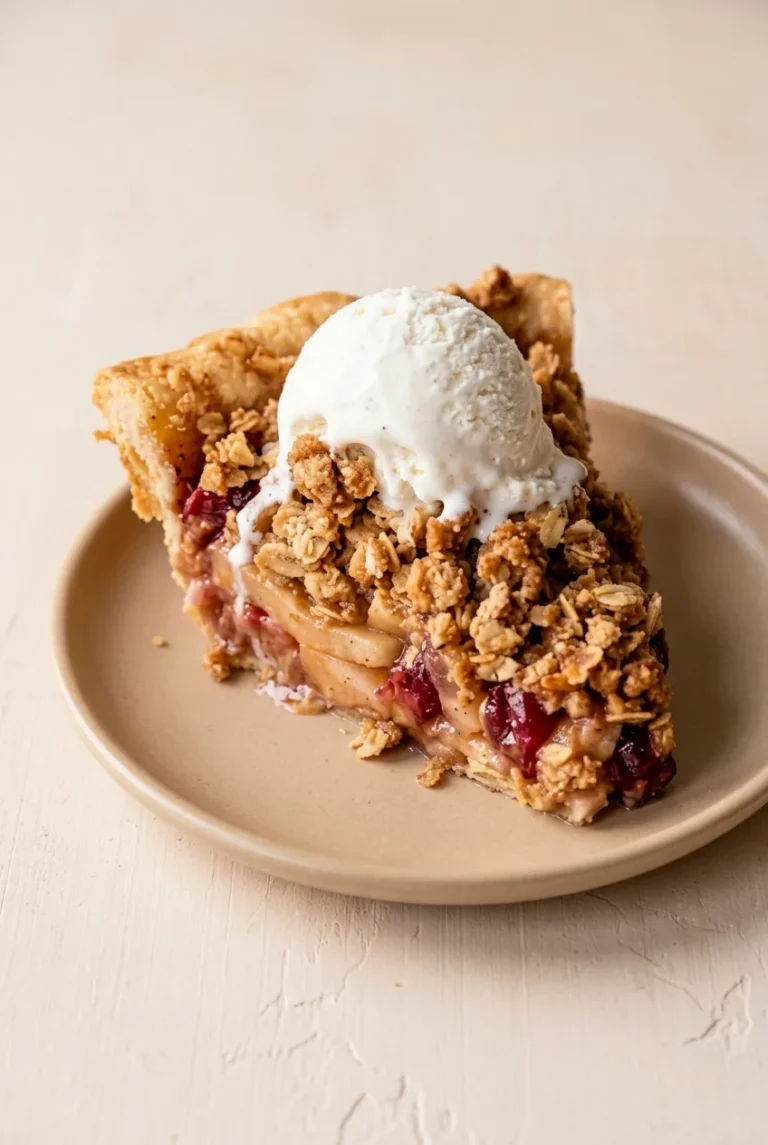
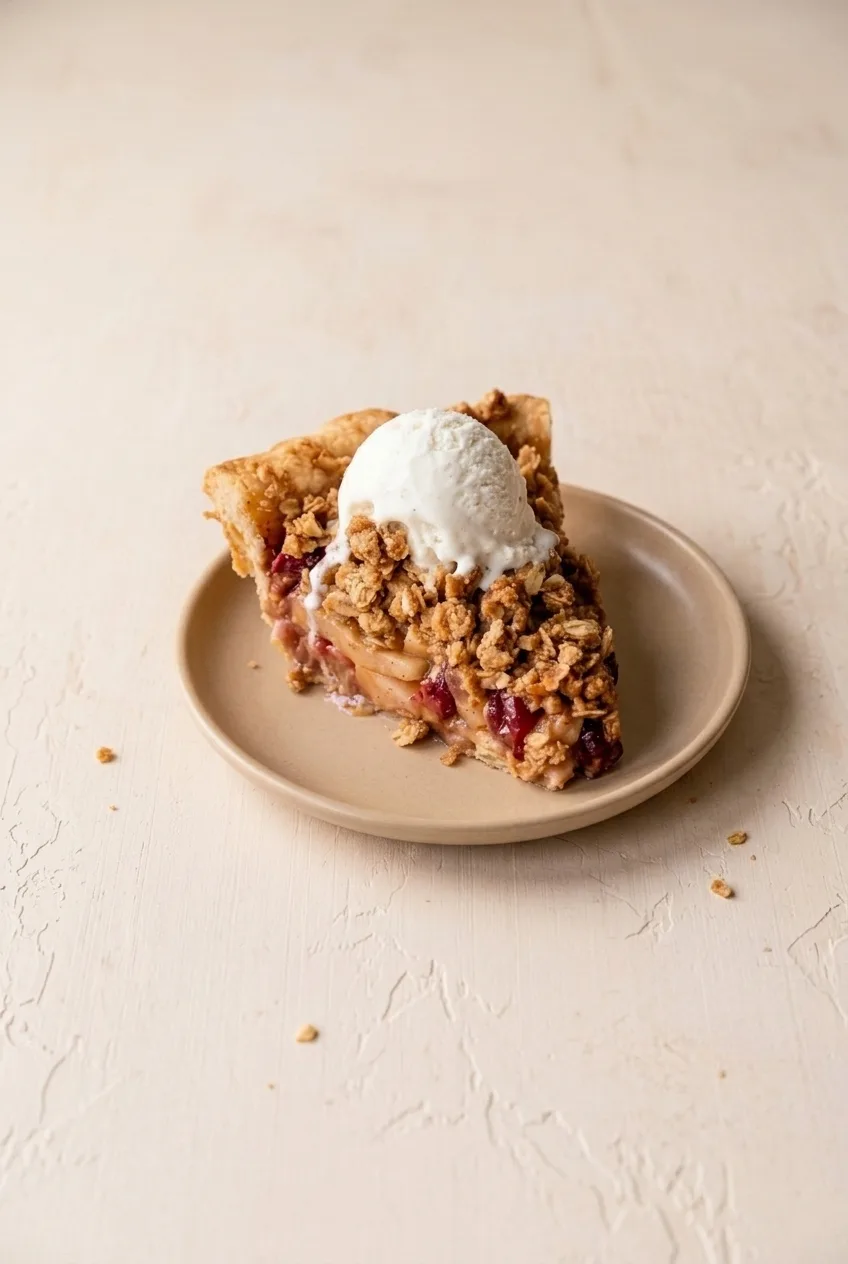
Apple cranberry pie wedge with ice cream on a complete plate, surrounded by a pale tabletop
  • 1 pie-dough round for a 9-inch pie, homemade or refrigerated (about 230g)
  • About 2 1/2 pounds firm baking apples (about 1,150g whole), yielding roughly 6 cups peeled, cored, 1/4-inch slices
  • 1 cup fresh or frozen cranberries (about 100g)
  • 3/4 cup granulated sugar (150g)
  • 3 tablespoons cornstarch (about 25g)
  • 1 teaspoon ground cinnamon
  • 1 teaspoon finely grated orange zest, optional

Oat crumble and serving

  • 3/4 cup all-purpose flour (90g)
  • 1/2 cup old-fashioned rolled oats (45g)
  • 1/3 cup packed light brown sugar (70g)
  • 1/4 teaspoon fine salt
  • 6 tablespoons cold unsalted butter, cubed (85g)
  • About 1 pint vanilla ice cream, for 8 small scoops
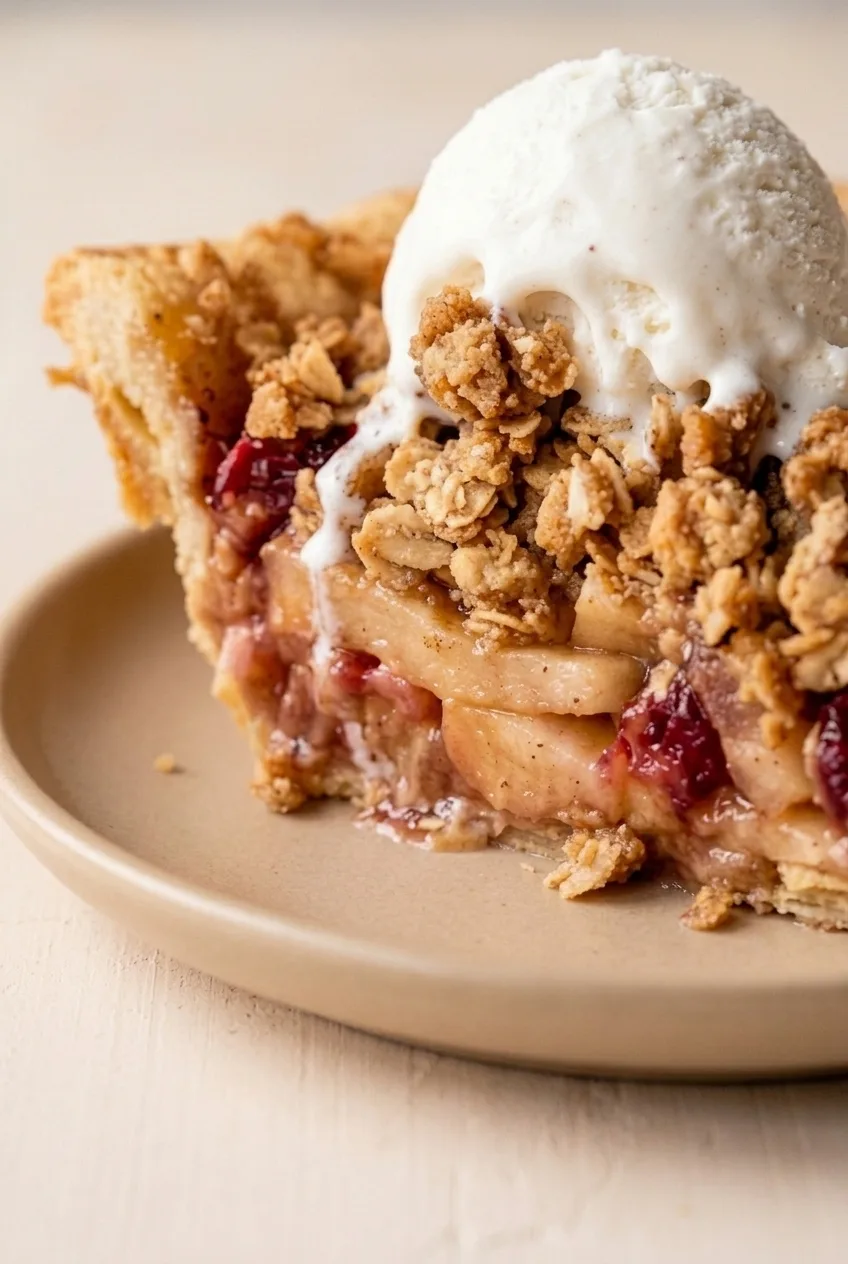
Close view of apple slices and red cranberries above the pastry crust of an apple cranberry pie wedge

How to Bake Apple Cranberry Pie

  1. Line the pie plate: Fit the dough into a standard-depth 9-inch pie plate without stretching it, and crimp the edge. Refrigerate the unbaked shell while you prepare the topping and filling.
  2. Make the crumble: Mix the flour, oats, brown sugar, and salt. Work in the cold butter with a pastry blender or your fingertips until you have loose crumbs and larger clumps. Refrigerate the topping.
  3. Mix the filling: Peel, core, and slice the apples about 1/4 inch thick. Toss them with the cranberries, granulated sugar, cornstarch, cinnamon, and optional orange zest until no dry cornstarch remains. Add frozen cranberries straight from the freezer; do not thaw them.
  4. Assemble and chill: Mound the fruit in the cold shell. Scatter the crumble over most of the filling, leaving small gaps where juices can bubble through. Refrigerate the assembled pie for about 15 minutes. Meanwhile, preheat the oven to 400°F (205°C) with a rack in the lower third.
  5. Bake: Set the pie on a rimmed baking sheet to catch drips. Bake uncovered for 20 minutes, then reduce the oven to 375°F (190°C) and bake for about 35 to 45 minutes more. Check the browning after about 35 minutes total. If the crumble or exposed crust is getting too dark, tent the pie loosely with foil. Rotate it once if your oven browns unevenly.
  6. Check and cool: Start checking the fruit around 55 minutes total. The juices should bubble thickly, including near the center, and the crust and crumble should be golden brown. A thin knife inserted into an apple slice near the center should meet little resistance. Keep baking if the apples are firm or the filling has not bubbled thickly; frozen cranberries may extend the bake. Cool the whole pie on a rack for at least 3 hours. Cut into 8 wedges and add a small scoop of vanilla ice cream to each just before serving.

Choosing Apples and Cranberries

Firm baking apples, such as a mix of Granny Smith and Honeycrisp, soften while keeping recognizable slices. Cut them to a similar thickness so they cook evenly, and avoid soft, mealy apples. Fresh and unthawed frozen cranberries both work; judge a pie made with frozen fruit by the bubbling filling and tender apples rather than the clock.

How to Tell When the Pie Is Done

The crumble can brown before the fruit finishes cooking. If that happens, tent the pie loosely with foil and continue baking. Look for thick bubbles through gaps in the topping and test an apple near the center with a thin knife. The lower oven rack helps the bottom pastry brown, so check the crust along with the fruit before removing the pie.

Getting a Slice That Holds Together

Measure the cornstarch and bake until the juices bubble thickly so the filling can thicken. Then cool the whole pie for at least 3 hours before slicing. Cutting it hot is more likely to release juice, and adding ice cream before plating will melt it during the wait.

Storing Leftover Pie

Store the pie without ice cream. Once fully cool, cover it and keep it at room temperature for up to 1 day or refrigerate it for up to 5 days. You can bake it a day ahead and add ice cream when serving. An individual slice can be gently warmed, though it may not hold its shape as neatly as a fully cooled slice.

If freezing a baked pie, freeze it for up to 3 months and thaw it overnight in the refrigerator. The crumble may soften.

Nutrition

Approximate per serving, based on 1 of 8 slices with a small scoop of vanilla ice cream: 550 calories, 6g protein, 23g fat, and 82g carbohydrates. Approximate per 100g: 230 calories, 3g protein, 10g fat, and 34g carbohydrates. Values vary with the pie dough, apples, ice cream, and scoop size.

Apple Cranberry Pie

A bottom-crust pie filled with sliced apples and cranberries and topped with an oat crumble.
Course: Dessert
Cuisine: American
Prep: 35 min
Cook: 60 min
Total: 290 min
Servings: 8 Calories: 550 kcal

Equipment

  • 9-inch pie plate
  • Mixing bowls
  • Pastry blender
  • Rimmed baking sheet
  • Cooling rack
  • Thin knife

Ingredients

Crust and filling

  • 1 pie-dough round for a 9-inch pie, homemade or refrigerated (about 230g)
  • About 2 1/2 pounds firm baking apples (about 1,150g whole), yielding roughly 6 cups peeled, cored, 1/4-inch slices
  • 1 cup fresh or frozen cranberries (about 100g)
  • 3/4 cup granulated sugar (150g)
  • 3 tablespoons cornstarch (about 25g)
  • 1 teaspoon ground cinnamon
  • 1 teaspoon finely grated orange zest, optional

Oat crumble and serving

  • 3/4 cup all-purpose flour (90g)
  • 1/2 cup old-fashioned rolled oats (45g)
  • 1/3 cup packed light brown sugar (70g)
  • 1/4 teaspoon fine salt
  • 6 tablespoons cold unsalted butter, cubed (85g)
  • About 1 pint vanilla ice cream, for 8 small scoops

Instructions

  1. Fit the dough into a standard-depth 9-inch pie plate without stretching it, then crimp the edge. Refrigerate the unbaked shell while preparing the other components.
  2. Mix the flour, oats, brown sugar, and salt. Work in the cold butter with a pastry blender or your fingertips until loose crumbs and larger clumps form. Refrigerate the topping.
  3. Peel, core, and slice the apples about 1/4 inch thick. Toss them with the cranberries, granulated sugar, cornstarch, cinnamon, and optional orange zest until no dry cornstarch remains. Use frozen cranberries straight from the freezer without thawing.
  4. Mound the fruit in the cold pie shell. Scatter the crumble over most of the filling, leaving small gaps for juices to bubble through.
  5. Refrigerate the assembled pie for about 15 minutes. Meanwhile, preheat the oven to 400°F (205°C) with a rack in the lower third.
  6. Set the pie on a rimmed baking sheet. Bake uncovered for 20 minutes, then reduce the oven to 375°F (190°C) and bake for about 35 to 45 minutes more.
  7. Check browning after about 35 minutes total. If the crumble or exposed crust is getting too dark, tent the pie loosely with foil. Rotate it once if your oven browns unevenly.
  8. Start checking the fruit around 55 minutes total. Bake until juices bubble thickly near the center, the crust and crumble are golden brown, and a thin knife inserted into an apple slice near the center meets little resistance. Continue baking if the apples are firm or the filling has not bubbled thickly.
  9. Cool the pie on a rack for at least 3 hours. Cut into 8 wedges and add a small scoop of vanilla ice cream to each just before serving.

Tips

  • Choose firm baking apples, such as Granny Smith and Honeycrisp, and avoid soft, mealy apples.
  • Slice the apples to a similar thickness so they cook evenly.
  • Judge doneness by thickly bubbling juices and tender apples near the center, not by the topping color alone.
  • Tent the pie loosely with foil if the crumble or crust browns before the filling is done.
  • Cool the whole pie for at least 3 hours before slicing so the filling can set.

Notes

Store the cooled pie covered at room temperature for up to 1 day or refrigerate for up to 5 days. Freeze baked pie for up to 3 months and thaw overnight in the refrigerator; the crumble may soften. Nutrition is approximate and varies with ingredients and scoop size.

Nutrition

Calories: 550 kcal | Protein: 6 g | Fat: 23 g | Carbohydrates: 82 g | Per 100g Calories: 230 kcal | Per 100g Protein: 3 g | Per 100g Fat: 10 g | Per 100g Carbohydrates: 34 g

Apple Cream Cheese Pie

A tall graham cracker crust holds a baked cream cheese filling, with glossy cinnamon-caramel apples mounded on top. The apples are cooked separately and added after the filling has chilled, so the pie cuts into distinct layers. Leave a pale border around the apples for spaced whipped-cream dollops. Allow at least four hours of refrigeration before topping and slicing.

Ingredients for Apple Cream Cheese Pie

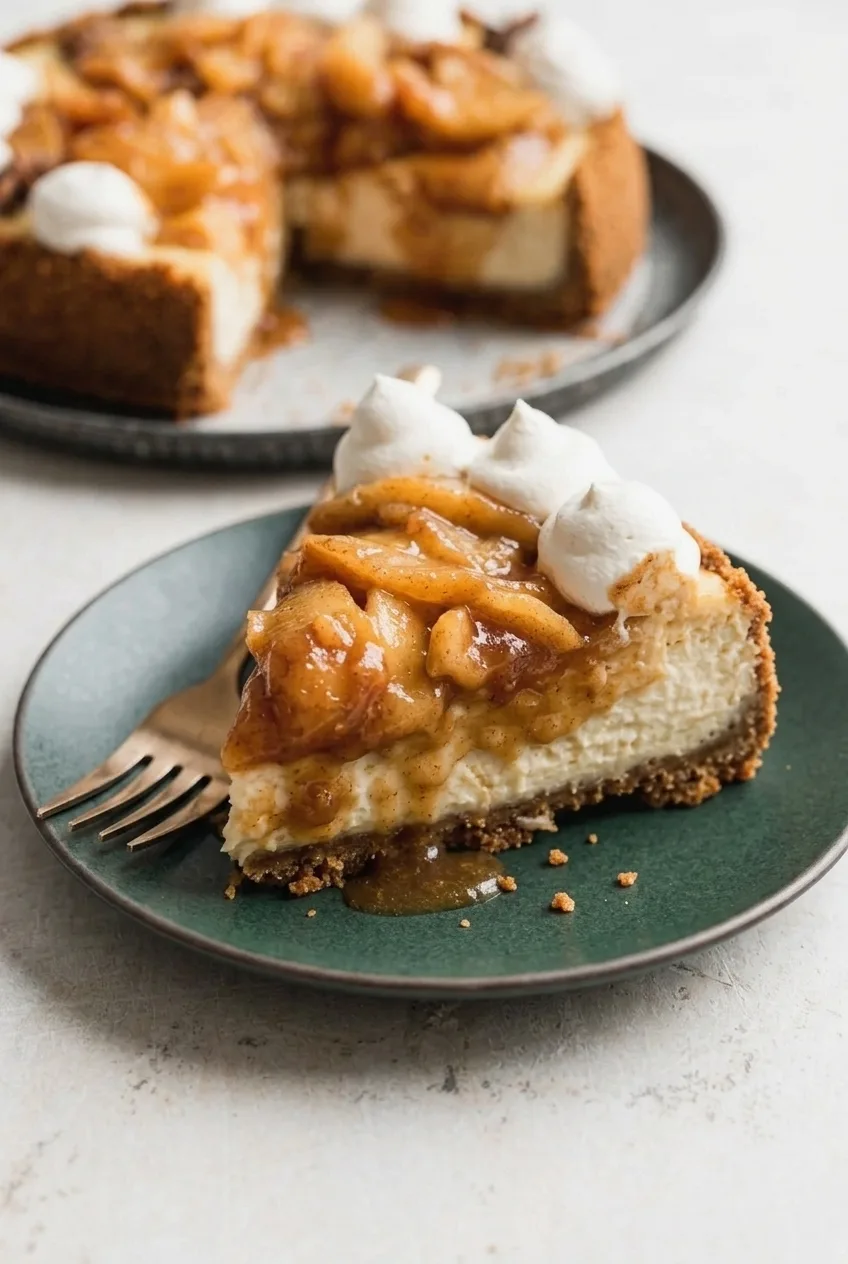
Close view of a pie wedge showing graham cracker crust, cream cheese filling, and caramel-coated apples

Graham cracker crust

  • 1 3/4 cups graham cracker crumbs (200g)
  • 6 tablespoons unsalted butter, melted
  • 2 tablespoons granulated sugar

Cream cheese filling

  • Three 8-ounce blocks full-fat cream cheese, softened (680g)
  • 2/3 cup granulated sugar
  • 1 teaspoon vanilla extract
  • 3 large eggs

Apple topping

  • 4 medium firm apples, about 1 1/2 pounds before peeling (680g)
  • 2 tablespoons unsalted butter
  • 1/3 cup packed light brown sugar (about 65g)
  • 1 teaspoon ground cinnamon
  • 1 tablespoon cornstarch
  • 2 tablespoons water
  • 1/4 cup prepared caramel sauce (80g)

Whipped-cream finish

  • 3/4 cup cold heavy whipping cream
  • 2 tablespoons powdered sugar
  • Optional: 2–3 whole star anise pods for removable decoration

How to Make Apple Cream Cheese Pie

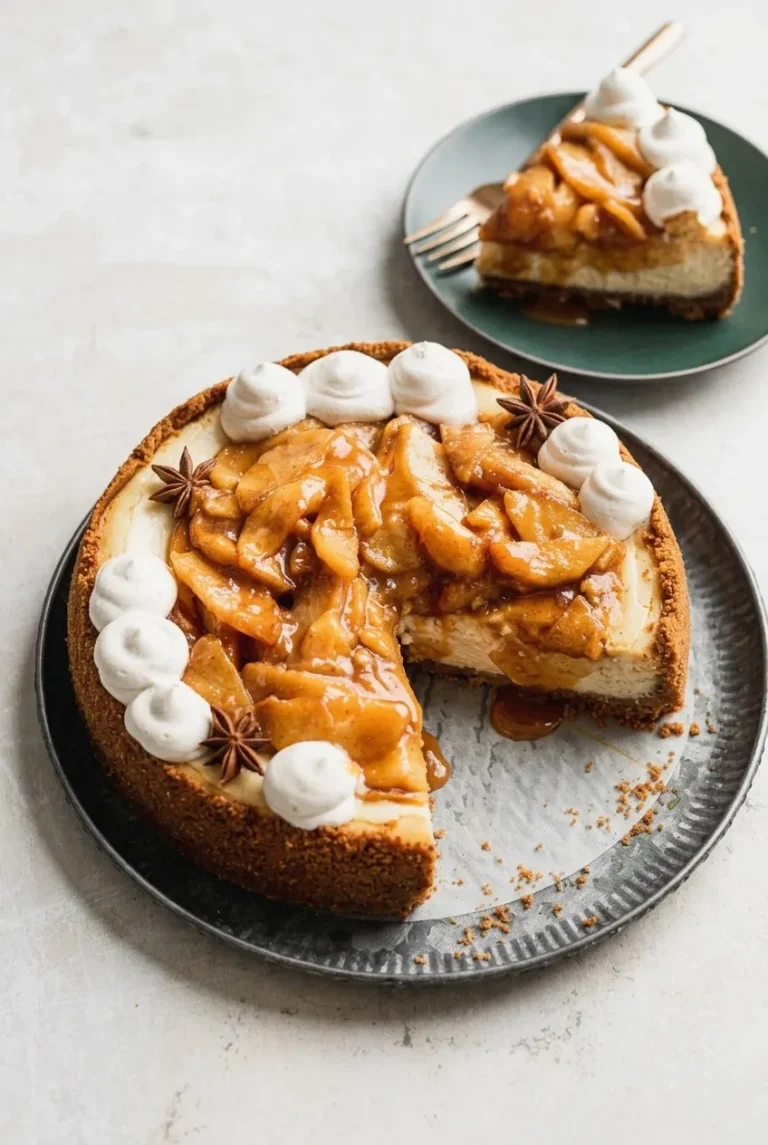
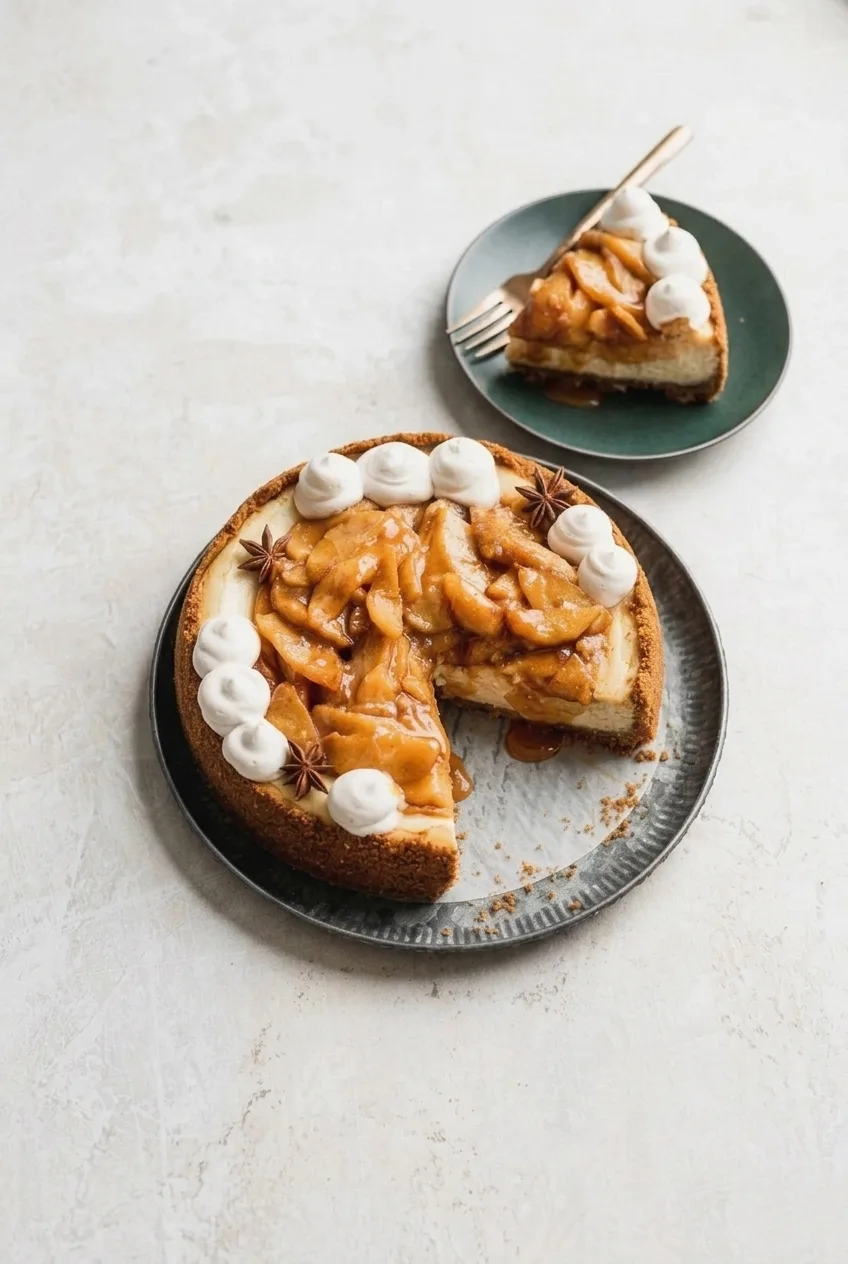
Wide view of apple cream cheese pie on a dark plate with a separate slice nearby

Yield: One 9-inch pie, about 10 slices. Active prep: About 35 minutes. Cooking: About 65–80 minutes. Total: About 7 hours, including cooling and chilling.

  1. Prebake the crust: Set a rack in the center of the oven and preheat to 350°F (175°C). Mix the graham cracker crumbs, melted butter, and 2 tablespoons granulated sugar. Press firmly across the base and about 1 1/2 inches up the sides of a 9-inch springform pan. Set the pan on a rimmed baking sheet to catch any butter drips. Bake uncovered for 8–10 minutes, until dry-looking and lightly golden. Reduce the oven to 325°F (165°C).
  2. Mix the filling: Beat the softened cream cheese and 2/3 cup granulated sugar until smooth. Mix in the vanilla. Add the eggs one at a time on low speed, mixing just until incorporated; avoid beating the batter until foamy. Pour into the crust.
  3. Bake and chill: Keep the pan on the rimmed sheet and bake uncovered at 325°F for approximately 50–65 minutes. Begin checking at 50 minutes. The edges should be set, with a slight wobble in the center when the pan is gently moved—not a liquid slosh. Cool for about 1 hour at room temperature, then cover and refrigerate for at least 4 hours before topping or slicing.
  4. Cook the apples: While the pie chills, peel, core, and slice the apples. Melt 2 tablespoons butter in a large skillet over medium heat. Add the apples, brown sugar, and cinnamon. Cook, stirring gently, for about 10–15 minutes, until the slices are tender but still hold their shape; start checking after about 8 minutes. Stir the cornstarch and water together, add to the skillet, and cook until the juices thicken and coat the slices. Stir in the caramel sauce and let the topping cool completely.
  5. Top and decorate: Unmold the chilled pie. Spoon the cooled apples into the center, leaving a visible border of cream cheese filling. Whip the cold cream and powdered sugar until soft peaks hold their shape, then pipe spaced dollops around the border. Add whole star anise only if desired for presentation.
  6. Slice and serve: Cut into chilled wedges, wiping the knife between cuts as needed to show the crust, filling, and apple layers. Remove any whole star anise before eating.

How to Tell When the Filling Is Baked

Do not wait for the center to become rigid in the oven. Set edges and a slight center wobble are the cues; if the middle sloshes like liquid, bake it longer. The filling firms as it cools and needs at least four hours in the refrigerator for neat slices.

Keep the Apple Topping from Running

Stir the apples gently so the slices stay distinct. After adding the cornstarch slurry, cook until the sauce clings to the apples rather than pooling thinly in the skillet. Let the topping cool completely before mounding it on the chilled pie; warm apples can soften the filling and melt the whipped cream.

Make-Ahead and Storage

Bake and chill the plain pie the day before serving if convenient. Keep the cooked, cooled apples separate, then add them and pipe the whipped cream close to serving for the clearest border and neatest dollops. Refrigerate the finished pie, covered, because it contains cream cheese filling and whipped cream. Do not reheat the assembled pie.

For a crumb-topped apple dessert, try Dutch apple pie with streusel topping. For a pastry-topped option, see this double-crust caramel apple pie.

Nutrition

Approximate nutrition per slice, based on 10 slices: 635 calories, 8g protein, 43g fat, and 59g carbohydrates. Per 100g: approximately 290 calories, 4g protein, 19g fat, and 27g carbohydrates. Values are estimates; slice size, apple yield, and caramel sauce will affect the totals.

Apple Cream Cheese Pie

A graham cracker crust holds a baked cream cheese filling topped with cinnamon-caramel apples and whipped cream.
Course: Dessert
Cuisine: American
Prep: 35 min
Cook: 75 min
Total: 420 min
Servings: 10 Calories: 635 kcal

Equipment

  • 9-inch springform pan
  • Rimmed baking sheet
  • Oven
  • Electric mixer
  • Large skillet
  • Mixing bowls
  • Piping bag

Ingredients

Graham Cracker Crust

  • 1 3/4 cups graham cracker crumbs (200 g)
  • 6 tablespoons unsalted butter, melted
  • 2 tablespoons granulated sugar

Cream Cheese Filling

  • Three 8-ounce blocks full-fat cream cheese, softened (680 g)
  • 2/3 cup granulated sugar
  • 1 teaspoon vanilla extract
  • 3 large eggs

Apple Topping

  • 4 medium firm apples, about 1 1/2 pounds before peeling (680 g)
  • 2 tablespoons unsalted butter
  • 1/3 cup packed light brown sugar (about 65 g)
  • 1 teaspoon ground cinnamon
  • 1 tablespoon cornstarch
  • 2 tablespoons water
  • 1/4 cup prepared caramel sauce (80 g)

Whipped-Cream Finish

  • 3/4 cup cold heavy whipping cream
  • 2 tablespoons powdered sugar
  • Optional: 2–3 whole star anise pods for decoration

Instructions

  1. Set a rack in the center of the oven and preheat to 350°F (175°C).
  2. Mix the graham cracker crumbs, melted butter, and 2 tablespoons granulated sugar. Press the mixture firmly across the base and about 1 1/2 inches up the sides of a 9-inch springform pan.
  3. Set the pan on a rimmed baking sheet and bake the crust uncovered for 8–10 minutes, until dry-looking and lightly golden. Reduce the oven to 325°F (165°C).
  4. Beat the softened cream cheese and 2/3 cup granulated sugar until smooth. Mix in the vanilla.
  5. Add the eggs one at a time on low speed, mixing just until incorporated. Pour the filling into the crust.
  6. Bake uncovered at 325°F (165°C) for approximately 50–65 minutes, checking from 50 minutes. The edges should be set and the center should wobble slightly when the pan is gently moved.
  7. Cool the pie at room temperature for about 1 hour. Cover and refrigerate for at least 4 hours before topping or slicing.
  8. While the pie chills, peel, core, and slice the apples. Melt 2 tablespoons butter in a large skillet over medium heat.
  9. Add the apples, brown sugar, and cinnamon. Cook gently for about 10–15 minutes, stirring carefully, until tender but still holding their shape.
  10. Mix the cornstarch and water together, then stir the slurry into the skillet. Cook until the juices thicken and coat the apples. Stir in the caramel sauce and cool the topping completely.
  11. Unmold the chilled pie. Spoon the cooled apples into the center, leaving a visible border of filling.
  12. Whip the cold cream and powdered sugar until soft peaks hold their shape. Pipe spaced dollops around the border and add star anise for decoration if desired.
  13. Slice the pie while chilled, wiping the knife between cuts as needed. Remove any star anise before eating.

Tips

  • Mix the eggs in on low speed and avoid beating the filling until foamy.
  • Look for set edges and a slight center wobble; do not wait for the center to become rigid in the oven.
  • Cook the cornstarch slurry until the sauce clings to the apples rather than pooling thinly.
  • Cool the apple topping completely before adding it to the chilled pie.
  • Stir the apples gently to help the slices keep their shape.

Notes

Refrigerate the finished pie covered. For best results, add the apples and whipped cream close to serving. Do not reheat the assembled pie.

Nutrition

Calories: 635 kcal | Protein: 8 g | Fat: 43 g | Carbohydrates: 59 g

Apple Galette

This apple galette bakes free-form on parchment, with thin cinnamon-coated apple slices exposed inside a broad, folded butter crust. Egg wash and coarse sugar give the rim a glossy, crisp finish. Keep the apples in loose, overlapping groups rather than a precise spiral.

The bake time is a guide: the pastry should be well browned near its base, and an apple slice in the center should yield readily to a knife.

Ingredients for Apple Galette

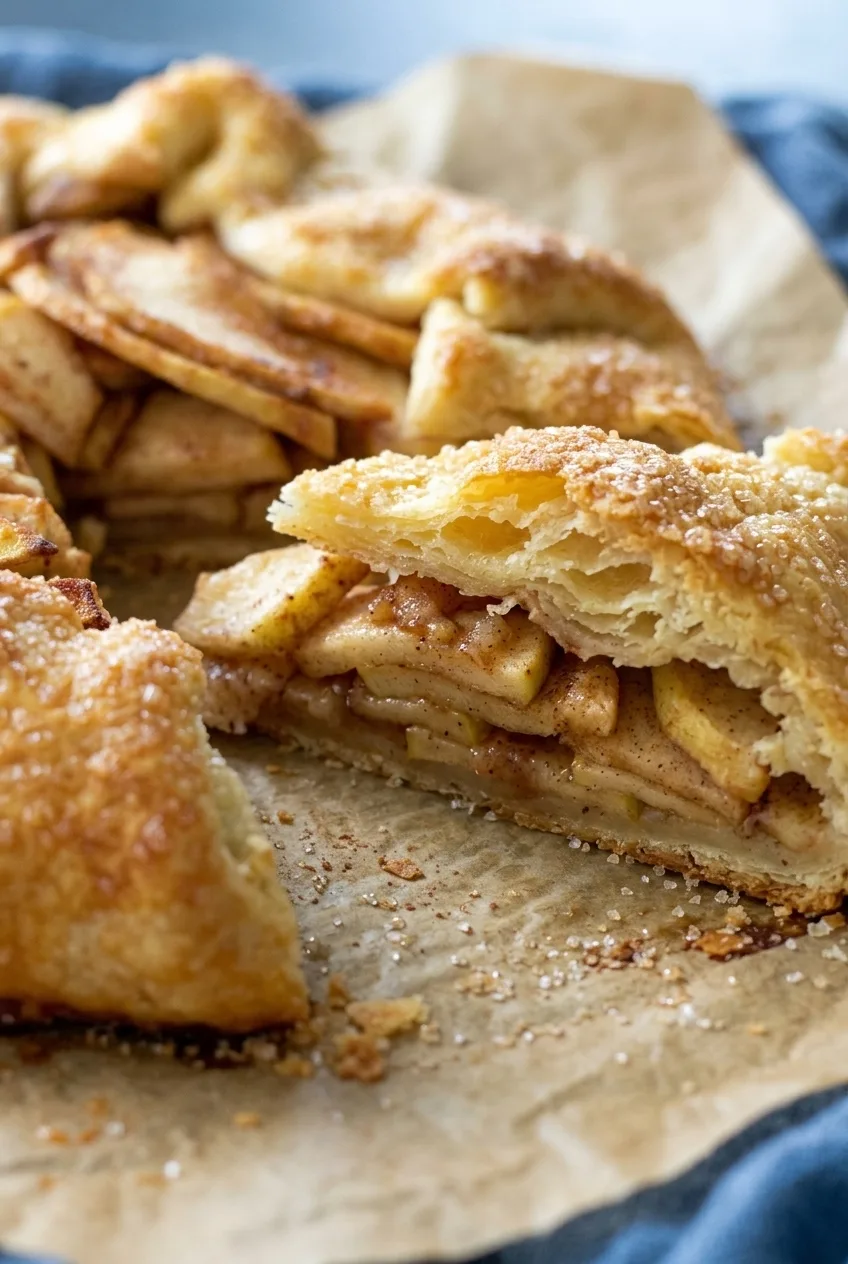
Close view of a cut apple galette slice showing tender layered apples and flaky, sugared pastry

Pastry

  • 1 1/4 cups all-purpose flour (155g)
  • 1 tablespoon granulated sugar
  • 1/4 teaspoon fine salt
  • 8 tablespoons (1 stick) cold unsalted butter, cubed (113g)
  • 3 to 4 tablespoons ice water, as needed

Apple filling

  • About 1 lb firm apples, approximately 3 medium, weighed before peeling and coring (450g)
  • 1/4 cup granulated sugar (50g)
  • 1 tablespoon all-purpose flour
  • 1 teaspoon ground cinnamon
  • 1 tablespoon lemon juice

Crust finish

  • 1 large egg, beaten, for brushing; some will remain
  • 1 tablespoon coarse or turbinado sugar

Yield: One galette, cut into 6 to 8 slices. Time: About 25 minutes active preparation, 45 to 60 minutes chilling, 35 to 45 minutes baking, and 20 minutes cooling.

How to Make Apple Galette

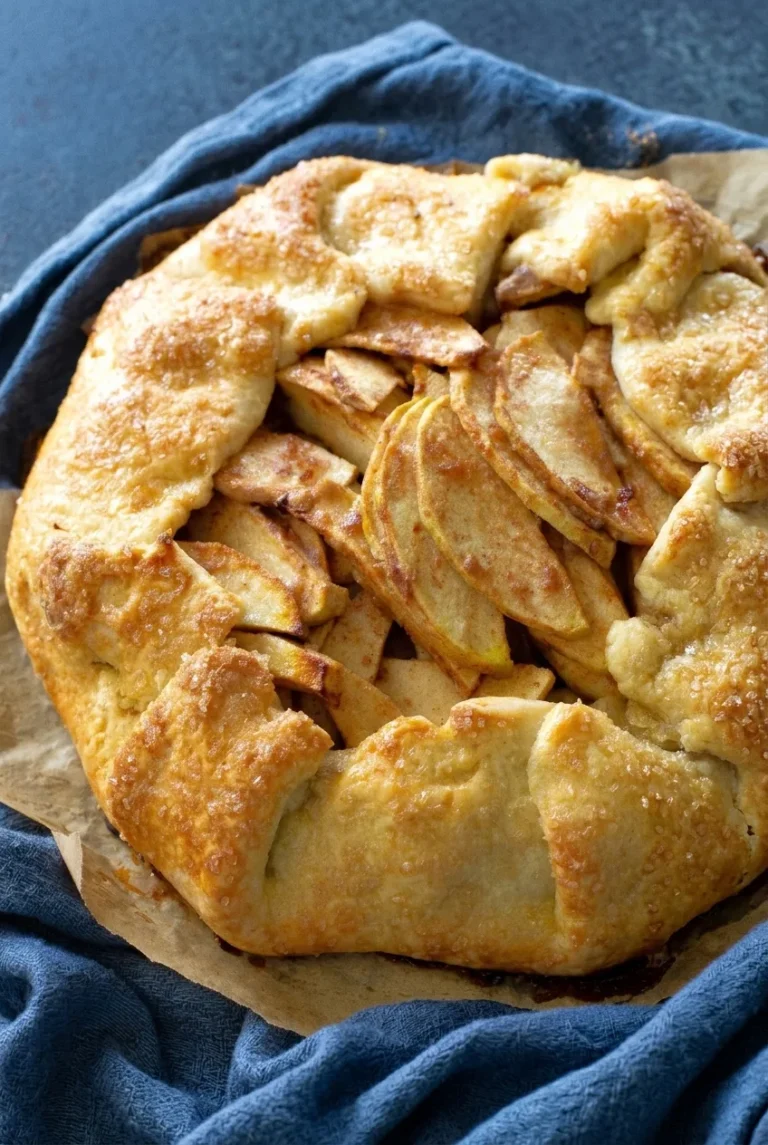
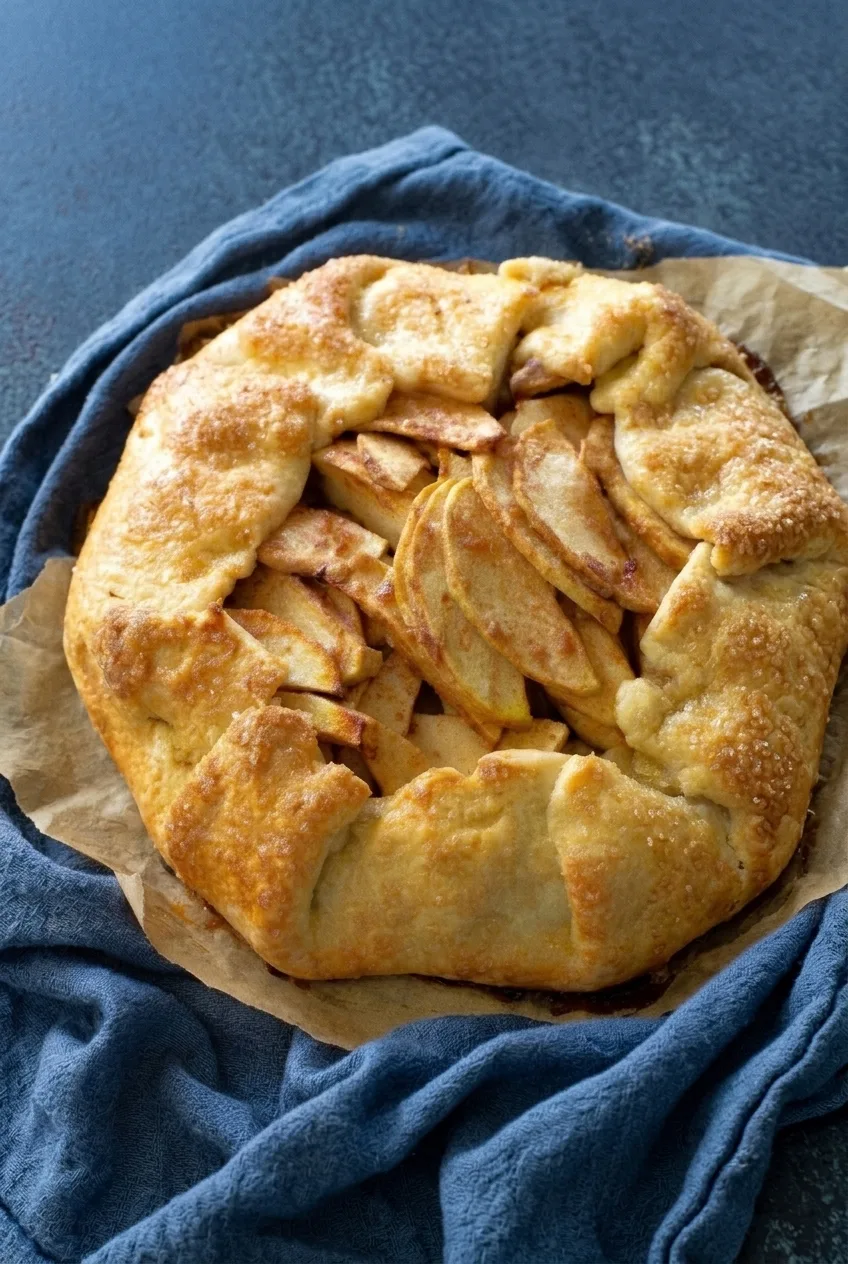
Whole rustic apple galette on parchment, seen from farther back against a dark blue surface
  1. Make the pastry: Mix the pastry flour, sugar, and salt. Work in the cold butter until small pieces remain visible. Add ice water 1 tablespoon at a time, stopping when the dough holds together when pressed but is not sticky. Form a disk and refrigerate for 45 to 60 minutes.
  2. Preheat and roll: Preheat the oven to 400°F (205°C). Roll the dough on parchment into a roughly 12-inch round, about 1/8 inch thick. The edges need not be even.
  3. Prepare the apples: Peel and core the apples, then cut them into approximately 1/8-inch slices. Just before assembly, toss them with the filling sugar, flour, cinnamon, and lemon juice.
  4. Fill and fold: Arrange the apples in loose, overlapping groups, leaving about a 2-inch pastry border. Fold the border up and over the outer apples in broad, overlapping pleats, keeping the center open. Pinch cracks or open seams closed to help contain the juices. If the dough becomes too soft to fold, refrigerate it briefly until firmer.
  5. Finish the crust: Transfer the parchment and galette to a rimmed baking sheet. Lightly brush the exposed pastry with beaten egg, then sprinkle the coarse sugar over it.
  6. Bake: Bake uncovered for about 35 to 45 minutes, starting checks at 30 minutes. The folded crust should be well browned, including near its base, and an apple slice near the center should yield readily to a thin knife while holding its shape. If the rim browns before the apples soften, loosely shield it with foil and continue baking.
  7. Cool: Leave the galette on the baking sheet for about 20 minutes so it is easier to slice. Serve slightly warm or at room temperature.

How to Fold a Rustic Galette

The 2-inch border provides enough pastry to partly cover the outer apples while leaving most of the filling visible. Broad, irregular folds give the rim its height; overlapping them and pinching shut holes helps keep juices off the baking sheet. For an apple dessert with a more deliberate arrangement, try this French apple tart.

Choosing and Slicing the Apples

Granny Smith apples work on their own or mixed with another firm apple, such as Pink Lady. Slices about 1/8 inch thick can soften during the bake without losing their shape. Thicker slices or a more heavily filled galette may need longer, so check the fruit rather than relying only on the timer.

Using Purchased Pie Crust

One purchased pie crust can replace the homemade dough. Adjust the area covered by apples to leave a border wide enough to fold, and judge doneness by pastry color and apple tenderness; its diameter and baking time may differ. Puff pastry produces a different, puffier crust and is not a direct swap for these instructions.

Making Ahead and Storing Leftovers

The pastry dough can be refrigerated for up to 5 days or frozen for later use. Wrap leftover baked galette and refrigerate it; aim to enjoy it within a couple of days for best quality. Gently reheat refrigerated slices in the oven if desired.

Nutrition

Approximate nutrition per slice, based on 8 slices and excluding optional ice cream: 245 calories, 3g protein, 12g fat, and 33g carbohydrates. Approximate values per 100g of baked galette: 290 calories, 3g protein, 14g fat, and 39g carbohydrates. Values vary with apple size, moisture lost during baking, and how much egg wash is used.

Apple Galette

Thin cinnamon-coated apples bake in a free-form butter crust with a crisp, sugared edge.
Course: Dessert
Cuisine: American
Prep: 25 min
Cook: 40 min
Total: 140 min
Servings: 8 Calories: 245 kcal

Equipment

  • Mixing bowl
  • Rolling pin
  • Parchment paper
  • Rimmed baking sheet
  • Pastry brush
  • Thin-bladed knife

Ingredients

Pastry

  • 1 1/4 cups all-purpose flour (155 g)
  • 1 tablespoon granulated sugar
  • 1/4 teaspoon fine salt
  • 8 tablespoons (1 stick) cold unsalted butter, cubed (113 g)
  • 3 to 4 tablespoons ice water, as needed

Apple filling

  • About 1 lb firm apples, approximately 3 medium, weighed before peeling and coring (450 g)
  • 1/4 cup granulated sugar (50 g)
  • 1 tablespoon all-purpose flour
  • 1 teaspoon ground cinnamon
  • 1 tablespoon lemon juice

Crust finish

  • 1 large egg, beaten, for brushing; some will remain
  • 1 tablespoon coarse or turbinado sugar

Instructions

  1. Mix the pastry flour, sugar, and salt in a bowl.
  2. Work in the cold butter until small pieces remain visible.
  3. Add ice water 1 tablespoon at a time until the dough holds together when pressed but is not sticky. Form a disk and refrigerate for 45 to 60 minutes.
  4. Preheat the oven to 400°F (205°C).
  5. Roll the dough on parchment into a roughly 12-inch round, about 1/8 inch thick.
  6. Peel and core the apples, then cut them into approximately 1/8-inch slices. Just before assembly, toss them with the filling sugar, flour, cinnamon, and lemon juice.
  7. Arrange the apples in loose, overlapping groups, leaving about a 2-inch pastry border.
  8. Fold the border up and over the outer apples in broad, overlapping pleats, leaving the center open. Pinch cracks or open seams closed. If the dough is too soft to fold, refrigerate it briefly until firmer.
  9. Transfer the parchment and galette to a rimmed baking sheet. Brush the exposed pastry lightly with beaten egg and sprinkle with coarse sugar.
  10. Bake uncovered for about 35 to 45 minutes, starting checks at 30 minutes. Bake until the crust is well browned near its base and a center apple slice yields readily to a thin knife while holding its shape. Loosely shield the rim with foil if it browns before the apples soften.
  11. Cool on the baking sheet for about 20 minutes. Serve slightly warm or at room temperature.

Tips

  • Keep the butter cold and stop adding water as soon as the dough holds together when pressed.
  • Arrange the apples in loose, overlapping groups rather than a precise spiral.
  • Pinch gaps in the folded crust closed to help contain the juices.
  • Check the apples and the crust for doneness rather than relying only on the timer.
  • Use firm apples such as Granny Smith, or combine them with Pink Lady apples.

Variations

  • Purchased pie crust: Replace the homemade pastry with one purchased pie crust, leaving a wide enough border to fold over the apples.
  • Mixed apple filling: Use Granny Smith apples alone or combine them with another firm apple, such as Pink Lady.

Notes

Refrigerate wrapped leftovers and enjoy within a couple of days; reheat slices gently in the oven if desired. Pastry dough can be refrigerated for up to 5 days or frozen. Nutrition estimates are per slice based on 8 slices.

Nutrition

Calories: 245 kcal | Protein: 3 g | Fat: 12 g | Carbohydrates: 33 g

Apple Slab Pie

Apple slab pie puts tender cinnamon-spiced apples between two layers of butter pastry in a 15-by-10-inch rimmed pan. The mostly solid top crust bakes golden, and the shallow pie cuts into substantial rectangles with the apple filling visible at the edges.

Mix the apples with sugar just before assembly to limit excess juice, then bake until the filling bubbles through the vents. Cooling the pie before cutting helps the portions hold together. For a round pie with a lattice top, try classic homemade apple pie.

Ingredients for Apple Slab Pie

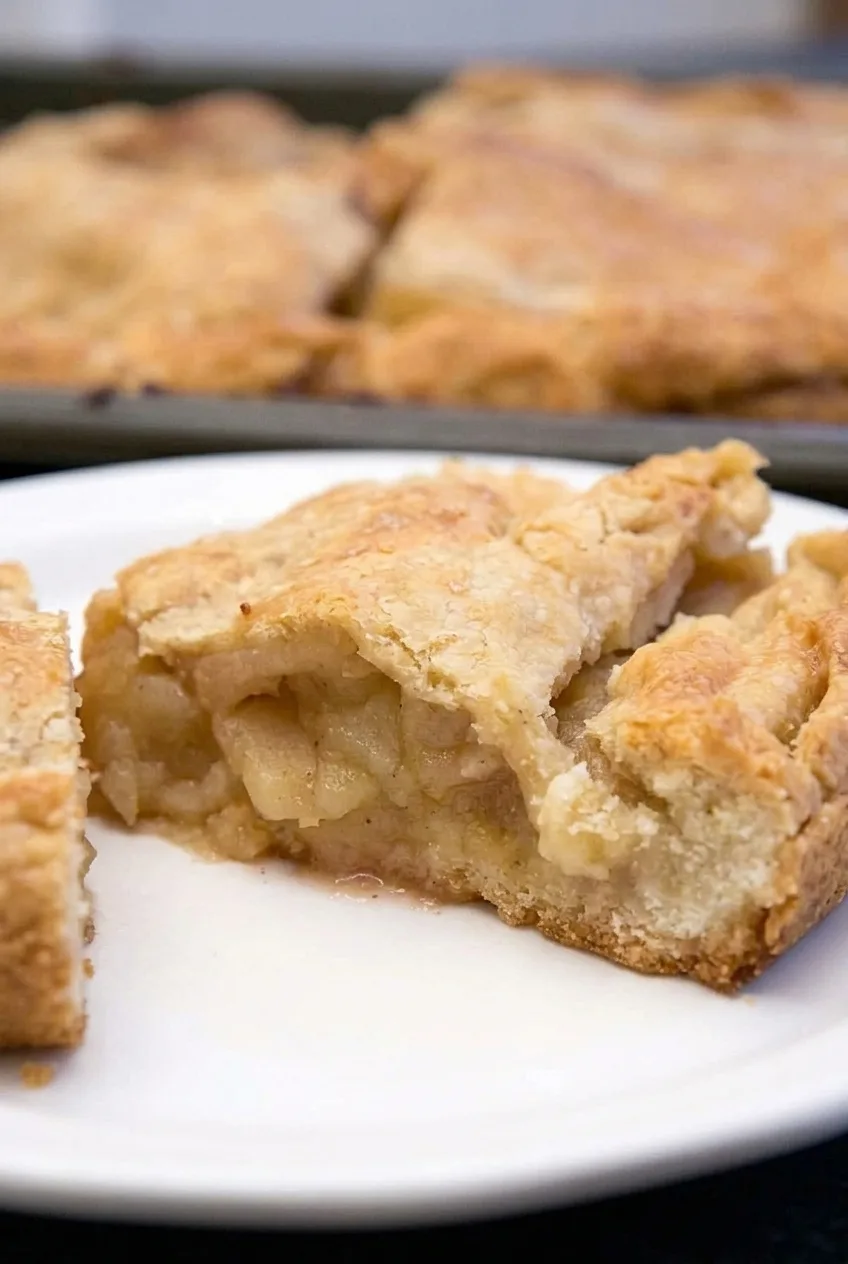
Close view of tender apple slices between the golden top and bottom crusts of apple slab pie

Makes about 15 portions. Allow about 45 minutes of active preparation, at least 30 minutes for chilling, 45 to 55 minutes for baking, and at least 90 minutes for cooling—about 3 hours 30 minutes total.

Butter pastry

  • 4 cups all-purpose flour (480g)
  • 1 teaspoon fine salt
  • 1 tablespoon granulated sugar (12g)
  • 1 1/2 cups cold unsalted butter, cubed (3 sticks; 340g)
  • 8 to 12 tablespoons ice water, as needed

Apple filling and top

  • About 3 1/2 lb fresh apples, yielding approximately 8 cups peeled, cored, 1/4-inch slices
  • 1/2 cup granulated sugar (100g)
  • 1/4 cup all-purpose flour (30g)
  • 1 1/2 teaspoons ground cinnamon
  • 1/4 teaspoon ground nutmeg
  • 1 tablespoon lemon juice
  • 1 tablespoon milk, for brushing

A mix of firm tart and sweet baking apples works well. Keep the flour amounts separate: 4 cups go into the pastry, and 1/4 cup goes into the filling.

How to Make Apple Slab Pie

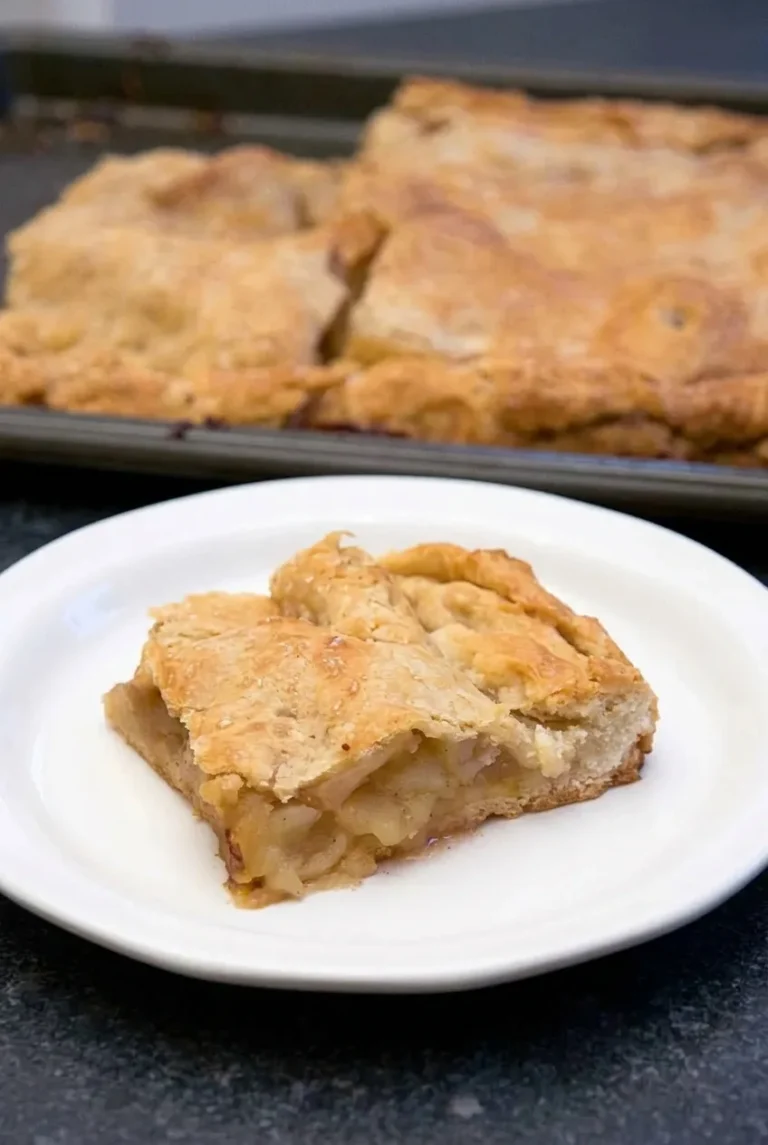
Wider view of apple slab pie in a rimmed pan with one rectangular portion served on a white plate
  1. Make the pastry: In a large bowl, combine the 4 cups flour, salt, and 1 tablespoon sugar. Cut in the cold butter until the pieces range from pea-sized to slightly larger. Add 8 tablespoons ice water, then add more 1 tablespoon at a time only until the dough holds together when pressed. Small butter pieces should still be visible.
  2. Divide and chill: Divide the dough into a larger piece for the bottom crust and a smaller piece for the lid, about 60/40. Flatten each into a rectangle, wrap, and refrigerate for at least 30 minutes, until cool and firm but still rollable.
  3. Line the pan: Preheat the oven to 375°F (190°C) with a rack in the lower third. Line a sturdy 15-by-10-by-1-inch rimmed pan with parchment. Roll the larger dough piece into a rectangle large enough to cover the bottom and reach the rim. Fit it into all four corners without stretching it.
  4. Add the apples: Peel, core, and slice the apples about 1/4 inch thick. Just before filling the crust, toss them with the 1/2 cup sugar, 1/4 cup flour, cinnamon, nutmeg, and lemon juice. Spread them evenly over the pastry, leaving any substantial pooled liquid in the bowl.
  5. Add the lid: Roll the remaining dough into a rectangle large enough to cover the apples. Lay it over the filling and seal it to the bottom crust around the edges. Cut several small steam vents, keeping the lid mostly solid, then brush lightly with milk.
  6. Bake: Bake uncovered on the lower-third rack for about 45 to 55 minutes. Start checking at 40 minutes, and rotate the pan only if it is browning unevenly. The top and edges should be golden, thickened juices should bubble through the vents, and an apple slice tested through a vent should be tender. If the top darkens before the filling bubbles, tent it loosely with foil and continue baking.
  7. Cool and cut: Cool in the pan for at least 90 minutes before cutting into about 15 rectangles; cool completely for the neatest portions. Lift each piece with a wide spatula rather than pulling up the filled pie by its parchment. The bottom pastry should look baked, not visibly raw.

Why the Pan Size Matters

A 15-by-10-by-1-inch rimmed pan keeps this amount of pastry and filling in a shallow, contained layer. The larger dough piece lines the bottom, sides, and corners; the smaller piece only needs to cover the top. A wider half-sheet pan would spread the filling thinner and require more pastry coverage. A deeper pan would change the filling depth and baking time.

How to Keep the Apple Filling from Getting Watery

Slice the apples evenly so they soften at a similar rate. Wait until the bottom crust is ready before tossing them with sugar and the measured flour: sugared apples release juice as they stand. Leave substantial pooled liquid in the bowl rather than pouring it into the pastry.

Do not judge doneness by the golden top alone. The juices need to bubble through the vents to thicken, and the apples should be tender. If juice runs freely when you cut the pie, let it cool longer. A damp-looking bottom may mean excess filling liquid or that the crust needed more baking time.

Serving and Storing Apple Slab Pie

Serve the rectangles at room temperature or gently warmed, with vanilla ice cream alongside if desired. Cover leftovers and refrigerate for up to 4 days.

For a crisper crust, warm an individual portion in a 300°F (150°C) oven until heated through, starting to check after about 5 minutes. Microwaving will soften the pastry. To freeze, cool portions completely, wrap them individually, and keep them in an airtight container for up to 2 months; thaw before gently reheating.

The pastry dough can be made ahead and kept chilled until ready to roll. For a shortcut, use enough refrigerated pie crust to roll separate pan-sized bottom and top rectangles. Packaged pastry may be thinner, so follow the browning and bubbling cues rather than assuming the same baking time.

Nutrition

Approximate per portion, based on 15 portions: 350 calories, 4g protein, 19g fat, and 43g carbohydrates. Approximate per 100g of baked pie: 265 calories, 3g protein, 14g fat, and 32g carbohydrates. Values vary with apple yield and moisture lost during baking; optional ice cream is not included.

Apple Slab Pie

Cinnamon-spiced apples bake between two layers of butter pastry in a shallow rimmed pan.
Course: Dessert
Cuisine: American
Prep: 45 min
Cook: 55 min
Total: 210 min
Servings: 15 Calories: 350 kcal

Equipment

  • Large mixing bowl
  • Rolling pin
  • 15-by-10-by-1-inch rimmed pan
  • Parchment paper
  • Wide spatula

Ingredients

Butter Pastry

  • 4 cups all-purpose flour (480g)
  • 1 teaspoon fine salt
  • 1 tablespoon granulated sugar (12g)
  • 1 1/2 cups cold unsalted butter, cubed (3 sticks; 340g)
  • 8 to 12 tablespoons ice water, as needed

Apple Filling and Top

  • About 3 1/2 lb fresh apples, yielding approximately 8 cups peeled, cored, and sliced 1/4 inch thick
  • 1/2 cup granulated sugar (100g)
  • 1/4 cup all-purpose flour (30g)
  • 1 1/2 teaspoons ground cinnamon
  • 1/4 teaspoon ground nutmeg
  • 1 tablespoon lemon juice
  • 1 tablespoon milk, for brushing

Instructions

  1. Combine the 4 cups flour, salt, and 1 tablespoon sugar in a large bowl.
  2. Cut in the cold butter until the pieces range from pea-sized to slightly larger.
  3. Add 8 tablespoons ice water. Add more 1 tablespoon at a time, just until the dough holds together when pressed; small butter pieces should remain visible.
  4. Divide the dough into a larger piece for the bottom crust and a smaller piece for the top, about 60/40. Flatten each into a rectangle, wrap, and chill for at least 30 minutes, until cool and firm but still rollable.
  5. Preheat the oven to 375°F (190°C) with a rack in the lower third. Line a sturdy 15-by-10-by-1-inch rimmed pan with parchment.
  6. Roll the larger dough piece into a rectangle large enough to cover the bottom and reach the rim. Fit it into the corners without stretching it.
  7. Peel, core, and slice the apples about 1/4 inch thick. Just before filling the crust, toss them with the sugar, 1/4 cup flour, cinnamon, nutmeg, and lemon juice.
  8. Spread the apples evenly over the pastry, leaving any substantial pooled liquid in the bowl.
  9. Roll the remaining dough into a rectangle large enough to cover the apples. Lay it over the filling and seal it to the bottom crust around the edges.
  10. Cut several small steam vents in the top crust and brush lightly with milk.
  11. Bake uncovered on the lower-third rack for 45 to 55 minutes. Start checking at 40 minutes; rotate the pan only if it is browning unevenly. Bake until the top and edges are golden, thickened juices bubble through the vents, and an apple slice is tender.
  12. If the top darkens before the filling bubbles, tent it loosely with foil and continue baking.
  13. Cool in the pan for at least 90 minutes before cutting into about 15 rectangles. Cool completely for the neatest portions, and lift pieces with a wide spatula.

Tips

  • Use a mix of firm tart and sweet baking apples.
  • Toss the apples with sugar and flour just before assembly to limit excess juice.
  • Slice the apples evenly so they soften at a similar rate.
  • Leave substantial pooled liquid in the bowl instead of adding it to the crust.
  • Check for bubbling juices and tender apples; a golden top alone does not indicate doneness.
  • Let the pie cool fully for portions that hold together neatly.

Variations

  • Refrigerated Pie Crust Shortcut: Use enough refrigerated pie crust to roll separate pan-sized bottom and top rectangles; follow the browning and bubbling cues because packaged pastry may be thinner.

Notes

Cover and refrigerate leftovers for up to 4 days. Reheat portions in a 300°F (150°C) oven, checking after about 5 minutes. Freeze cooled, individually wrapped portions in an airtight container for up to 2 months; thaw before reheating.

Nutrition

Calories: 350 kcal | Protein: 4 g | Fat: 19 g | Carbohydrates: 43 g

Puff Pastry Apple Pie

This round, double-crust pie has flaky puff pastry above and beneath a generous filling of cinnamon-spiced apple pieces. Cooking the apples until their juices turn syrupy, then cooling them before assembly, helps the bottom crust bake through instead of soaking up liquid.

Bake until the top is deeply golden and the filling bubbles through the vents, but check the bottom crust too. After a short rest, cut the pie into wedges and place a scoop of vanilla ice cream directly on each slice. For a homemade-crust alternative, try classic homemade apple pie.

Ingredients for Puff Pastry Apple Pie

Close view of flaky puff pastry, chunky cinnamon apples and vanilla ice cream on a pie slice
  • 2 1/2 pounds firm apples, such as a mix of Granny Smith and Honeycrisp, about 6 medium (about 1,150g before peeling and coring)
  • 2 tablespoons unsalted butter (30g)
  • 1/2 cup packed light brown sugar (100g)
  • 1 teaspoon ground cinnamon
  • 1 tablespoon fresh lemon juice
  • 2 sheets ready-made puff pastry, from one 17.3-ounce package (490g), thawed but cold
  • 1 large egg, beaten
  • 1 tablespoon coarse sugar
  • About 1 pint vanilla ice cream, for 8 modest scoops

Firm sweet and tart apples give the filling balance while keeping the pieces distinct. For another warm spice, add 1/8 teaspoon ground nutmeg with the cinnamon.

How to Make Puff Pastry Apple Pie

Round puff pastry apple pie with a wedge removed and an ice-cream-topped slice on a white plate

Makes one 9-inch pie, or 8 slices. Allow about 25 minutes of active prep, 55 to 65 minutes of cooking, and about 2 hours 30 minutes total, including cooling, chilling, and resting.

  1. Cook the apples: Peel, core, and cut them into roughly 3/4-inch pieces. In a large skillet or wide saucepan, cook the apples, butter, brown sugar, cinnamon, and lemon juice over medium heat for about 12 to 15 minutes, stirring occasionally. The apples should be tender but hold their shape. If thin juice still pools in the pan, keep cooking until it turns syrupy and coats the pieces. Do not add water.
  2. Cool the filling: Spread the apples in a shallow bowl or on a tray. Let them cool completely, about 25 to 35 minutes, until they no longer feel warm or give off steam.
  3. Line the dish: Gently roll one cold pastry sheet large enough to line the bottom and sides of a 9-inch standard-depth pie dish, leaving a little overhang. Ease it in without stretching, then add the cooled apples. Avoid piling the filling far above the rim.
  4. Cover and vent: Roll the second pastry sheet as needed and place it over the filling. Trim excess pastry, press or crimp the edges firmly together, and cut several small vents through the top sheet.
  5. Chill and finish: Refrigerate the assembled pie for 15 minutes while the oven preheats to 400°F (205°C). Lightly brush the top with beaten egg, avoiding heavy buildup along the cut edges, then scatter the coarse sugar over it.
  6. Bake: Set the dish on a parchment-lined baking sheet on a lower oven rack. Bake uncovered for about 40 to 50 minutes. Check the top after 30 minutes; if it is darkening too quickly, loosely shield it with foil. Begin checking overall doneness around 40 minutes. The top should be deeply golden and puffed, the filling should bubble through the vents, and the visible bottom-crust edges should look baked rather than doughy.
  7. Rest and serve: Let the pie rest for at least 30 minutes so the filling stays in the slices. Cut into generous wedges and add one scoop of vanilla ice cream directly on each plated slice just before serving.

How to Avoid a Soggy Bottom Crust

For a full enclosed pie, the apple juices need to cling to the fruit rather than run across the pan. Cooling the filling completely keeps it from softening the pastry during assembly. Thawed pastry should still feel cool; roll it gently to fit the dish, seal the edges, and vent the top so steam can escape.

A golden top alone does not mean the bottom crust is baked. Use a standard-depth dish on a lower oven rack and check the visible bottom-crust edges. If the top browns first, shield it loosely with foil and continue baking. A light-colored metal dish can help the bottom brown; with a ceramic dish, pay particular attention to that bottom-crust cue.

Make Ahead, Storage, and Reheating

The apple filling can be cooked ahead, cooled, and refrigerated. Assemble the pie with cold filling and cold pastry.

Let leftover pie cool, then cover and refrigerate it without ice cream for up to about 3 days. Reheat slices in a 350°F (175°C) oven for about 10 to 15 minutes, until warmed and the pastry regains some crispness. Loosely tent a slice if its crust is already dark. Add fresh ice cream when serving; a microwave will soften the pastry.

Nutrition

Approximate nutrition per slice, based on 8 slices and including one modest scoop of vanilla ice cream: 575 calories, 7g protein, 31g fat, and 65g carbohydrates. Approximate values per 100g of served pie and ice cream: 265 calories, 3g protein, 14g fat, and 30g carbohydrates. Values vary with the puff pastry, apples, ice cream, and scoop size.

Puff Pastry Apple Pie

A double-crust apple pie filled with cinnamon-spiced apples and topped with vanilla ice cream.
Course: Dessert
Cuisine: American
Prep: 25 min
Cook: 60 min
Total: 150 min
Servings: 8 Calories: 575 kcal

Equipment

  • Large skillet or wide saucepan
  • Shallow bowl or tray
  • Rolling pin
  • 9-inch pie dish
  • Baking sheet
  • Parchment paper
  • Pastry brush

Ingredients

Apple Filling

  • 2 1/2 pounds firm apples, such as Granny Smith and Honeycrisp, about 6 medium (about 1,150 g before peeling and coring)
  • 2 tablespoons unsalted butter (30 g)
  • 1/2 cup packed light brown sugar (100 g)
  • 1 teaspoon ground cinnamon
  • 1 tablespoon fresh lemon juice

Pastry and Topping

  • 2 sheets ready-made puff pastry, from one 17.3-ounce package (490 g), thawed but cold
  • 1 large egg, beaten
  • 1 tablespoon coarse sugar

For Serving

  • About 1 pint vanilla ice cream, for 8 modest scoops

Instructions

  1. Peel, core, and cut the apples into roughly 3/4-inch pieces.
  2. Cook the apples, butter, brown sugar, cinnamon, and lemon juice in a large skillet over medium heat for 12 to 15 minutes, stirring occasionally, until tender but still holding their shape.
  3. If thin juice pools in the pan, continue cooking until it turns syrupy and coats the apples. Do not add water.
  4. Spread the apples in a shallow bowl or on a tray and cool completely, about 25 to 35 minutes.
  5. Roll one cold pastry sheet to fit the bottom and sides of a 9-inch standard-depth pie dish, leaving a little overhang. Ease it into the dish without stretching.
  6. Add the cooled apples without piling them far above the rim.
  7. Roll the second pastry sheet as needed and place it over the filling. Trim excess pastry, firmly press or crimp the edges together, and cut several small vents in the top.
  8. Refrigerate the assembled pie for 15 minutes while preheating the oven to 400°F (205°C).
  9. Lightly brush the top with beaten egg, avoiding heavy buildup along the cut edges, and scatter the coarse sugar over it.
  10. Place the pie dish on a parchment-lined baking sheet on a lower oven rack. Bake uncovered for about 40 to 50 minutes.
  11. Check the top after 30 minutes and loosely shield it with foil if it is darkening too quickly. Begin checking doneness around 40 minutes; the top should be deeply golden and puffed, the filling should bubble through the vents, and the visible bottom-crust edges should look baked.
  12. Rest the pie for at least 30 minutes before cutting. Serve each wedge with a scoop of vanilla ice cream.

Tips

  • Cook the apples until their juices are syrupy so liquid does not soak the bottom crust.
  • Cool the filling completely before assembling the pie, and keep the thawed pastry cold.
  • Use a lower oven rack and check the visible bottom-crust edges; a golden top alone does not confirm the bottom is baked.
  • If the top browns before the pie is done, loosely shield it with foil and continue baking.
  • Use a light-colored metal pie dish to help the bottom crust brown; watch the bottom especially closely when using ceramic.

Variations

  • Nutmeg-Spiced Apple Pie: Add 1/8 teaspoon ground nutmeg with the cinnamon.

Notes

Refrigerate cooled leftover pie without ice cream for up to about 3 days. Reheat slices at 350°F (175°C) for 10 to 15 minutes; add fresh ice cream when serving.

Nutrition

Calories: 575 kcal | Protein: 7 g | Fat: 31 g | Carbohydrates: 65 g

Apple Hand Pies

These fried apple hand pies have softly rectangular pastry shells, tender apple pieces, and a generous coating of fine cinnamon sugar. The filling stays chunky rather than turning into applesauce, while the crust browns on both sides and along the seams.

Cook, thicken, and cool the apples before filling the dough. Cool filling is easier to enclose, and juices that cling to the fruit are less likely to leak into the oil. This recipe makes 8 hand pies in about 1 hour 35 minutes, including chilling and cooling.

Ingredients for Apple Hand Pies

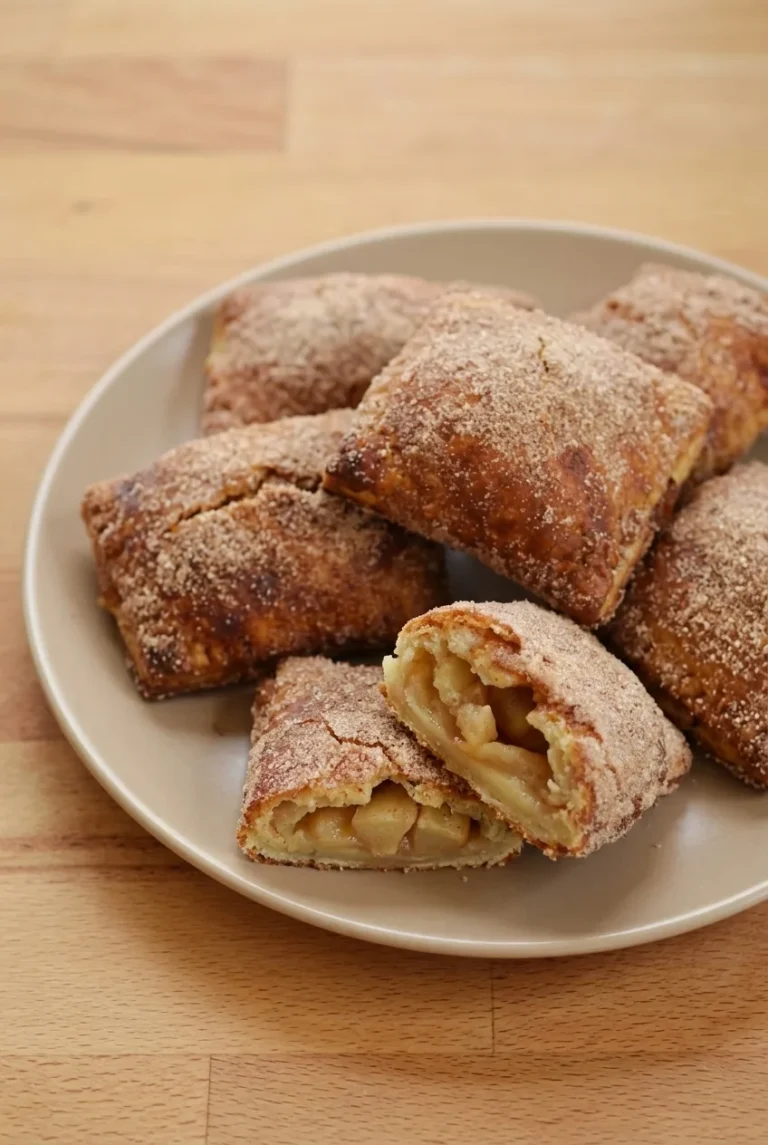
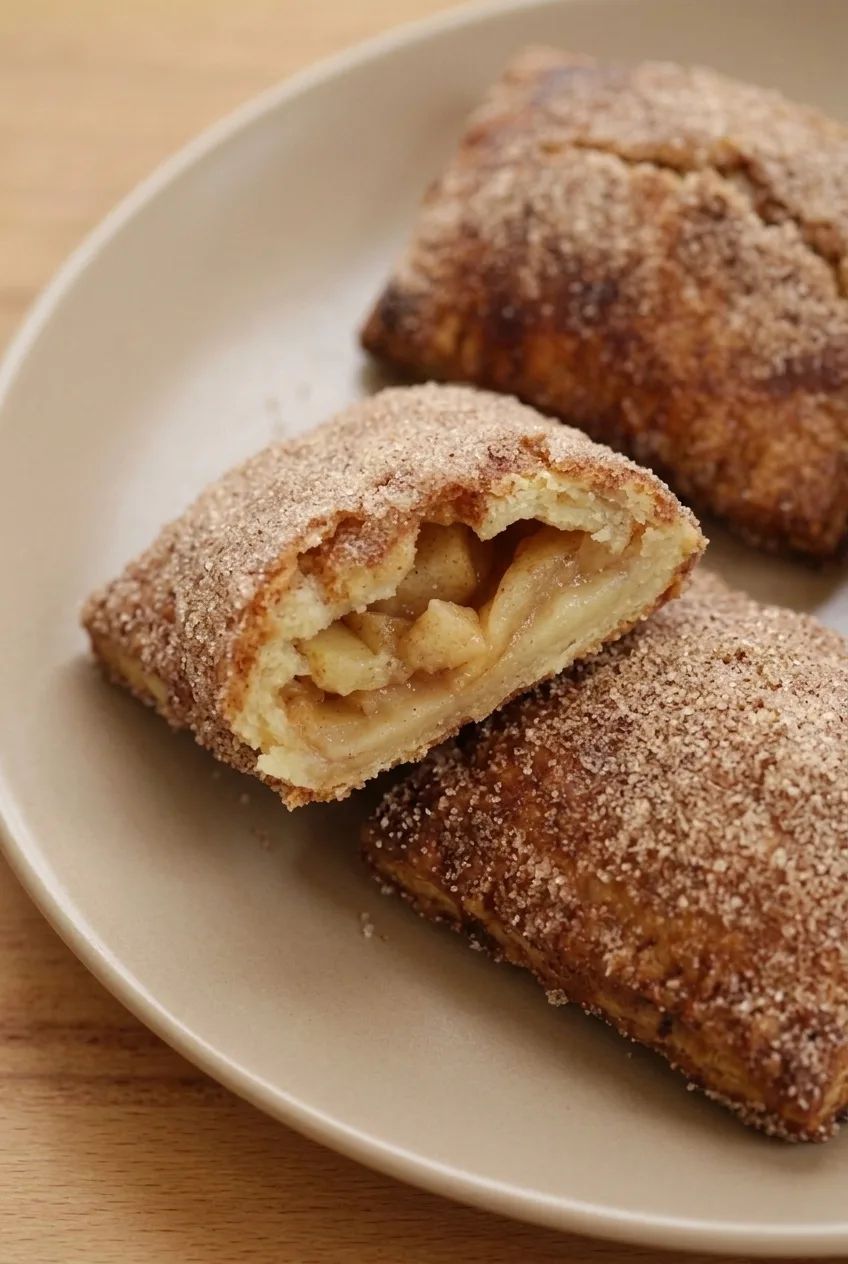
Close view of a broken apple hand pie showing diced apples and a cinnamon-sugar-coated crust

Pastry

  • 2 cups all-purpose flour (240g)
  • 1 tablespoon granulated sugar (12g)
  • 1/2 teaspoon fine salt
  • 1/3 cup vegetable shortening (65g)
  • 1 large egg, beaten
  • 1/3 cup evaporated milk (80g)

Apple filling

  • 2 medium apples, peeled, cored, and diced small, about 2 cups (300g)
  • 2 tablespoons unsalted butter (30g)
  • 1/4 cup packed light brown sugar (50g)
  • 1 teaspoon ground cinnamon
  • 1 teaspoon cornstarch
  • 1 tablespoon cool water

For frying and coating

  • About 6 cups neutral frying oil, or enough for roughly 2 inches of depth in the pot; most will remain in the pot
  • 1/3 cup granulated sugar (65g)
  • 1 teaspoon ground cinnamon

Granny Smith apples give the filling a tart edge; Honeycrisp or Pink Lady also work. Keep the prepared apple quantity close to 2 cups.

How to Make Fried Apple Hand Pies

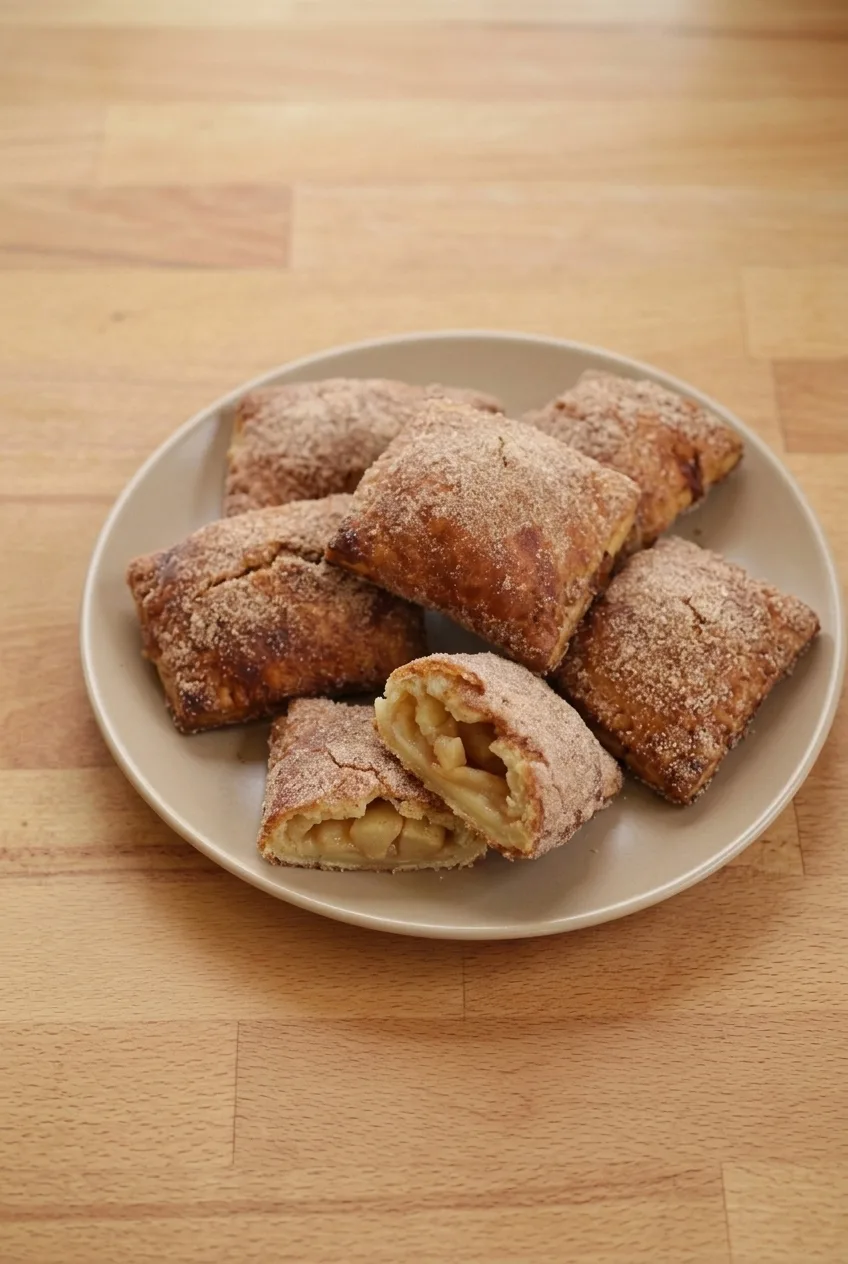
Full plate of fried apple hand pies on a wooden table, including a broken-open piece
  1. Make and chill the dough: Mix the flour, tablespoon of sugar, and salt. Cut in the shortening, then mix in the beaten egg and evaporated milk just until the dough holds together. If dry flour remains, add only a few drops of water. The dough should be cohesive, not sticky. Wrap and refrigerate for about 20 minutes.
  2. Cook and cool the filling: In a medium skillet or saucepan over medium heat, cook the apples with the butter, brown sugar, and teaspoon of cinnamon for 8 to 12 minutes, until tender but still in distinct pieces. Stir the cornstarch into the tablespoon of cool water, add it to the apples, and cook briefly until the juices thicken and cling to the fruit. Spread the filling out and cool completely, about 20 minutes. No thin liquid should pool around it.
  3. Cut the pastry: Roll the dough to an even 1/8-inch thickness. Cut eight roughly 4-by-6-inch rectangles, gently rerolling scraps as needed. If the dough becomes soft or sticky, chill it briefly before filling.
  4. Fill and seal: Place about 1 1/2 tablespoons cooled filling on one half of each rectangle, leaving a clean 1/2-inch border. Lightly dampen the border with water. Fold the dough over to make a roughly 3-by-4-inch pocket, press out excess air, and seal the edges firmly. Crimp the seam with a fork. Keep assembled pies cool while you work.
  5. Heat the oil: Pour roughly 2 inches of oil into a heavy 4- to 5-quart pot, filling it no more than one-third full. Heat to 335°F (170°C) on a frying thermometer. Mix the coating sugar and cinnamon in a shallow dish. Fry uncovered, and keep water away from the hot oil.
  6. Fry in batches: Carefully lower 2 or 3 pies into the oil. Fry for about 6 to 8 minutes per batch, turning carefully halfway through or as needed. Check the color after about 5 minutes, sooner if the pastry is thin. Remove the pies when both sides and the seams are deep golden brown and the crust feels set, with no pale, doughy-looking areas. Let the oil return near 335°F between batches; adjust the heat to keep it approximately 325–350°F (165–175°C).
  7. Coat while warm: Drain the pies briefly on a wire rack, then turn them in the cinnamon sugar while they are still warm so it adheres. Let them cool for several minutes before eating; the filling will be hot.

How to Keep the Hand Pies Sealed

Stick to about 1 1/2 tablespoons filling per pie, even if the pocket looks roomy. Filling on the border can prevent a firm seal, while trapped air can push against the seam during frying. Check each crimp before the pie goes into the oil and press closed any loose spots.

Frying Temperature and Doneness

Use a thermometer and fry only a few pies at a time. Crowding can lower the oil temperature and leave the crust pale or greasy; oil that runs too hot may brown the outside before the seams cook through. The 6-to-8-minute range is a guide. Dough thickness and oil recovery affect the timing, so look for a set crust and deep golden color all the way around.

Serving, Make-Ahead, and Leftovers

Serve the pies warm, once the filling has cooled enough to eat. Vanilla ice cream can go alongside without covering the cinnamon-sugar crust. For a full-size baked dessert, try classic homemade apple pie.

The filling can be cooked ahead and refrigerated; use it cool for assembly. The fried pies have their best crust texture the day they are made. Cool leftovers completely and store covered at room temperature for up to 2 days. Rewarm on a rack in a 350°F (175°C) oven for roughly 6 to 10 minutes, checking early. Some of the sugar coating may loosen.

Nutrition

Approximate nutrition per hand pie, based on 8 pies: 360 calories, 5g protein, 18g fat, and 46g carbohydrates. Approximate values per 100g: 330 calories, 4g protein, 16g fat, and 42g carbohydrates. Pie size, sugar coating, and the amount of frying oil absorbed will affect these estimates.

Apple Hand Pies

Fried pastry pockets filled with tender cinnamon apples and coated in cinnamon sugar.
Course: Dessert
Cuisine: American
Prep: 55 min
Cook: 40 min
Total: 95 min
Servings: 8 Calories: 360 kcal

Equipment

  • Mixing bowl
  • Rolling pin
  • Skillet or saucepan
  • Heavy 4- to 5-quart pot
  • Frying thermometer
  • Shallow dish
  • Wire rack

Ingredients

Pastry

  • 2 cups all-purpose flour (240g)
  • 1 tablespoon granulated sugar (12g)
  • 1/2 teaspoon fine salt
  • 1/3 cup vegetable shortening (65g)
  • 1 large egg, beaten
  • 1/3 cup evaporated milk (80g)
  • Water, as needed

Apple Filling

  • 2 medium apples, peeled, cored, and diced small, about 2 cups (300g)
  • 2 tablespoons unsalted butter (30g)
  • 1/4 cup packed light brown sugar (50g)
  • 1 teaspoon ground cinnamon
  • 1 teaspoon cornstarch
  • 1 tablespoon cool water

For Frying and Coating

  • About 6 cups neutral frying oil, or enough for roughly 2 inches of depth in the pot
  • 1/3 cup granulated sugar (65g)
  • 1 teaspoon ground cinnamon
  • Water, for sealing the pastry

Instructions

  1. Mix the flour, 1 tablespoon sugar, and salt. Cut in the shortening, then mix in the beaten egg and evaporated milk just until the dough holds together. Add a few drops of water if dry flour remains.
  2. Wrap the dough and refrigerate for about 20 minutes.
  3. Cook the apples, butter, brown sugar, and 1 teaspoon cinnamon in a skillet or saucepan over medium heat for 8 to 12 minutes, until tender but still in distinct pieces.
  4. Stir the cornstarch into 1 tablespoon cool water. Add the slurry to the apples and cook briefly until the juices thicken and cling to the fruit.
  5. Spread the filling out and cool completely, about 20 minutes.
  6. Roll the dough to an even 1/8-inch thickness. Cut eight roughly 4-by-6-inch rectangles, rerolling scraps as needed. Chill the dough briefly if it becomes soft or sticky.
  7. Place about 1 1/2 tablespoons cooled filling on one half of each rectangle, leaving a clean 1/2-inch border.
  8. Lightly dampen each border with water. Fold the dough over to make a roughly 3-by-4-inch pocket, press out excess air, seal firmly, and crimp the edges with a fork.
  9. Pour roughly 2 inches of oil into a heavy 4- to 5-quart pot, filling it no more than one-third full. Heat the oil to 335°F (170°C).
  10. Mix 1/3 cup sugar and 1 teaspoon cinnamon in a shallow dish. Keep water away from the hot oil.
  11. Carefully lower 2 or 3 pies into the oil. Fry for about 6 to 8 minutes per batch, turning carefully halfway through or as needed.
  12. Remove the pies when both sides and seams are deep golden brown and the crust feels set, with no pale, doughy-looking areas. Let the oil return near 335°F between batches and keep it approximately 325–350°F (165–175°C).
  13. Drain the pies briefly on a wire rack, then turn them in the cinnamon sugar while warm. Cool for several minutes before eating.

Tips

  • Keep the filling cool and free of pooled liquid before assembling the pies.
  • Use about 1 1/2 tablespoons filling per pie and keep it off the pastry border.
  • Press out trapped air and check each crimp before frying.
  • Fry only a few pies at a time and let the oil recover between batches.
  • Check the color after about 5 minutes, especially if the pastry is thin.

Variations

  • Honeycrisp or Pink Lady Apple Filling: Use Honeycrisp or Pink Lady apples in place of Granny Smith; keep the prepared apple quantity close to 2 cups.

Notes

Cool leftovers completely and store covered at room temperature for up to 2 days. Rewarm on a rack in a 350°F (175°C) oven for about 6 to 10 minutes, checking early. Filling may be made ahead and refrigerated; use it cool. The filling is hot after frying.

Nutrition

Calories: 360 kcal | Protein: 5 g | Fat: 18 g | Carbohydrates: 46 g

French Apple Tart

A fluted butter crust holds a thin layer of cooked apple beneath a dense spiral of tender slices. The apples bake until golden, then get a light apricot glaze. For a crust that holds up to the filling, blind bake the pastry until the base looks dry and reduce the cooked apple until it is thick enough to spread.

Allow about 50 minutes of active work and 2½ to 3 hours overall, including chilling and cooling. The tart makes 8 wedges and has its best crust texture on the day it is baked.

Ingredients for French Apple Tart

Close view of a French apple tart wedge showing glazed slices, soft apple filling, and butter crust

For the pastry

  • 1¼ cups all-purpose flour (150g)
  • ¼ cup powdered sugar (30g)
  • ¼ teaspoon fine salt
  • ½ cup (1 stick) cold unsalted butter, cubed (115g)
  • 1 large egg yolk
  • 1 to 2 tablespoons ice water, as needed

For the apples and glaze

  • 5 medium firm baking apples, about 2¼ pounds total (about 1kg), divided
  • 3 tablespoons granulated sugar, divided
  • 1 tablespoon lemon juice, divided
  • 2 tablespoons water, for the apple purée
  • 1 tablespoon unsalted butter, melted (15g)
  • ¼ cup apricot preserves (80g), divided

How to Make French Apple Tart

Whole French apple tart with a wedge removed and plated nearby on a gray tabletop
  1. Make and chill the pastry: Mix the flour, powdered sugar, and salt. Cut in the cold butter until crumbly, then add the egg yolk and just enough ice water for the dough to hold together when pressed. Roll out the dough and fit it into a 9-inch fluted tart pan with a removable bottom. Press it gently into the flutes without stretching, trim the edge, and refrigerate for 30 minutes.
  2. Cook the apple base: Peel, core, and dice 2 apples. Put them in a medium saucepan with 2 tablespoons of the granulated sugar, 2 teaspoons of the lemon juice, and 2 tablespoons of water. Cover and cook over medium-low heat until the apples soften. Uncover, mash, and stir often until the purée holds a brief trail when a spatula is drawn through it, about 15 to 20 minutes total. You should have roughly ¾ to 1 cup. Let it cool.
  3. Blind bake the shell: Preheat the oven to 375°F (190°C) with a rack near the center. Set the chilled tart pan on a baking sheet. Line the pastry with parchment and fill with pie weights or dried beans. Bake for 20 to 25 minutes, then remove the weights and parchment. Bake for another 8 to 10 minutes, checking the exposed base at 8 minutes. It should look dry and lightly golden, not pale or damp.
  4. Slice the topping apples: While the shell bakes, peel and core the remaining 3 apples. Cut them into even slices about 1/8 to 3/16 inch thick. Keep similarly sized slices together and gently coat them with the remaining teaspoon of lemon juice.
  5. Seal and fill the shell: Warm the apricot preserves until brushable. Brush about 1 tablespoon in a thin layer across the baked pastry base. Spread the cooled apple purée evenly over it, keeping the filling below the rim.
  6. Arrange the spiral: Starting near the outer rim, overlap the apple slices generously in a curved row. Continue in close rows toward the middle so large patches of purée do not show. Curl smaller, pliable slices into a compact center. Brush the apples with melted butter and sprinkle with the remaining tablespoon of sugar.
  7. Bake the tart: Bake at 375°F for 30 to 40 minutes, checking from 30 minutes. The slices should yield to a knife tip but remain distinct, with a few amber-brown edges and a golden-brown crust. Rotate the tart if it browns unevenly. If the fluted edge darkens before the apples are tender, shield it loosely with foil. Do not broil.
  8. Glaze and cool: Warm the remaining preserves, adding 1 to 2 teaspoons of water only if needed to brush them on thinly. Brush over the warm apples without leaving pools of jam. Cool for at least 30 minutes before removing the pan ring and cutting into wedges.

How to Keep the Tart Crust Crisp

Fitting the dough without stretching it and chilling the lined pan help the fluted sides keep their shape. The weighted bake supports those sides; the uncovered bake dries the bottom. If the exposed base still looks pale or damp, it needs more time before filling.

The apple purée should be thick enough to hold a brief spatula trail. If it flows back immediately, keep cooking it uncovered to remove moisture. The thin layer of preserves helps separate the filling from the pastry, but it will not prevent the crust from gradually softening.

Arranging the Apple Spiral

Even slices are easier to overlap and soften at a similar rate. Keep their broad curved edges visible as you work from the outside inward, overlapping each slice with the next. Finish with the smallest pliable slices at the center rather than piling fruit above the rim.

Choosing Apples and Shortcuts

Firm apples such as Pink Lady, Honeycrisp, or Braeburn hold their shape in the visible topping. One variety is enough; the 2 apples cooked for the base do not need to stay intact. Because apples vary in moisture and sweetness, judge the purée by its thickness and the topping by tenderness, not time alone.

Thick prepared applesauce can replace the cooked base; reduce it first if it is watery. An all-butter prepared shortcrust can replace homemade pastry, but it still needs to be fitted, chilled, and blind baked until dry and golden. Apple jelly can replace apricot preserves in both the shell and the finishing glaze.

Serving, Storing, and Making Ahead

Serve the tart slightly warm or at room temperature, plain or with vanilla ice cream or crème fraîche alongside each wedge. Cover and refrigerate leftovers for up to about 2 days. The base will soften; let a leftover wedge come to room temperature or warm it briefly in a low oven, without expecting the crust to become fresh-baked again.

To work ahead, line and chill the pastry and prepare the cooked purée separately. Assemble the tart close to baking rather than storing it with raw apple slices on top. Freezing the finished tart is not recommended.

For a different baked apple dessert, try this classic apple crumb pie. For a no-bake apple snack, see these apple slices with peanut butter and chocolate.

Nutrition

Approximate nutrition per wedge, based on 8 wedges: 300 calories, 2g protein, 14g fat, and 39g carbohydrates. Per 100g: approximately 230 calories, 2g protein, 10g fat, and 30g carbohydrates. Values vary with apple size, trimming, and the preserves used.

French Apple Tart

A butter pastry shell is filled with thick apple purée, topped with a spiral of sliced apples, and finished with apricot glaze.
Course: Dessert
Cuisine: French
Prep: 50 min
Cook: 85 min
Total: 180 min
Servings: 8 Calories: 300 kcal

Equipment

  • 9-inch fluted tart pan with removable bottom
  • Baking sheet
  • Parchment paper
  • Pie weights or dried beans
  • Medium saucepan
  • Pastry brush

Ingredients

For the pastry

  • 1 1/4 cups all-purpose flour (150g)
  • 1/4 cup powdered sugar (30g)
  • 1/4 teaspoon fine salt
  • 1/2 cup (1 stick) cold unsalted butter, cubed (115g)
  • 1 large egg yolk
  • 1 to 2 tablespoons ice water, as needed

For the apples and glaze

  • 5 medium firm baking apples, about 2 1/4 pounds total (about 1kg), divided
  • 3 tablespoons granulated sugar, divided
  • 1 tablespoon lemon juice, divided
  • 2 tablespoons water, for the apple purée
  • 1 tablespoon unsalted butter, melted (15g)
  • 1/4 cup apricot preserves (80g), divided

Instructions

  1. Mix the flour, powdered sugar, and salt. Cut in the cold butter until crumbly.
  2. Add the egg yolk and just enough ice water for the dough to hold together when pressed. Roll out the dough and fit it into a 9-inch fluted tart pan with a removable bottom. Press it gently into the flutes without stretching, trim the edge, and refrigerate for 30 minutes.
  3. Peel, core, and dice 2 apples. Put them in a medium saucepan with 2 tablespoons of sugar, 2 teaspoons of lemon juice, and the water. Cover and cook over medium-low heat until softened. Uncover, mash, and stir often until the purée holds a brief spatula trail, about 15 to 20 minutes total. You should have roughly 3/4 to 1 cup. Let cool.
  4. Preheat the oven to 375°F (190°C) with a rack near the center. Set the chilled tart pan on a baking sheet. Line the pastry with parchment and fill with pie weights or dried beans.
  5. Bake the shell for 20 to 25 minutes. Remove the weights and parchment, then bake for another 8 to 10 minutes, checking at 8 minutes. The base should look dry and lightly golden.
  6. While the shell bakes, peel and core the remaining 3 apples. Cut them into even slices about 1/8 to 3/16 inch thick and gently coat with the remaining 1 teaspoon of lemon juice.
  7. Warm about 1 tablespoon of the apricot preserves until brushable. Brush it in a thin layer over the baked pastry base. Spread the cooled apple purée evenly over it, keeping the filling below the rim.
  8. Overlap the apple slices in curved rows, starting near the outer rim and working toward the middle. Use smaller, pliable slices to make a compact center. Brush the apples with melted butter and sprinkle with the remaining 1 tablespoon of sugar.
  9. Bake at 375°F (190°C) for 30 to 40 minutes, checking from 30 minutes. The slices should yield to a knife tip but remain distinct, with some amber-brown edges and a golden-brown crust. Rotate if browning unevenly and loosely shield the edge with foil if it darkens before the apples are tender.
  10. Warm the remaining preserves, adding 1 to 2 teaspoons of water only if needed to make them brushable. Brush a thin layer over the warm apples without leaving pools of jam.
  11. Cool for at least 30 minutes before removing the pan ring and cutting into wedges.

Tips

  • Fit the dough into the pan without stretching it, then chill it to help the fluted sides hold their shape.
  • Bake the shell until its exposed base looks dry and lightly golden before adding the filling.
  • Cook the apple purée until it holds a brief spatula trail; reduce it uncovered longer if it flows back immediately.
  • Use firm baking apples and slice them evenly so they soften at a similar rate.
  • Arrange the apples from the outside inward and keep the center compact rather than piling fruit above the rim.

Variations

  • Prepared applesauce base: Replace the cooked apple base with thick prepared applesauce, reducing it first if it is watery.
  • Prepared shortcrust: Use an all-butter prepared shortcrust in place of homemade pastry; fit, chill, and blind bake it until dry and golden.
  • Apple jelly glaze: Replace the apricot preserves with apple jelly for the shell layer and finishing glaze.

Notes

Serve slightly warm or at room temperature. Cover and refrigerate leftovers for up to about 2 days; the crust will soften. Freezing the finished tart is not recommended.

Nutrition

Calories: 300 kcal | Protein: 2 g | Fat: 14 g | Carbohydrates: 39 g